

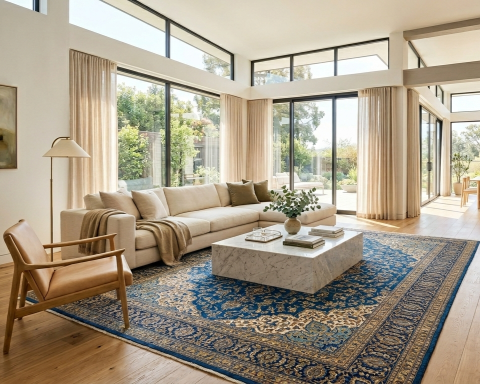
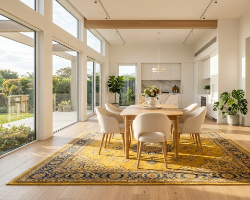
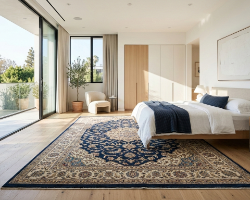

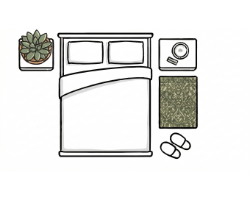
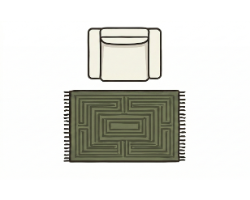
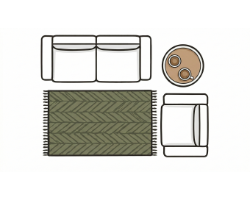
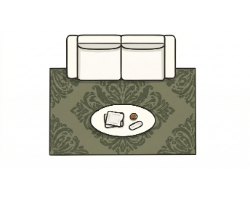
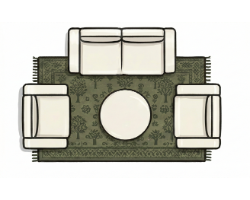
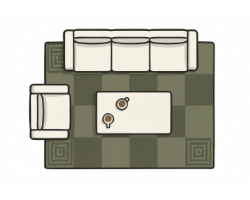
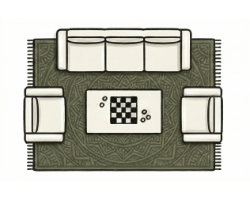
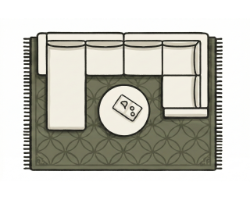

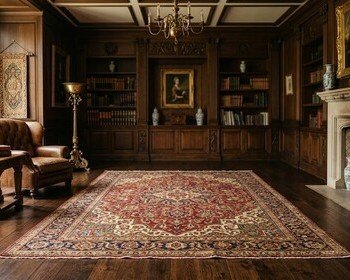
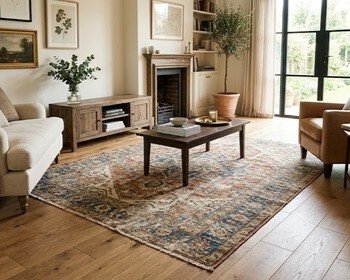
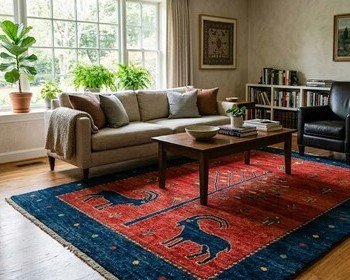
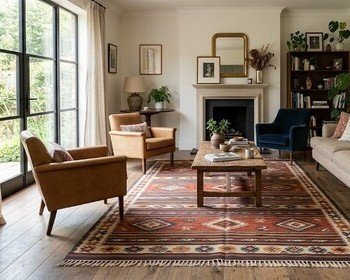
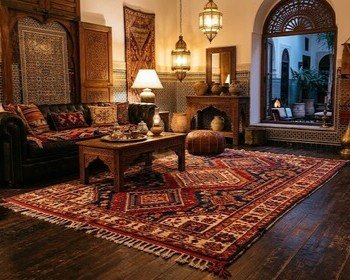
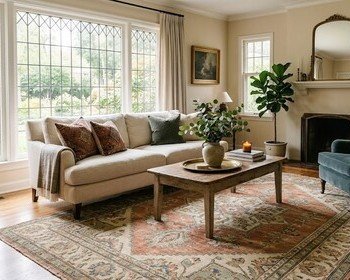
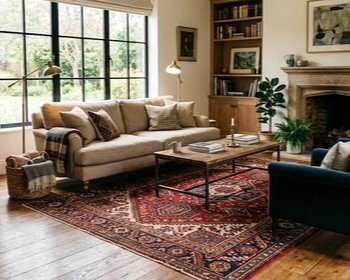
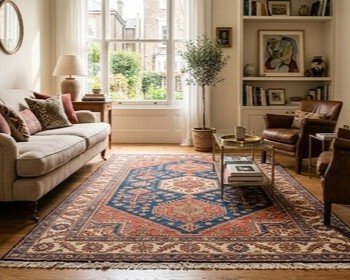
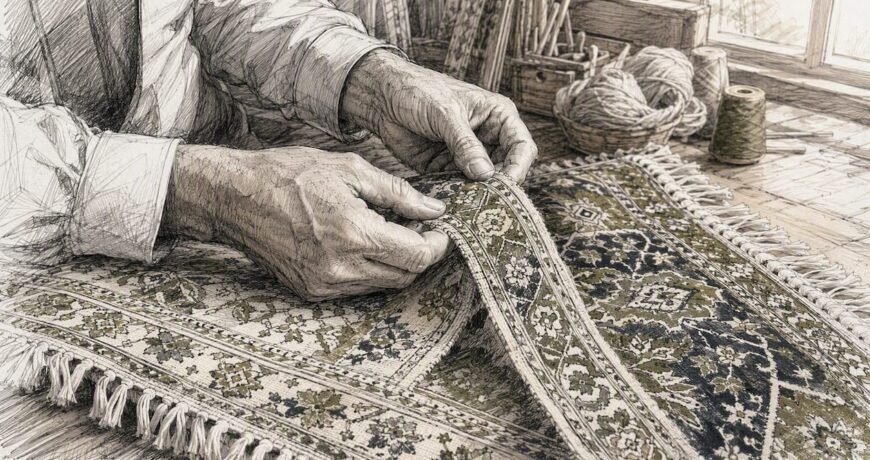
Persian rugs fall into three broad groups: city/workshop rugs (Tabriz, Kashan, Nain) with high knot counts and formal designs; village/town rugs (Heriz, Bakhtiari, Malayer, Mahal, Sarouk) with stylized motifs and sturdy builds; and tribal/nomadic rugs (Gabbeh, Serapi, Persian kilim) with bold geometric improvisation and thick, expressive piles. The name on the label tells you where it was made, and that single fact predicts almost everything else about construction, durability, and price. According to the three-pillar classification used by specialist dealers, matching rug type to room use first, then to design and budget, is the approach that consistently reduces buyer regret.
The major types covered in this guide:
- Tabriz (city, northwest Iran)
- Kashan (city, central Iran)
- Heriz (village/town, northwest Iran)
- Bijar/Bidjar (village, Kurdistan)
- Bakhtiari (village/tribal, Chahar Mahal)
- Kerman (city, southeast Iran)
- Gabbeh (tribal/nomadic, Fars province)
- Sarouk (village/town, Markazi province)
- Mahal (village, Arak region)
- Malayer (village/town, Hamadan region)
- Nain (city, Isfahan province)
- Serapi (village/tribal, northwest Iran)
- Persian kilim (flatweave, nationwide)
Quick verdict: for a high-traffic living room or hallway, start with Heriz or Bijar. For a formal dining room or study, a Kashan or Tabriz city rug rewards the investment. For a casual, contemporary space, Gabbeh delivers texture and character at a lower price point.
Key Takeaways
Persian rugs divide into three groups — city/workshop, village/town, and tribal/nomadic — and the group a rug belongs to predicts its construction, durability, and price more reliably than any single visual feature.
| Point | Details |
|---|---|
| Three groups, three expectations | City rugs (Tabriz, Kashan, Nain) offer high knot density and formal designs; village rugs (Heriz, Bijar) offer durability; tribal rugs (Gabbeh, kilim) offer texture and character. |
| Knot density is the clearest quality signal | Under 50 KPSI is coarse/tribal; 50–150 KPSI is village/city; above 150 KPSI is fine city/workshop production. |
| Match room use before design | High-traffic rooms need Heriz or Bijar; formal low-traffic rooms suit Kashan or Kerman; bedrooms and casual spaces suit Gabbeh. |
| Abrash is a feature, not a flaw | Visible dye-bath variation in village and tribal rugs signals hand-dyed wool and authentic hand production. |
| Rugsonlinemarket | Browse handmade Persian-style rugs filtered by material, color, and room at Rugsonlinemarket, with free shipping over $300 and 30-day returns. |
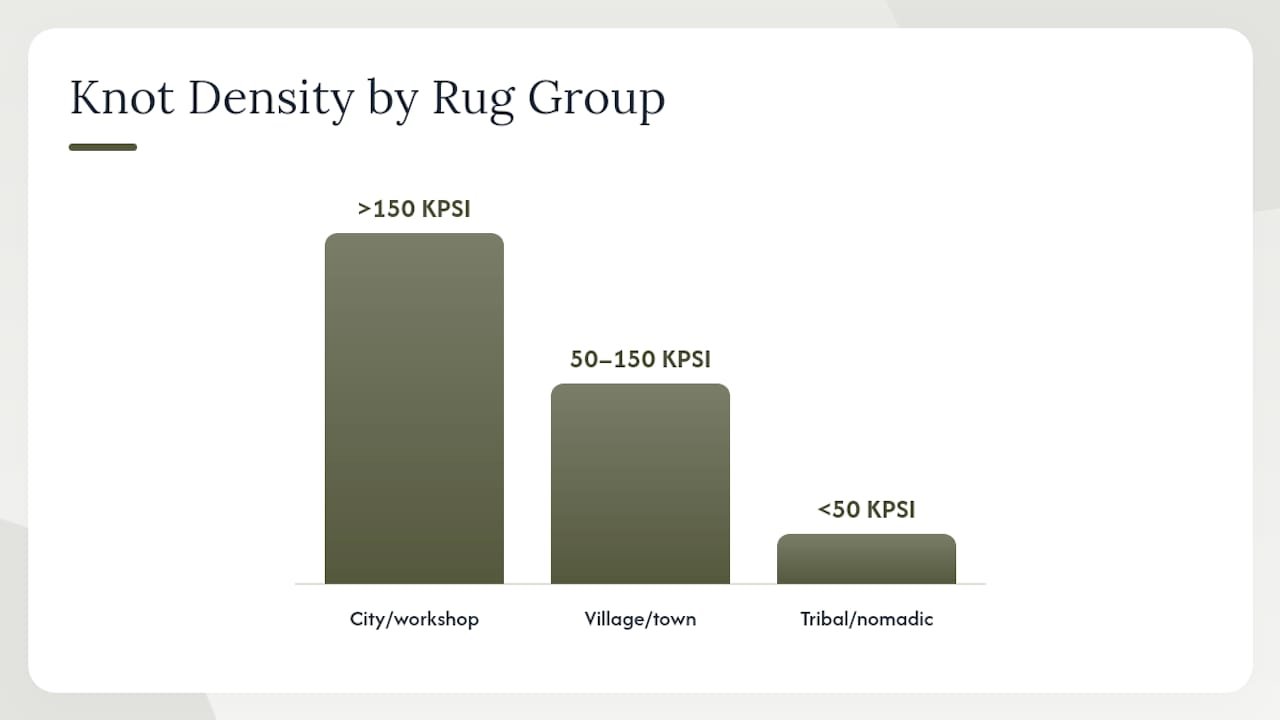
Table of Contents
- What Are the Main Persian Rug Types?
- Why Are Persian Rugs Named After Places or Tribes?
- What Do Persian Rug Patterns and Motifs Actually Mean?
- How to Identify a Persian Rug’s Type and Quality
- Which Persian Rugs Are Most Valuable and Why?
- Which Rug Type Works Best in Each Room?
- Why You Can Trust This Guide
- An Honest Take on Buying Persian Rugs
- Browse Persian Rugs by Type at Rugsonlinemarket
- Sources
What Are the Main Persian Rug Types?
The thirteen types below represent the styles you are most likely to encounter in U.S. showrooms and online listings. Each entry covers origin, typical design, knot type, materials, pile, durability, color palette, and one practical buying note.
Tabriz
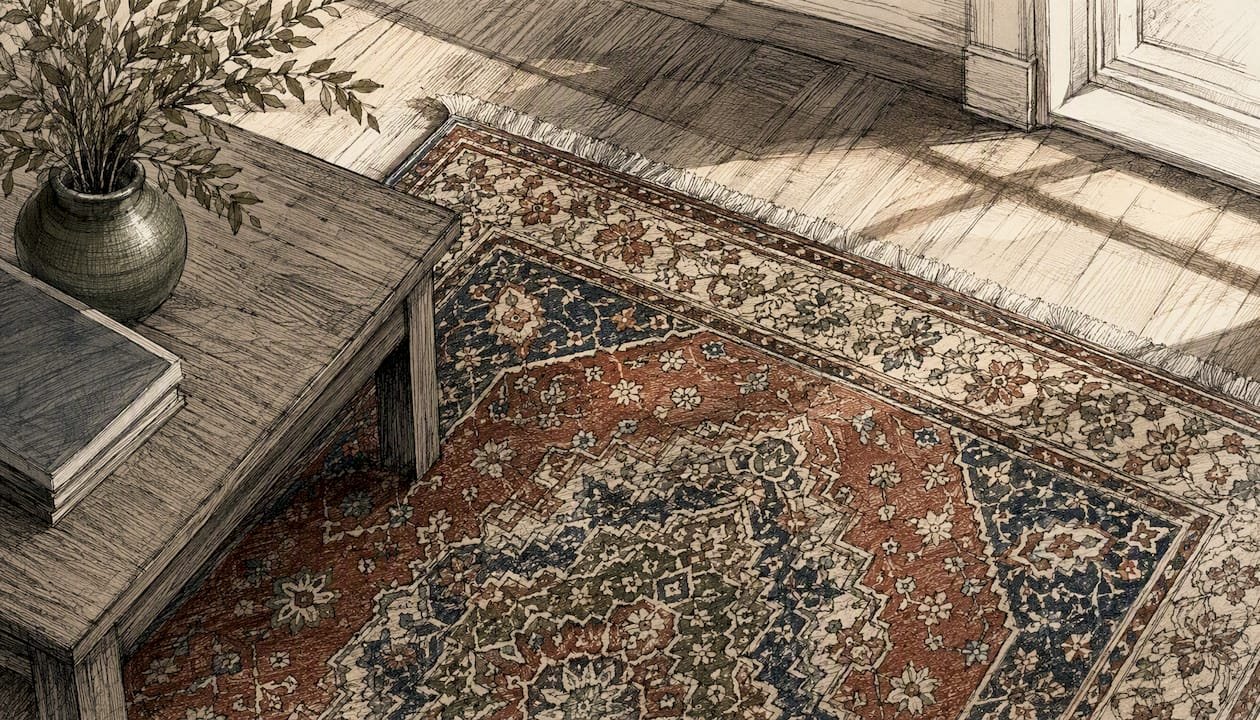
Tabriz, in northwest Iran, is one of the oldest rug-weaving centers in the world. Designs range from formal medallion-and-corner (lechek-torunj) layouts to pictorial hunting scenes and garden compositions. Tabriz weavers use both the Persian (asymmetric) and Turkish (symmetric) knot, depending on the workshop, and knot density typically ranges in the medium to high range for Persian rugs. Foundations are usually cotton, pile is wool or silk, and pile height is medium. City rugs like Tabriz are associated with precise, complex designs and higher knot densities, which supports their strong collectibility. Color palettes favor ivory, navy, and terracotta. Buying tip: check the back for a consistent, tight grid of knots; uneven spacing suggests a lower-grade workshop piece.
Kashan
Kashan sits in central Iran and produces some of the most recognizable floral medallion rugs in the world. The palette runs to deep reds, navy blues, and ivory, with curvilinear arabesques filling every corner. Persian (asymmetric) knot on a cotton foundation is standard; quality pieces reach a high knot density. Pile is medium-low wool, which keeps the surface crisp and the design readable from across a room. Kashan rugs suit formal living rooms and dining rooms well. Buying tip: antique Kashans often command higher prices than modern workshop pieces, so ask about the production date.
Heriz
Heriz rugs come from the villages around the city of Heriz in Azerbaijan province. The design is almost always a large geometric medallion with angular, rectilinear fill patterns, and the palette leans toward brick red, navy, and ivory. Heriz rugs are known for bold geometric medallions and exceptional durability, making them a standard recommendation for high-traffic rooms. Knot density is lower than city rugs (roughly 25–50 KPSI), but the cotton foundation and tightly packed wool pile make them genuinely tough. Buying tip: the geometric drawing is intentional, not a flaw; a Heriz with slightly irregular lines is hand-knotted, not defective.

Bijar/Bidjar
Bijar rugs come from the Kurdish town of Bijar in western Iran. They are called “Iron Rugs” in the trade for good reason: Bijar’s wet-weaving technique and vigorous beating of the weft compacts the weave to a density that makes them among the most durable hand-knotted rugs produced anywhere. Persian knot on a cotton or wool foundation, medium-high pile, and a palette of deep reds, blues, and greens. Designs include the Herati pattern (a fish-and-flower repeat) and floral medallions. Buying tip: the stiff, almost board-like hand of a genuine Bijar is unmistakable; if a rug labeled “Bijar” folds easily, question the attribution.
Bakhtiari
Bakhtiari rugs originate from the Chahar Mahal region of western Iran, woven by both settled villagers and semi-nomadic Bakhtiari tribespeople. The signature design is a garden compartment layout: the field is divided into panels, each containing a flowering tree, vase, or botanical motif. Colors are rich and varied, often including multiple shades of red, green, blue, and ivory within a single rug. Knot density is moderate, foundation is cotton, and pile is a thick, lustrous wool. Buying tip: the compartment layout makes Bakhtiari rugs forgiving in rooms with furniture placed over them, since no single motif is centered and covered.
Kerman
Kerman, in southeast Iran, produces rugs with an open, airy aesthetic quite different from the dense medallion work of Kashan or Tabriz. Typical designs feature large central medallions surrounded by floral sprays on a pale ivory, rose, or soft blue field. Kerman weavers use the Persian knot on a cotton foundation; quality ranges widely, from coarse commercial pieces to very fine examples exceeding 100 KPSI. Pile is soft, medium-length wool. Buying tip: Kerman’s pale grounds show soil quickly, so they work better in low-traffic formal rooms than in hallways or under dining tables.
Gabbeh
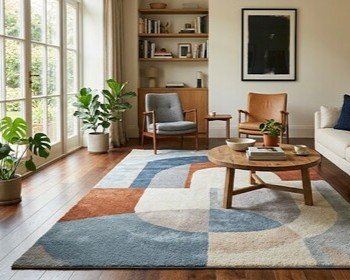
Gabbeh rugs are tribal pieces from the Qashqai and Luri tribes of Fars province in southern Iran. Gabbeh rugs have thick piles, simple or naive motifs, and a tactile, contemporary-friendly aesthetic that suits casual modern interiors as well as traditional ones. Designs are abstract: animals, human figures, and geometric shapes appear without formal symmetry. Knot density is low (often under 30 KPSI), but the thick pile compensates with warmth and texture. Colors are bold, sometimes raw, using natural dyes. Buying tip: Gabbeh rugs work exceptionally well in bedrooms and casual living rooms where bare feet meet the floor.
Sarouk
Sarouk rugs come from the village of Sarouk near Arak in central Iran. American Sarouk rugs, exported heavily to the U.S. market in the early 20th century, were often re-dyed to meet American color preferences (typically a deep rose or burgundy), which is a documented historical practice worth knowing when buying antiques. Modern Sarouks retain the classic all-over floral spray design on a deep-colored field. Persian knot, cotton foundation, medium pile. Buying tip: if you are buying a vintage American Sarouk, ask whether the rug has been re-dyed; original dye color affects value for collectors.
Mahal
Mahal rugs are large-format village rugs from the Arak region, often woven on the same looms and by the same families as Sarouk rugs but to a lower specification. Designs borrow from the Herati pattern and floral medallion traditions. Knot density is lower than Sarouk, pile is thicker and coarser, and the overall effect is more casual. Mahal rugs are among the most accessible entry points into hand-knotted Persian rugs in terms of price. Buying tip: Mahal rugs are an excellent choice for large rooms where you want the authenticity of hand-knotted construction without the cost of a city rug.
Malayer
Malayer rugs come from the town of Malayer in Hamadan province. They sit stylistically between Hamadan village rugs and the more refined Sarouk, often featuring the Herati pattern or geometric floral repeats in navy, camel, and ivory. Single-wefted construction (one weft pass between knot rows) is common, which produces a flatter, more flexible rug than double-wefted types. Malayer rugs work well as hallway runners and in narrow spaces. Buying tip: the single-weft construction means Malayer rugs lie flat without a pad more readily than thicker village types.
Nain
Nain is a small city in Isfahan province that began producing high-quality rugs only in the 20th century, yet quickly became associated with some of the finest wool-and-silk pieces available. Designs are almost always a central medallion with intricate arabesque fill on an ivory or pale blue field. Silk highlights (harir) outline the floral motifs and give Nain rugs their characteristic luminosity. Knot density is very high, often 100–300 KPSI. Buying tip: Nain rugs are graded by “la” (layers of thread): a 4-la Nain is finer than a 9-la; ask the seller for the la count.
Serapi
Serapi rugs are large-format pieces from the Heriz region of northwest Iran, typically antique (pre-1900) or antique-style. They share Heriz’s geometric medallion vocabulary but tend to be more loosely drawn, with a softer, more abrash-rich palette of terracotta, camel, and faded navy. Serapi is not a city or village name but a trade designation for these older, larger Heriz-area pieces. Buying tip: genuine antique Serapis are rare and expensive; many pieces sold as “Serapi” are modern Heriz rugs with distressed finishes, so ask for provenance documentation.
Persian kilim
Persian kilims are flatweave rugs with no pile, produced across Iran by tribal and village weavers. Because there is no pile, the design is entirely geometric, formed by the interlocking of colored weft threads. Kilims are lighter, thinner, and more portable than pile rugs, and they work well as wall hangings, layering pieces, or in low-traffic rooms. They are not as durable underfoot as pile rugs in high-traffic areas. Buying tip: look at the back; on a genuine kilim, the design is equally clear on both sides.
Quick comparison: region, knot type, materials, and durability
Why Are Persian Rugs Named After Places or Tribes?
The name on a Persian rug is not a brand; it is a geographic and cultural address. Understanding what that address implies saves you from overpaying for a misattributed piece and helps you predict what you will get before you see a photograph.
Three naming conventions and what each implies
City/workshop names (Tabriz, Kashan, Isfahan, Nain, Kerman, Qom) signal planned, workshop production. A master designer draws the cartoon (the full-scale pattern), and weavers follow it knot by knot. The result is precise, symmetrical, and repeatable. Cotton foundations are standard because they hold tension well on vertical looms. Knot counts are high. These rugs were made to be sold, often to merchants and export markets, so quality control was a commercial priority.
Village/town names (Heriz, Bijar, Sarouk, Mahal, Malayer, Bakhtiari) sit in the middle. Weavers work from memory or simplified cartoons, often on horizontal looms. Designs are more stylized and less perfectly symmetrical than city rugs, but construction is still deliberate. Village rugs tend to be thicker and more durable than their city counterparts, and their slight irregularities are part of the appeal.
Tribal/nomadic names (Gabbeh, Qashqai, Luri, Shahsavan) signal improvisational production. Weavers carry their looms with them, work from memory and tradition, and make design decisions on the fly. Geometric motifs dominate because curvilinear drawing is difficult without a fixed cartoon. Pile is thick, wool foundations are common, and no two rugs are identical.
Why provenance matters for price and collectibility
The same Herati motif appears in Bijar, Tabriz, Malayer, and Kashan rugs. What changes is the execution: a Bijar Herati is woven tightly into a stiff, durable structure; a Malayer Herati is looser and more casual. Buyers who know this can compare like with like. For collectors, documented provenance (a dealer invoice, auction record, or museum deaccession note) is the single most reliable way to confirm attribution, because visual inspection alone cannot always distinguish a high-quality village rug from a lower-quality city rug of the same design.
Practical takeaways for buyers:
- A city name on the label predicts high knot density, cotton foundation, and formal design.
- A village name predicts moderate density, stylized motifs, and strong durability.
- A tribal name predicts geometric improvisation, thick pile, and natural materials.
- The same motif in two different rug types is not the same rug; construction and provenance determine value.
- When a seller cannot name the specific village or city of origin, treat the attribution as approximate.
What Do Persian Rug Patterns and Motifs Actually Mean?
Persian rug design borrows directly from manuscript illumination and court arts. Encyclopaedia Iranica documents that the medallion-and-corner layout derives from 15th-century book illumination, which is why many Persian rugs are treated as fine art objects rather than merely floor coverings. Knowing the major motifs helps you read a rug the way you would read a painting.
Layout types
Central medallion: a single large medallion at the center of the field, usually with matching corner pieces (spandrels). This is the most formal layout and dominates city rug production.
Repeating allover: a single motif (Herati, boteh, or geometric) repeated across the entire field with no central focal point. Common in village and tribal rugs.
Open-field medallion: a medallion floats on a plain or lightly decorated field, giving the design room to breathe. Kerman and some Kashan rugs use this layout.
Compartment/garden: the field is divided into panels or garden beds, each containing a distinct motif. Bakhtiari rugs are the clearest example.
Motif glossary
Boteh: a teardrop or leaf shape, often called “paisley” in Western markets. It appears in Sarouk, Mir, and many village rugs. Its exact symbolic meaning is debated, but it is one of the oldest recurring motifs in Persian textile art.
Herati: a rosette inside a diamond, surrounded by curving lancet leaves. It is named for the city of Herat (now in Afghanistan) but appears across Iran, particularly in Bijar, Tabriz, and Malayer rugs.
Mahi (fish): a variation of the Herati pattern in which the lancet leaves are read as fish swimming around a central flower. Common in Tabriz and Kashan.
Gul: a geometric octagonal or hexagonal medallion used as a repeating field motif in tribal rugs, particularly Turkmen-influenced pieces.
Shah Abbasi: a large, stylized palmette flower named for Shah Abbas I of the Safavid dynasty. A signature motif of Isfahan and Kashan city rugs.
Stars and lozenges: geometric fill elements in tribal and village rugs, particularly Gabbeh, Qashqai, and kilim production.
Motif-to-type quick mapping
- Kashan / Tabriz: floral and curvilinear medallions, Shah Abbasi palmettes, arabesques
- Heriz / Serapi: bold geometric medallions, angular fill, rectilinear drawing
- Bijar / Malayer: Herati repeat, floral medallions
- Bakhtiari: garden compartments, flowering trees, vases
- Gabbeh / Qashqai kilim: naive geometric fields, animals, abstract shapes
- Kerman: open-field medallions, large floral sprays, soft pastel grounds
How to Identify a Persian Rug’s Type and Quality
Identifying a Persian rug accurately takes about ten minutes if you know where to look. Here is a prioritized checklist you can use in a showroom or when reviewing seller photos online.
- Read the label and ask for origin. A reputable seller can name the specific city, village, or region of production. “Persian-style” or “Persian-inspired” on a label means machine-made or non-Iranian production.
- Flip the rug and examine the back. Hand-knotted rugs show individual knot bumps on the reverse; the design is visible but slightly blurred. A perfectly sharp, identical back-to-front image indicates machine production. Look also for tram-line ribbing caused by warp/weft tension, a reliable indicator of traditional hand construction.
- Count knots per square inch. Fold a one-inch section of the rug back and count the knot bumps along one inch horizontally and one inch vertically, then multiply. Knot density can exceed 400 KPSI in the finest hand-knotted Persian pieces; coarse tribal pieces may fall below 30 KPSI. As a rough guide: under 50 KPSI is coarse (tribal/village), 50–150 KPSI is medium (village/city), above 150 KPSI is fine (city/workshop).
- Identify the knot type. Pull a small section of pile aside at the back. A Persian (asymmetric/Senneh) knot wraps around one warp thread and loops under the adjacent one; a Turkish (symmetric/Ghiordes) knot wraps symmetrically around two warps. Most Persian rugs use the Persian knot; Tabriz and some Kurdish pieces use the Turkish knot.
- Assess pile height and material. Run your hand across the pile. Wool pile has a slight lanolin warmth; silk is cooler and more lustrous. Thick pile (Gabbeh, Bijar) signals tribal or village origin; thin, even pile (Nain, Kashan) signals city workshop production.
- Check for abrash. Horizontal bands of slightly different color intensity across the field are called abrash. Abrash is a normal sign of hand-dyed wool in village and tribal rugs and is generally considered a desirable authenticity marker, not a defect.
- Smell and feel for natural dyes. Natural-dye wool has a faintly earthy, lanolin scent. Synthetic dyes (introduced widely after the 1870s) can produce a slightly chemical smell in older rugs that were re-dyed. Rub a damp white cloth on the pile; significant color transfer suggests unstable synthetic dyes.
- Inspect for repairs and re-dyes. Hold the rug up to a strong light source. Repaired areas show as slightly thicker or differently textured patches. Re-dyed sections often have a flatter, less varied color than the surrounding field.
Pro Tip: When shopping online, request at least four images: the full rug face, the back, a close-up of the fringe and selvedge edge, and a macro shot of the pile. Identical, perfectly repeating motifs with no variation are the clearest sign of machine production. A rug with slight drawing irregularities and visible knot variation on the back is almost certainly hand-knotted.
Which Persian Rugs Are Most Valuable and Why?
Value in Persian rugs is driven by a cluster of factors that interact in ways that can surprise even experienced buyers. Age alone does not make a rug valuable; a poorly preserved antique is worth less than a well-maintained mid-century piece of the same type.
Core value drivers:
- Age and rarity: Antique rugs (generally 100+ years old) from documented workshops command premiums. Pre-1900 Serapis and 19th-century Kashans are among the most sought-after pieces at U.S. auction.
- Knot density: Higher KPSI generally means more labor, finer wool or silk, and more precise design execution. A Nain with 200 KPSI is worth more than a Nain with 80 KPSI, all else equal.
- Materials: Silk pile rugs (Qom, fine Nain, Kashan silk) command the highest prices per square foot. Wool-on-cotton city rugs follow. Wool-on-wool tribal pieces are typically the most accessible.
- Provenance and documentation: A rug with an auction record, dealer invoice, or museum deaccession note is easier to authenticate and therefore easier to sell or insure at full value.
- Condition: A rug with its original pile intact, no re-weaving, and stable dyes is worth significantly more than a restored example of the same type. Even minor repairs reduce value for collectors.
- Design rarity: Unusual colorways, pictorial scenes, or documented master-weaver attributions add a premium that standard medallion pieces do not carry.
City rugs such as Kashan, Isfahan, and Qom frequently appreciate in value if well preserved, while modern machine-made “Persian-style” rugs do not share that collectibility. The gap between a hand-knotted antique Kashan and a machine-made Kashan-pattern rug is not just aesthetic; it is structural and financial.
Caveats every buyer should know:
- Re-dyed rugs: Many older rugs were chemically washed or re-dyed to meet Western market preferences (the American Sarouk practice is the most documented example). Re-dyeing masks original color and reduces collector value, even when the rug looks attractive.
- Restamped or misattributed rugs: A rug labeled “Tabriz” may have been woven in a nearby village to a lower specification. Without independent verification, attribution claims from sellers are not guarantees.
- Restoration history: Professional restoration can preserve a rug’s usability, but disclosed restoration reduces auction value. Always ask for a written condition report on any rug priced above a few hundred dollars.
For buyers seeking antique or collectible pieces, independent condition reports and third-party dye testing are the only conclusive authentication tools when provenance matters.
Which Rug Type Works Best in Each Room?
Matching rug type to room is the most practical decision a buyer makes, and dealer guides consistently recommend prioritizing durability over design when the two are in tension.
| Rug type(s) | Best rooms | Care notes |
|---|---|---|
| Heriz, Bijar/Bidjar | Living room, hallway, dining room | Vacuum weekly; rotate every 12–18 months; professional clean every 3–5 years |
| Bakhtiari, Sarouk | Living room, dining room | Vacuum weekly; rotate annually; professional clean every 3–5 years |
| Tabriz, Kashan, Nain | Formal living room, study, bedroom | Vacuum gently; avoid high foot traffic; professional clean every 5–7 years |
| Kerman | Formal living room, bedroom | Low-traffic only; spot-clean immediately; professional clean every 5 years |
| Gabbeh | Bedroom, casual living room | Vacuum regularly; shake out periodically; professional clean every 3–4 years |
| Mahal, Malayer | Large casual rooms, hallways | Vacuum weekly; rotate every 12 months; professional clean every 3–5 years |
| Serapi | Living room, dining room | Treat as antique; professional clean only; avoid direct sunlight |
| Persian kilim | Low-traffic rooms, layering, wall display | Shake or vacuum flat; rotate frequently; professional clean every 3–5 years |
Everyday care:
- Vacuum pile rugs in the direction of the pile, not against it, and never vacuum the fringe with a beater bar.
- Blot spills immediately with a clean, dry cloth; do not rub, which spreads the stain and damages pile.
- Use a quality rug pad under all pile rugs to prevent slipping and reduce wear on the foundation.
- Rotate rugs every 12–18 months to even out foot traffic and sun exposure.
Shopping questions to ask any seller:
- What is the exact city, village, or region of origin?
- What is the foundation material (cotton, wool)?
- What is the approximate knot count per square inch?
- Are there any known repairs, re-weaving, or re-dyeing?
- What is the return and shipping policy?
Why You Can Trust This Guide
The classification system used throughout this article draws on Encyclopaedia Iranica’s documentation of Persian carpet history and design lineage, which is the standard academic reference for Iranian textile arts. Technical construction details (knot types, density ranges, wet-weaving techniques) are cross-referenced against the Wikipedia entry on Persian carpet, which aggregates specialist dealer and academic sources. Buyer-facing guidance on room use, durability, and value is drawn from specialist dealer resources including Rugs Clinic and Boga Rugs.
Sources used in this guide:
- Encyclopaedia Iranica (“Carpets iv”): historical design lineage, medallion layout origins, cultural significance
- Wikipedia (“Persian carpet”): technical construction details, knot density ranges, Bijar wet-weaving, tram-line indicator
- Rugs Clinic (2025): practical three-pillar classification, room-use guidance, value and collectibility caveats
- Boga Rugs: distinguishing features of major city and regional types, maintenance recommendations
- Emily Henderson Design Guide: Gabbeh characteristics, abrash explanation, contemporary styling guidance
Brand proof points: Rugsonlinemarket carries handmade rugs in wool, silk, and cotton across traditional Persian styles, with free shipping on orders over $300, hassle-free 30-day returns, and a 100% feedback guarantee. The collection includes natural-material rugs and curated traditional styles that map directly to the types discussed in this guide.
An Honest Take on Buying Persian Rugs
The conventional advice is to buy the best quality you can afford. That is not wrong, but it misses the more useful question: best quality for what? A Nain with 200 KPSI is a masterpiece of craft, but it is the wrong rug for a hallway with kids and dogs. A Gabbeh is not a “lesser” rug because its knot count is low; it is a different answer to a different problem.
What I find most buyers underestimate is the relationship between pile height and room acoustics. Thick-pile tribal rugs (Gabbeh, Bakhtiari) absorb sound noticeably in open-plan spaces. Thin-pile city rugs (Nain, Kashan) do not. That functional difference often matters more than design preference in a real living situation.
The other thing worth saying plainly: the market for “Persian-style” machine-made rugs is enormous, and many of them are beautiful. But they do not age the way hand-knotted rugs do. A hand-knotted Heriz that gets 20 years of family use develops character; a machine-made approximation just wears out. If you are buying for the long term, the construction method is the single most important variable, ahead of design, color, or even price per square foot. The photographic detail in a listing matters here: a close-up of the back of the rug tells you more about what you are buying than any description.
Browse Persian Rugs by Type at Rugsonlinemarket
Knowing the type you want is the hard part. Finding it should not be.
Rugsonlinemarket organizes its Persian rug collection by material, style, pile height, and room, so the filters map directly to the types covered in this guide. Looking for a durable geometric rug for a living room? The traditional styles category surfaces Heriz and Bakhtiari options. Searching for a formal city rug in deep navy or red? The blue and red/burgundy color filters narrow the field immediately. For buyers considering high-end city rugs like Nain or Kashan, the best luxury rugs collection is the right starting point.
Every order over $300 ships free. Browse the full collection and use the on-site filters to match rug type, room, and budget at Rugsonlinemarket.
Sources
- Carpets iv — Encyclopaedia Iranica
- Persian carpet — Wikipedia
- Types of Persian Rugs, Styles and Patterns (2025) — Rugs Clinic
- The Ultimate Guide To Persian Rugs — Emily Henderson
