

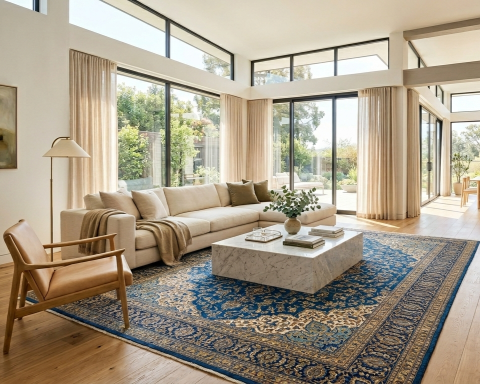
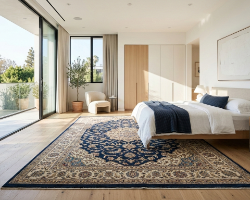




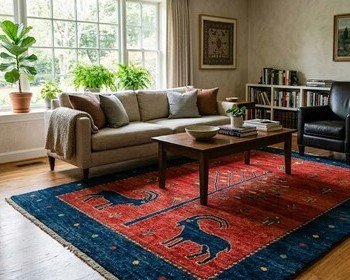
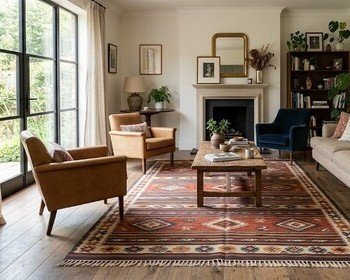



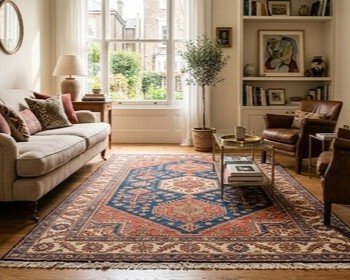

A genuine hand-knotted Persian rug typically runs $1,000 to $10,000 for a standard living room size, with entry-level pieces starting around $300–$1,500 and investment-grade antiques climbing past $50,000 into six figures among the rarest examples. Before you compare a single listing, check two things first: size and fiber. A 5’x8’ wool rug and a 5’x8’ silk rug can differ by 2 to 5 times in price for the same design, since silk simply costs more to source and knot.
Here’s the fast version of what moves a price tag:
- Knot density ranges broadly from around 30 KPSI on basic pieces up to 400+ on museum-quality weaves, with labor cost increasing as knot density rises.
- Shipping and cleaning aren’t optional line items. Domestic delivery on a large rug often falls between $200 and $500, and professional cleaning runs about $2.50 to $5 per square foot.
- Where you buy matters. A seller like Rugsonlinemarket that publishes condition details and a clear returns policy removes a lot of the guesswork that comes with private-listing shopping.
Key Takeaways
Authentic Persian rug prices depend primarily on size, material, and knot density, with silk and high KPSI pieces commanding several times the price of comparable wool rugs.
| Point | Details |
|---|---|
| Set your price expectation first | Entry pieces start near $300, mid-range 5’x8’ to 8’x10’ rugs run $1,000–$10,000, investment antiques exceed $50,000. |
| Check size and material before anything else | Silk costs 2 to 5 times more than wool for the same size and design complexity. |
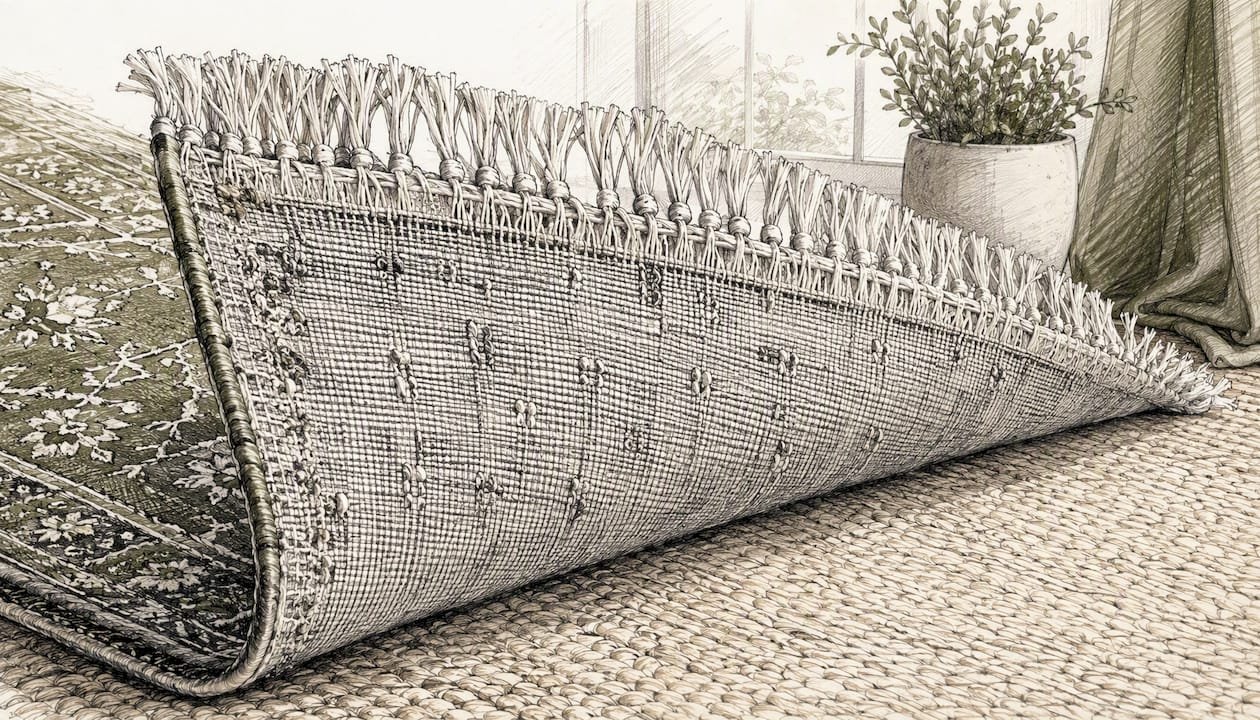
| Verify authenticity with a backing check | Genuine hand-knotted rugs show irregular knots on the back and integrated fringe, not sewn-on trim. |
| Budget beyond the sticker price | Shipping ($200–$500), cleaning ($2.50–$5/sq ft), and appraisals ($250–$750) add up over ownership. |
| Buy from a seller with real documentation | Rugsonlinemarket pairs curated Persian and antique inventory with condition reports and a 30-day return policy. |
Where to Verify Pricing and Seller Reputation
Cross-check any listing against rugsexpert’s pricing guide for benchmarks, Trustpilot or BBB for seller reputation, and Rugsonlinemarket’s antique collection for documented inventory examples.
Table of Contents
- How Much Do Persian Rug Prices Depend on These Factors?
- What Are Typical Persian Rug Prices by Size and Type?
- How Can You Tell If a Persian Rug Is Real?
- Online vs. Showroom: What Should You Expect When Buying?
- What Ongoing Costs Should You Budget For?
- Why We Take a Documentation-First Approach to Persian Rugs
- See What’s Actually Available Before You Decide
- Frequently Asked Questions
- Sources
How Much Do Persian Rug Prices Depend on These Factors?
Eight things decide what you’ll pay, and most buyers only think about one or two of them.
- Size is the obvious one. Price scales roughly with square footage, but not perfectly. A 9’x12’ room-size rug costs more than double a 5’x8’, because larger pieces demand more time on the loom and more raw material.
- Material splits the market cleanly. Wool dominates the mid-range; silk pushes prices up 2 to 5 times higher for a comparable size and pattern.
- Knot density (KPSI, knots per square inch) drives labor cost. A weaver spends dramatically more hours on a 300 KPSI piece than an 80 KPSI one, and that time gets priced in.
- Origin and region create surprising swings. Rugs from different Iranian weaving regions of similar size can vary by 200 to 300 percent based on regional reputation alone.
- Age, condition, and dye type (natural vs. synthetic) round out the list, along with design complexity.
Pro Tip: Ask any seller for a photo of the rug’s back before you buy. Knot counts get exaggerated constantly in online listings, and the reverse side shows the real density at a glance, no measuring tape required.
What Are Typical Persian Rug Prices by Size and Type?
Market data from two independent pricing models lines up closely enough to build a reliable benchmark table. Handmade wool pieces generally land between $2 and $20+ per square foot, with silk and antique examples breaking well past that ceiling.
A few notes on reading this table:
- “Entry-level” almost always means wool, machine-assisted finishing, or a newer production era, not a lesser origin.
- Investment-grade pieces stack multiple premium factors at once: silk pile, high KPSI, a respected region, and genuine age.
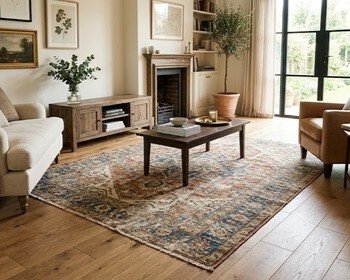
- A hand-knotted Kashan wool rug at 9’6" x 12’5" sits comfortably in the mid-to-high band for that size, which is a useful real-world anchor when you’re pricing similar listings elsewhere.
How Can You Tell If a Persian Rug Is Real?
Authenticity checks aren’t complicated, but they take a few extra minutes most shoppers skip.
- Flip it over. Hand-knotted rugs show irregular knots on the back that mirror the front pattern faintly. Machine-made rugs show a uniform, mesh-like backing.
- Check the fringe. Genuine Persian rugs have fringe that’s an extension of the foundation warp threads, not fabric sewn on afterward.
- Look for wear that matches the claimed age. An “antique” with pristine, unworn edges and bright, uniform color is a red flag.
- Ask for a certificate of authenticity or provenance documentation. Reputable sellers provide this without hesitation.
- Watch for generic stock photos, vague measurements, or a price that seems too low for the claimed age and origin. These almost always signal a machine-made or mislabeled piece.
Credible documentation looks like a detailed condition report with close-up photos of the pile, backing, and any repairs, ideally backed by an independent appraisal rather than just the seller’s word.
Online vs. Showroom: What Should You Expect When Buying?
Buying a Persian rug sight-unseen used to mean gambling on a photo and a hope. That’s changed. The gap between a good online seller and a good showroom has nearly closed, provided the seller documents the piece properly.
Showrooms let you touch the pile and negotiate face-to-face, but inventory is limited to what fits in one building. Online marketplaces and dedicated dealers give you access to a far larger range of regions, sizes, and price points, and the good ones compensate for the lack of in-person inspection with documentation.
Look for these signals from any online seller before you commit:
- Multiple close-up photos of the weave, back, and fringe, not just a staged room shot.
- A written condition report describing wear, repairs, and material composition.
- A clear return window (30 days is standard practice for serious rug retailers).
- A free-shipping threshold and transparent delivery pricing.
- Public reviews on platforms like Trustpilot or a BBB profile you can actually check.
Rugsonlinemarket’s antique collection and handmade rug category are built around exactly this kind of transparency, pairing curated inventory with the documentation buyers need to shop with confidence from a screen.
What Ongoing Costs Should You Budget For?
The purchase price is the beginning of the bill, not the whole thing.
- Shipping: domestic delivery on a large rug typically runs $200 to $500; international shipments can exceed $1,000.
- Cleaning: professional cleaning costs roughly $2.50 to $5 per square foot, and doing it every 3 to 5 years protects both fibers and dye.
- Padding: a quality rug pad runs $50 to $150 depending on size, and it’s cheap insurance against wear.
- Appraisal: getting a piece formally appraised for insurance or resale purposes typically costs $250 to $750.
Budget for these upfront rather than treating them as surprises after checkout.
Why We Take a Documentation-First Approach to Persian Rugs
We built our Persian and antique collections around the idea that buyers shouldn’t have to gamble on a listing. Every rug we carry comes with detailed photography and condition information, backed by a 30-day return policy and free shipping on qualifying orders, so you’re never locked into a purchase you can’t verify first.
See What’s Actually Available Before You Decide
Comparing dozens of dealer sites and marketplace listings eats hours you probably don’t have, and half of them skip the documentation that actually tells you what you’re buying. Rugsonlinemarket’s curated approach means every listing already comes with the size, material, and condition details laid out, so you’re comparing real options instead of chasing down photos from five different sellers.
If premium and investment-grade pieces are what you’re after, the best luxury rugs collection is a solid place to start narrowing your search. Prefer something more everyday? The full rug shop covers sizes from runners to room-size pieces across every price band discussed above. Every order ships with our return window intact, so browse the collection and reach out for condition photos or provenance details on any piece before you buy.
Frequently Asked Questions
Why are Persian rugs so expensive compared to other area rugs?
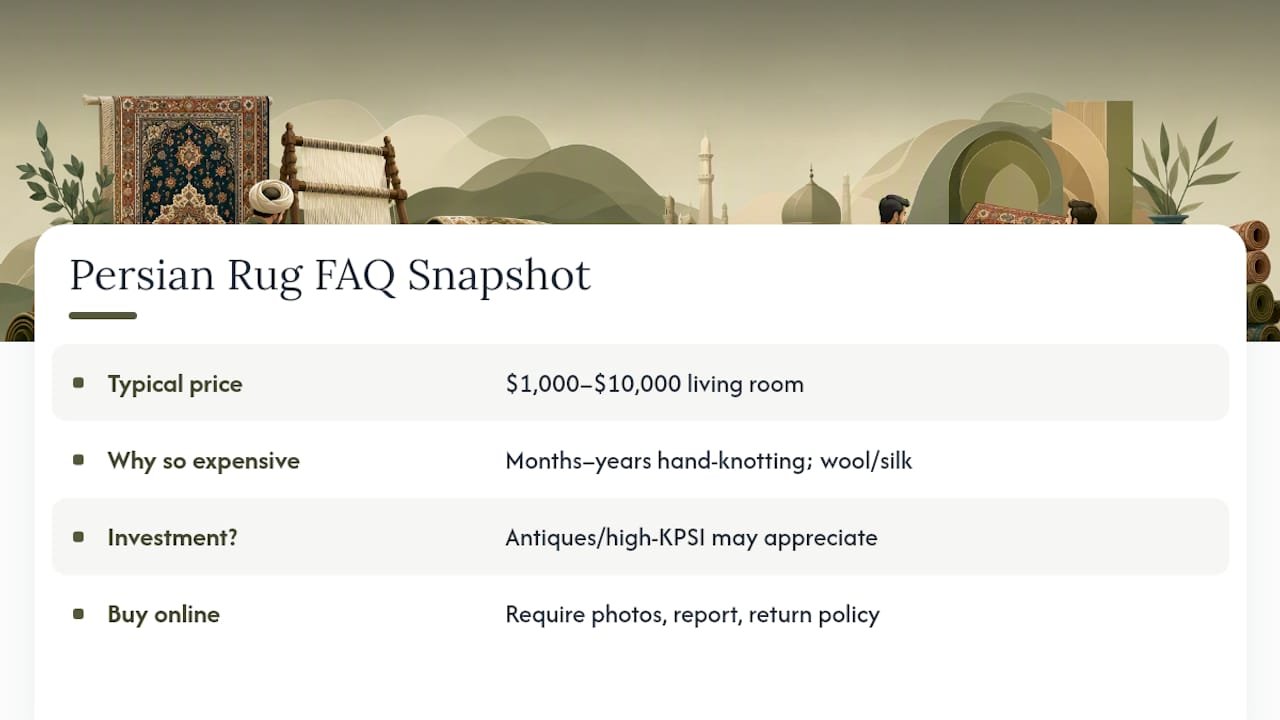
Hand-knotting a single rug can take months to years depending on size and knot density, and that labor, combined with wool or silk material costs, makes authentic Persian rugs fundamentally more expensive to produce than machine-made alternatives.
What’s a fair Persian rug price range for a first-time buyer?
For a standard living room size, expect to pay $1,000 to $10,000 for a genuine hand-knotted wool piece, with the exact number depending heavily on knot density, region, and condition.
Are Persian rugs a good investment?
Well-documented antique and high-KPSI pieces from respected regions can hold or appreciate in value over decades, but most mid-range rugs are better thought of as durable, beautiful flooring rather than a financial asset.
How do I negotiate a Persian rug price without overpaying?
Ask for the knot count, material breakdown, and region documentation upfront, then compare that specific combination against published price bands rather than negotiating off the asking price alone.
Is buying a Persian rug online as safe as buying in a showroom?
It can be, provided the seller offers detailed photos, a written condition report, and a real return policy. Those three things close most of the gap between an in-person inspection and an online purchase.
