

























Flip the rug over. If you can see individual knots and the pattern reads through clearly on the back, you’re almost certainly looking at a hand-knotted piece. That single move settles more arguments at estate sales and online checkouts than any seller’s description ever will.
Here’s the 60-second version before we get into the details:
- Back check: The design shows on the reverse with slight irregularities in the rows, not a smooth, uniform grid.
- Fringe check: Tug gently at the fringe. If it’s the same threads as the rug’s foundation running straight through, that’s a good sign. Sewn-on fringe means someone added it later.
- Backing check: No stiff canvas, no latex coating, no chemical smell. A hand-knotted rug’s back is just knots and yarn.
If any of these checks contradict each other, or a seller can’t answer a direct question about construction, stop and ask for close-up photos of the back and fringe corner before you buy. A legitimate seller will have those on hand.
Key Takeaways
A genuine hand-knotted rug reveals itself through visible knots on the back, warp-continued fringe, and the total absence of glue or canvas backing.
| Point | Details |
|---|---|
| Flip it first | Check the back for visible knots and a pattern that reads through clearly. |
| Test the fringe | Real fringe continues from the warp; sewn-on fringe signals aftermarket finishing. |
| Feel for backing | Stiff canvas or a rubbery latex coating means hand-tufted, not hand-knotted. |
| Count your KPSI | Measure knots per inch in a one-inch square to gauge density and craftsmanship. |
| Shop with construction details upfront | Rugsonlinemarket lists knot type and material clearly across its handmade and natural rug categories. |
Table of Contents
- How to Identify a Hand Knotted Rug by Its Back
- Is the Fringe Sewn On or Part of the Rug Itself?
- What Does a Latex or Glued Backing Tell You?
- How Do You Count Knots Per Square Inch?
- What Materials Reveal Handcrafted Construction?
- Flatweave vs Knotted: Don’t Confuse the Two
- What Age, Wear, and Repairs Say About Value
- Common Mislabels and Mistakes Buyers Make
- Your Step-by-Step Inspection Checklist and Toolkit
- Why Getting the Construction Right Actually Matters
- A Rug Retailer’s Honest Take on Buying Used
- Where to Find Genuine Hand-Knotted Rugs
- Sources
How to Identify a Hand Knotted Rug by Its Back
The back of a rug tells you more than the front ever will, and it’s the fastest way to identify a hand knotted rug without any special equipment. Each knot is tied by hand around the warp threads, so the reverse shows the same pattern as the front, just slightly less crisp. That “read-through” effect happens because there’s no backing material hiding the knot structure.
Machine-made rugs look almost identical on the front and back, but the back is smooth, mechanical, and repetitive. Every row lines up with mathematical precision because a loom is producing it, not a person. A hand-knotted piece will show small inconsistencies. One row might sit slightly higher than the next. Knot density might tighten or loosen a touch across the field. That’s not a flaw. It’s proof of human hands.
A few practical tips for checking this at home or from a listing photo:
- Fold back a corner of the rug rather than flipping the whole thing if it’s large or heavy.
- Use natural daylight or a bright, even lamp. Harsh shadows hide texture instead of revealing it.
- Take close-up photos from about 6 to 8 inches away, angled slightly to catch the knot ridges.
- A jeweler’s loupe or a $10 pocket magnifier makes individual knots pop into focus instantly.
Sometimes the back looks strange even on a genuine hand-knotted rug, usually because of heavy cleaning, an old repair, or a partial fringe replacement. If a section looks patched or oddly smooth compared to the rest, ask the seller directly what happened there. A reliable in-person test is still to flip the rug and look for that visible knot structure, even when parts of it show wear.
Is the Fringe Sewn On or Part of the Rug Itself?
Fringe is one of the most misunderstood parts of rug construction, and also one of the easiest to fake. On a genuine hand-knotted rug, the fringe is simply the exposed ends of the warp threads that run the entire length of the rug under the pile. It’s structural, not decorative.
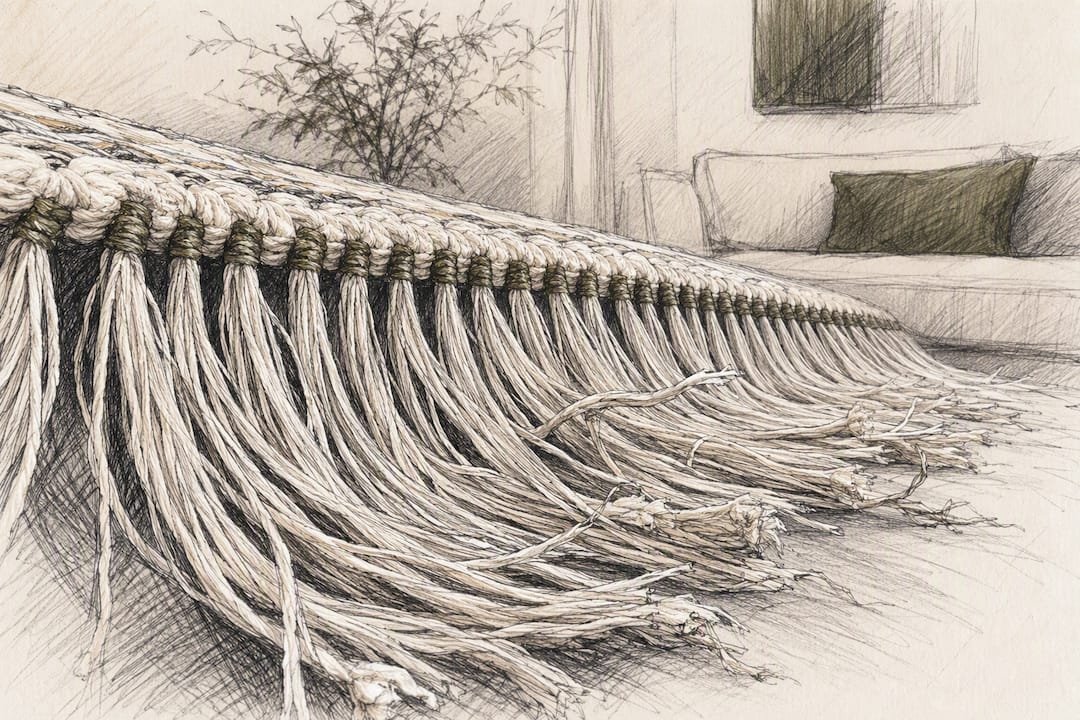
Grab the fringe gently and follow it with your fingers toward the body of the rug. If it disappears seamlessly into the pile with no seam, stitching, or tape, you’re looking at true warp continuation. That’s one of the clearest signals available, because fringe that continues from the warp is a strong marker of authentic hand-knotted construction, while sewn-on fringe usually means someone attached it after the fact, often to dress up a machine-made rug.
Watch for these red flags:
- A visible seam or stitch line where the fringe meets the pile.
- Fringe that feels glued, stiff, or oddly uniform in length.
- Fabric tape or a folded hem hidden just behind the fringe.
The selvage, the finished edge running along the long sides of the rug, offers a second clue. Hand-finished selvage often shows slightly uneven overcast stitching in wool or cotton thread. It should feel firm and tightly bound, not floppy or held together with a machine zigzag stitch.
What Does a Latex or Glued Backing Tell You?
This is where hand-tufted rugs give themselves away almost every time. Run your hand across the back. If you feel a stiff, rubbery coating or see a woven canvas fabric glued to the underside, you’re not looking at a hand-knotted rug. That’s the calling card of hand-tufted construction, where a canvas backing and layer of latex glue hold the yarn in place instead of hand-tied knots.
Bend the rug backward gently, corner to corner. A knotted rug flexes evenly because there’s nothing but yarn and foundation threads. A tufted rug often feels rigid or cracks slightly along the fold if the latex has aged.
Latex backing is the single biggest tell buyers overlook. It hides the knot structure entirely, and it’s also the reason tufted rugs rarely age well. The glue dries out, gets brittle, and eventually the whole backing can crumble or peel, taking tufts of yarn with it.
A sharp chemical or rubbery smell, especially on a “vintage” or “antique” listing, is a warning sign. Old hand-knotted rugs don’t smell like a hardware store. Quick steps to confirm construction:
- Flip the rug and look for canvas fabric instead of visible knots.
- Bend a corner and feel for stiffness or cracking.
- Press a fingernail into the back; latex leaves a slight grippy residue.
Hand-tufted rugs use that canvas and latex layer specifically because tufting guns punch yarn through fabric rather than tying it, which is faster to produce but far less repairable long term.
How Do You Count Knots Per Square Inch?
Knot type and knot density are the two numbers serious buyers ask about, and both are things you can check yourself with a ruler.
Rugs are typically tied with one of two major knot families:
- Asymmetrical (Persian/Senneh) knots wrap around one warp thread and loop under the neighboring one, producing finer detail and often higher knot counts.
- Symmetrical (Turkish/Ghiordes) knots wrap evenly around two warp threads, giving a slightly bolder, more geometric look common in Caucasian and Anatolian rugs.
You can usually tell them apart by looking closely at the back. Asymmetrical knots create a subtle offset pattern, while symmetrical knots look more evenly stacked.
To measure knots per square inch (KPSI):
- Flip the rug and find a clear one-inch section on the back.
- Count the knots horizontally across that inch, then vertically.
- Multiply the two numbers to get your KPSI figure.
Quality bands vary by rug type and region, but as a general guide, many good hand-knotted rugs fall between 100 and 300 KPSI, with fine silk pieces sometimes exceeding 600. Higher density generally means finer detail and more labor hours, though a lower-KPSI tribal rug isn’t automatically inferior. It’s just a different weaving tradition. When you contact an appraiser or seller, photograph your one-inch counting square directly so they can verify your math.
What Materials Reveal Handcrafted Construction?
Wool, silk, and cotton behave differently under your fingers than synthetic fibers do, and that difference is one of the fastest tactile clues you have.
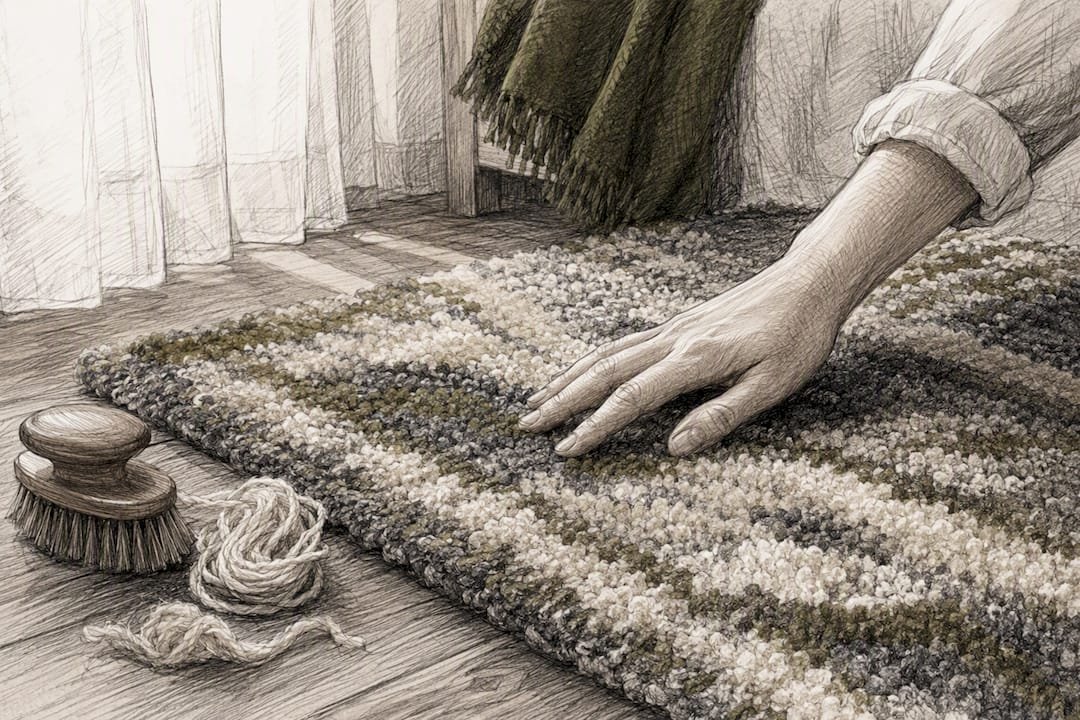
Real wool feels slightly oily or waxy from natural lanolin, and it springs back when you press the pile down with your palm. Synthetic fibers like polypropylene feel flatter, shinier, and stay compressed longer after you release pressure. Silk has a cool, almost slippery hand feel and catches light with a subtle sheen that changes as you shift your angle.
Look closely at the color across the field of the rug. Small, natural shifts in tone, known as abrash, happen when natural dyes are hand-mixed in small batches, so one dye lot never matches the next exactly. That subtle striping across the field is a strong indicator of traditional, small-batch production rather than a synthetic dye run.
Hand-spun wool also shows tiny thickness variations along a single strand, unlike the perfectly uniform diameter of machine-spun yarn.
Pro Tip: Wet a clean white cloth slightly and rub it gently on a hidden corner of the pile. A small amount of color transfer with natural, muted tones often points to traditional dyeing methods; heavy, bright color bleed can signal cheap or unstable synthetic dye.
Flatweave vs Knotted: Don’t Confuse the Two
Kilims and other flatweave rugs are hand-woven, but they have no pile and no knots at all. The warp and weft threads interlock directly, which means the pattern on a flatweave looks identical on both the front and back, just with the colors reversed in some cases.
A knotted rug can never do that. Its pile structure means the front always looks different from the back, since the knots and their cut ends are what create the surface texture. If a rug’s front and back match perfectly, you’re holding a flatweave, not a knotted pile rug.
- Flatweaves are thin, flexible, and reversible.
- Knotted rugs are thicker, have a distinct pile, and are not reversible.
- Sellers sometimes call a flatweave “hand-woven” while implying it’s the same as hand-knotted. It isn’t. Both are handmade, but they’re different techniques with different price points and different care needs.
What Age, Wear, and Repairs Say About Value
Genuine wear on a hand-knotted rug shows up gradually and unevenly, usually most visible in high-traffic paths where the pile thins slightly but the foundation stays intact. Because there’s no glue holding anything together, a skilled repairer can reweave a damaged section knot by knot, matching the original pile height and color as closely as possible. That’s a meaningful advantage: a hand-knotted rug can be repaired and can last for generations, while a hand-tufted rug’s latex backing eventually degrades and often can’t be restored the same way.
Ask sellers for documentation when it exists: region of origin, workshop or cooperative name, and photos showing the rug’s condition before any cleaning or restoration.
Pro Tip: Watch for red flags that quietly lower value: a splice repair with mismatched wool color, a patch glued rather than woven in, or a stiff, flattened pile from overly aggressive chemical cleaning. Any of these should factor into the price you’re willing to pay.
Common Mislabels and Mistakes Buyers Make
“Handmade” is technically accurate for a tufted rug, since a person operated the tufting gun, but it’s not the same claim as “hand-knotted.” That gap in wording causes more buyer confusion than almost anything else in the rug market.
If a listing says “handmade” without specifying the construction method, treat it as a question mark, not an answer. Ask directly: is this hand-knotted, hand-tufted, hand-loomed, or machine-made? A precise answer to that question should come easily to any seller who actually knows their inventory.
Watch for these common pitfalls:
- A high price attached to a rug described only as “handmade” with no construction details offered upfront.
- Fringe that looks suspiciously fresh, bright white, or machine-uniform on an otherwise “vintage” rug.
- Sellers who resist sending a photo of the back when you ask directly.
Your Step-by-Step Inspection Checklist and Toolkit
You don’t need specialty equipment to run a competent inspection. A phone camera, a small ruler, a flashlight, and an optional $10 magnifier will get you through every check that matters.
- Flip the rug and examine the back for visible knots and the pattern reading through.
- Feel the back for stiffness, canvas texture, or a rubbery coating.
- Check the fringe for warp continuation versus a sewn-on seam.
- Inspect the selvage edge for hand-stitched, slightly irregular binding.
- Count knots in a one-inch square on the back to estimate KPSI.
- Photograph the back, fringe corner, and any wear or repairs for a seller or appraiser.
Pro Tip: When buying remotely, always request a close-up photo of the back taken in natural light alongside a coin or ruler for scale. It’s the single most useful image for confirming construction from a distance.
Why Getting the Construction Right Actually Matters
Correctly identifying a hand-knotted rug isn’t just a matter of bragging rights. It affects how you clean it, how you insure it, and what you can expect to get back if you ever resell or pass it down. A well-made hand-knotted rug, properly cared for, can last decades and remain repairable the entire time, while a tufted rug’s latex foundation has a shorter practical lifespan no matter how gently it’s treated.
Getting the construction type right before you buy changes three decisions at once: how you clean the rug, what you tell your insurance appraiser, and what you can realistically expect to recover if you resell it.
Rugsonlinemarket built its collection around this exact distinction, and Kian, who edits our buying guides, has watched the same mislabeling issues trip up buyers again and again.
A Rug Retailer’s Honest Take on Buying Used
Most of the trouble we see happens when someone buys a “vintage” rug from a photo that never showed the back. Ask for it every time, no exceptions. If a seller hesitates, that tells you something on its own.
Our return policy exists for exactly this reason: you get 30 days to inspect a rug in person, no pressure. If you’re unsure about a piece, our customer service team can pull additional condition photos before you commit to anything.
Where to Find Genuine Hand-Knotted Rugs
Once you know what to look for, the shopping part gets a lot less stressful. Rugsonlinemarket carries a dedicated collection of handmade rugs, including wool and silk pieces sourced with clear construction details listed upfront, not buried in fine print.

Every listing includes the information this guide just walked you through: knot type, material, and origin, so you’re not stuck guessing from a single front-facing photo. If antique character matters to you, our antique collection is worth browsing, and if you want natural wool or silk specifically, the natural rugs category narrows things down fast. We offer free shipping on orders over $300, and every purchase comes with a 30-day return window, so you can run your own back-and-fringe check at home before deciding. If a listing photo doesn’t show the back clearly enough for you to judge, just ask our team for a close-up before you order.
Sources
For deeper background on construction terminology and quality benchmarks, these resources are worth a closer look:
- Hand Knotted vs Hand Tufted Rugs: Complete Comparison 2026
- Hand-Knotted vs Hand-Tufted vs Hand-Loomed – Rug Glossary
- How to Tell If a Rug Is Hand-Knotted: Expert Tips for Identification – NP Rugs
- How to identify handmade Oriental & Persian rugs – Carpet Wiki
