



























Yes, most damaged rug fringe can be repaired, but the right fix depends entirely on one question: is the fringe decorative or structural? Decorative fringe is sewn or glued onto a machine-made rug. Structural fringe is the exposed warp thread that holds a hand-knotted rug together.
Stop vacuuming the fringe with a beater bar right now, and photograph the damaged ends before you do anything else. Do not cut or trim until you know which type you’re dealing with.
- If it’s cosmetic (frayed strands, mild tangling): follow the DIY steps below.
- If it’s structural (exposed foundation, missing pile rows near the edge): call a restoration specialist before you touch it.
Vacuum beater bars are a leading cause of premature fringe damage, and switching to a suction-only attachment near the edges prevents a huge share of repairs from ever being necessary.
Pro Tip: Never cut fringe as a “quick fix” on a hand-knotted rug. On these pieces, the fringe is the visible end of the actual foundation, and cutting it can trigger unraveling that turns a $100 repair into a $600 one.
Key Takeaways
Correctly identifying whether rug fringe is decorative or structural before attempting any repair is the single decision that determines cost, safety, and outcome.
| Point | Details |
|---|---|
| Check construction first | Flip the rug over; sewn seams mean decorative fringe, continuous warp means structural fringe. |
| Stop the beater bar | Switch to suction-only vacuuming near fringe to prevent most future fraying. |
| Fix early, save money | Cosmetic fraying costs far less to repair than kilim band or foundation failure. |
| Match the method to the damage | Overcasting suits minor wear; reweaving is for structural loss on valuable rugs. |
| Know when to call a pro | Brittle fibers, band gaps, or fringe that pulls loose need professional assessment. |
Table of Contents
- How to Tell If Rug Fringe Is Decorative or Structural
- DIY Fixes for Minor Fringe Fraying and Missing Strands
- When Should You Call a Professional Instead?
- What Do Professional Fringe Repairs Cost?
- How to Prevent Fringe Damage Before It Starts
- Repair, Replace, or Restore: What Rugs Online Market Offers
- Why the Standard Fringe Advice Misses the Point
- Sources
How to Tell If Rug Fringe Is Decorative or Structural
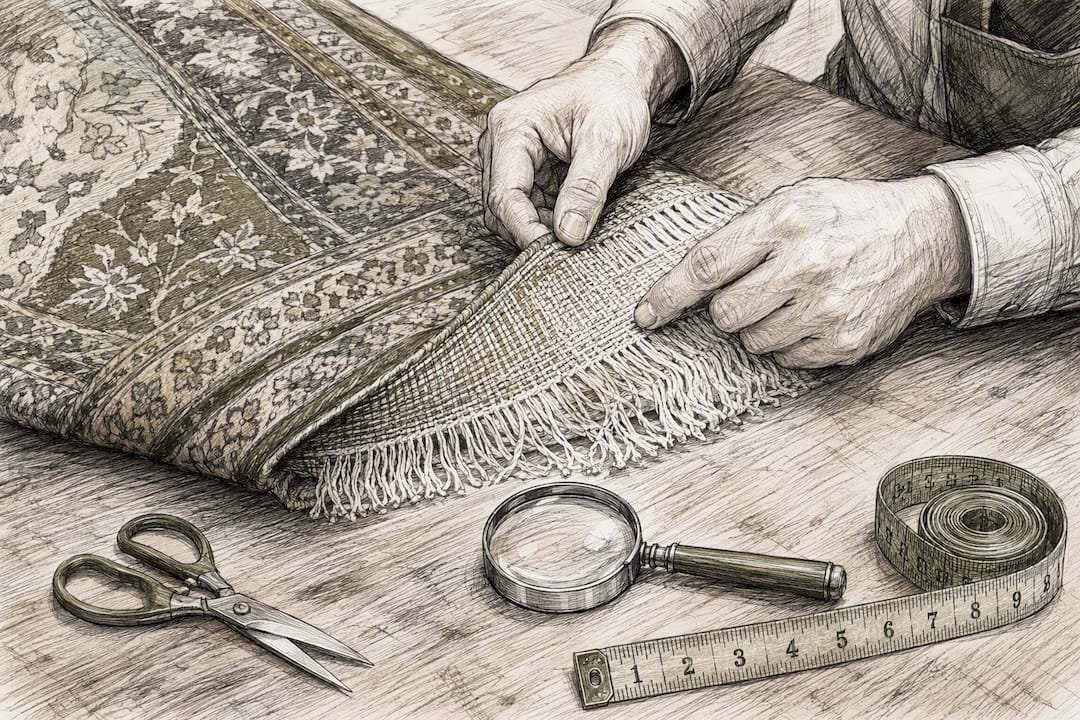
Flip the rug over and look at the back edge where the fringe meets the body. That single glance tells you almost everything.
- Check the attachment point. If the fringe is stitched or glued to a folded edge, it’s decorative and sewn on separately, typical of machine-made rugs. If the fringe strands run continuously into the rug’s woven body with no seam, it’s structural, part of a hand-knotted rug’s warp.
- Do a gentle pull test. Tug lightly on a single strand. Sewn-on fringe stays put or comes away cleanly at the seam. Structural fringe that pulls loose from the body itself signals warp damage, not just fringe wear.
- Look at the kilim band. Most hand-knotted rugs have a flat woven band (the kilim) between the pile and the fringe. Gaps or thinning in that band mean the damage has moved past cosmetic and into structural territory.
- Check for pile loss near the ends. Missing knots or bare foundation rows near the edge mean you’re past the point of a simple stitch fix.
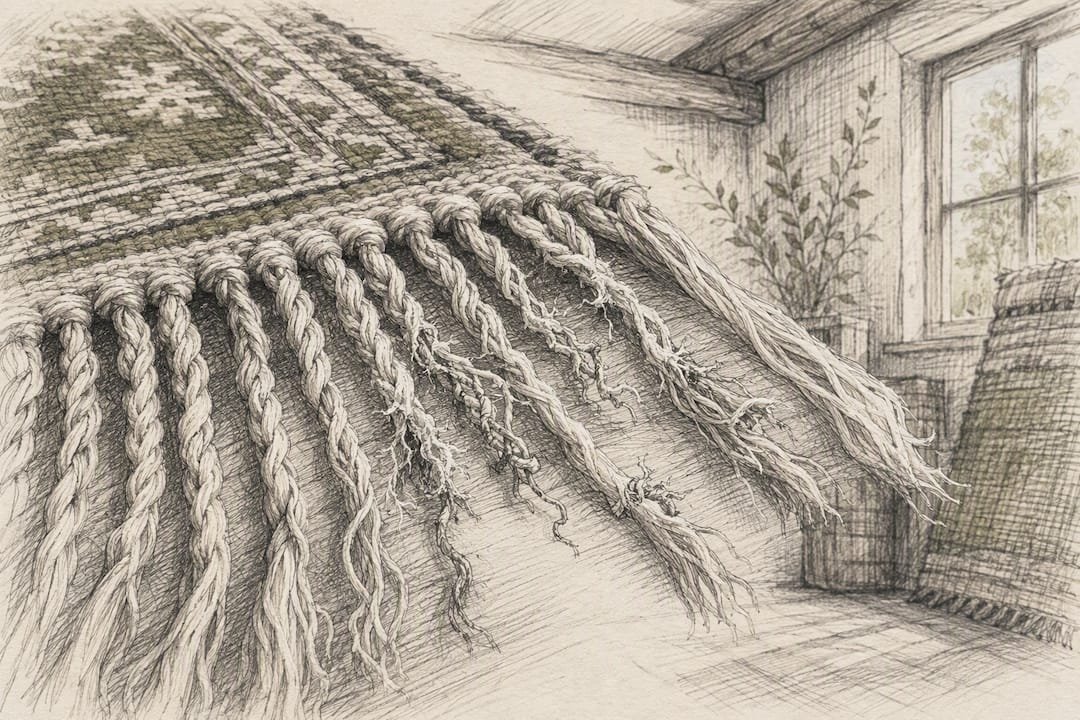
Damage tends to follow a predictable staging: cosmetic fraying first, then kilim band failure, then foundation loss. Repair costs rise sharply at each stage, so a $50 fix caught early can become a $500 reweaving job if ignored for a year or two.
DIY Fixes for Minor Fringe Fraying and Missing Strands
Once you’ve confirmed the damage is cosmetic, most of it is genuinely fixable at your kitchen table. Here’s the workflow that keeps risk low.
Tools and materials you’ll need:
- Curved upholstery needle and heavy-duty thread matched to the fringe color
- Small, sharp embroidery scissors
- Fabric-rated textile glue (not super glue, not hot glue)
- Soft-bristle brush and tweezers
- Replacement fringe trim, if your rug is machine-made
Step-by-step repair workflow:
- Clean first. Gently brush the fringe with a soft brush, then vacuum on suction-only mode. Never run a beater bar over fringe; it’s one of the most common causes of the damage you’re trying to fix.
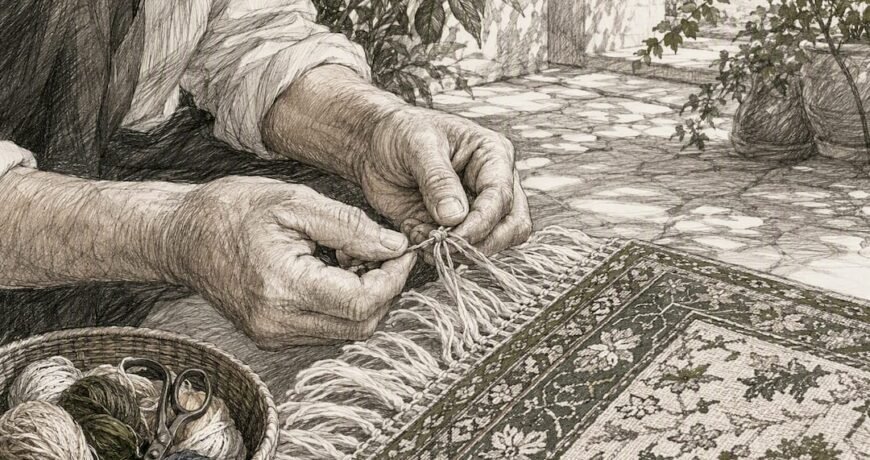
- Stabilize loose warps. Using the upholstery needle, run an overcasting stitch (a simple wrap-and-loop stitch) around the base of the fringe where it meets the rug body. This locks the strands so they can’t unravel further.
- Trim conservatively. Only snip stray, uneven strands that are already broken. Never square off the whole fringe line just to make it look tidy. That’s a cosmetic decision, but done wrong it removes usable structural length you can’t get back.
- Braid or bind the ends. A loose three-strand braid, or a simple overhand binding knot every two to three inches, keeps fringe from continuing to unravel between cleanings.
- Attach replacement fringe for sewn-on types. If your rug is machine-made, a matching prefabricated fringe strip can be stitched or glued along the original seam line. Machine-made rugs are typically repaired this way, since there’s no warp foundation to rebuild.
A few fiber cautions matter more than people expect. Silk and antique wool fringe fray differently than synthetic fringe and tear under far less pressure, so test any glue or dye on a hidden scrap first. Skip bleach and harsh solvents entirely. Gentle cleaners, mild soap, and full air drying preserve fringe integrity far better than anything marketed as “deep clean.” If you’re working on a silk piece, our silk rug care guide walks through fiber-specific handling in more detail.
Pro Tip: Glue is fine for a quick, temporary hold on synthetic machine-made fringe. For wool or silk, stitching almost always outlasts adhesive, which tends to stiffen and crack the fibers around it over time.
Home repair techniques like overcasting and braiding work best when applied early, before fraying has a chance to spread into the kilim band.
When Should You Call a Professional Instead?
Certain signs mean any DIY attempt will likely make things worse, not better.
- Visible gaps or thinning in the kilim band
- Multiple missing warp threads bunched in one section
- Pile loss right at the rug’s ends, not just fringe wear
- Fringe that snaps or pulls loose from the body with light tugging
- Fibers that feel brittle, chalky, or break apart when handled
If fringe has gone brittle, gentle cleaning alone usually won’t restore it, and pushing harder with DIY cleaning often accelerates the damage instead.
A professional assessment typically includes a full foundation inspection, a staging diagnosis (cosmetic, band failure, or foundation loss), a specific repair recommendation, and a cost estimate with a realistic timeline. Turnaround for straightforward overcasting work often runs a few days; full reweaving can take several weeks depending on rug size and knot density.
Catching damage at stage one, before it reaches the kilim band, is what keeps costs down. A restoration specialist who sees the rug early can often quote a fraction of what the same rug would cost to fix after another year of wear and unraveling.
What Do Professional Fringe Repairs Cost?
Shops offer a handful of standard repair methods, and picking the right one depends on the rug’s construction, value, and how far the damage has progressed.
- Re-securing or overcasting works on early-stage loose warps and keeps the original fringe intact. It’s the least invasive and least expensive fix.
- Fringe stop or band addition halts progression when the kilim band is starting to fail, adding a woven or stitched barrier that stops further unraveling without full reconstruction.
- Hand reweaving rebuilds the actual foundation strand by strand. It’s slow and skilled work, but it’s the only option that’s close to invisible when done well, and it’s usually reserved for rugs worth the investment.
- Replacement fringe or edge binding swaps in new sewn-on fringe or binds the raw edge entirely. It’s fast and cheap, but it can affect a hand-knotted rug’s appraisal value since it doesn’t address the underlying foundation.
| Repair Method | Best For | Typical Cost Range |
|---|---|---|
| Re-securing / overcasting | Early-stage loose warps, minor fraying | $50 to $500 |
| Fringe stop / band addition | Kilim band showing early wear or gaps | $80 to $500 |
| Hand reweaving | Structural foundation loss on valuable rugs | $300 to $600 |
Those figures apply to a typical 8×10 rug and rise with size, knot count, and how far the damage has spread. Replacement fringe and binding on lower-value machine-made rugs usually costs less than any of these structural methods, but it’s not appropriate for a hand-knotted piece, where it can mask the real problem instead of fixing it.
How to Prevent Fringe Damage Before It Starts
Most fringe damage is avoidable, and the fixes cost nothing.
- Vacuum smart. Turn off the beater bar or switch to a suction-only attachment before you reach the fringe; vacuum the rug face fully first, then pass gently over the fringe.
- Clean on a schedule. Spot-clean spills immediately, and plan on professional deep cleaning every twelve to eighteen months depending on foot traffic and fiber type.
- Rotate and route traffic. Turn the rug periodically so wear doesn’t concentrate on one edge, and keep heavy foot traffic from crossing directly over the fringe line whenever the layout allows it.
- Manage pets. Trim nails regularly and discourage chewing; fringe that gets tangled around a pet’s paw is one of the most common causes of sudden warp damage.
- Inspect monthly. A quick visual check catches fraying while it’s still a five-minute fix instead of a professional visit.
Pro Tip: Keep a small dedicated brush near the rug specifically for fringe. Using the same brush you use on upholstery or pet fur can transfer oils and debris that make strands tangle faster.
If you’re maintaining an antique or hand-knotted piece, our antique rug cleaning guide and Persian rug cleaning guide cover fiber-specific routines in more depth.
Repair, Replace, or Restore: What Rugs Online Market Offers
Sometimes the honest answer is that repair isn’t worth it. If a machine-made rug’s fringe damage is extensive and the rug itself is aging out, replacement is often the more practical move than sinking money into binding work on a low-value piece.
Rugsonlinemarket carries a wide range of rugs in natural materials like wool and silk, along with modern and traditional styles for every room. Orders over $300 ship free, and every purchase comes with a 30-day hassle-free return window.
- Compare repair cost against replacement cost before committing to hand reweaving on a mid-value rug
- Browse natural fiber rugs if you decide that replacement makes more sense than restoration
- Check out runner rugs if the damaged piece was a hallway or entry runner
- Visit our rug services page for guidance on pairing a new rug purchase with restoration advice
Pro Tip: As a rough rule, if hand reweaving would cost more than half of what a comparable new rug costs, replacement is usually the smarter financial call unless the rug has sentimental or antique value.
A rug’s fringe tells you more about its condition than almost any other visible feature, and treating it as disposable trim instead of a structural signal is the single most common mistake we see homeowners make.
Why the Standard Fringe Advice Misses the Point
Most fringe guides jump straight to gluing and trimming without asking the one question that actually matters: is this fringe load-bearing? That gap in the conventional advice is where homeowners get hurt financially. A trim that looks harmless on a hand-knotted Persian can quietly open the door to unraveling that costs hundreds more to fix later.
The staging model, cosmetic, then band failure, then foundation loss, deserves more attention than it gets. It’s the closest thing to an objective decision tool in a topic that’s otherwise full of vague “consult a professional” hedging. If you take one thing from this article, take that: figure out the stage before you touch a needle or a pair of scissors.
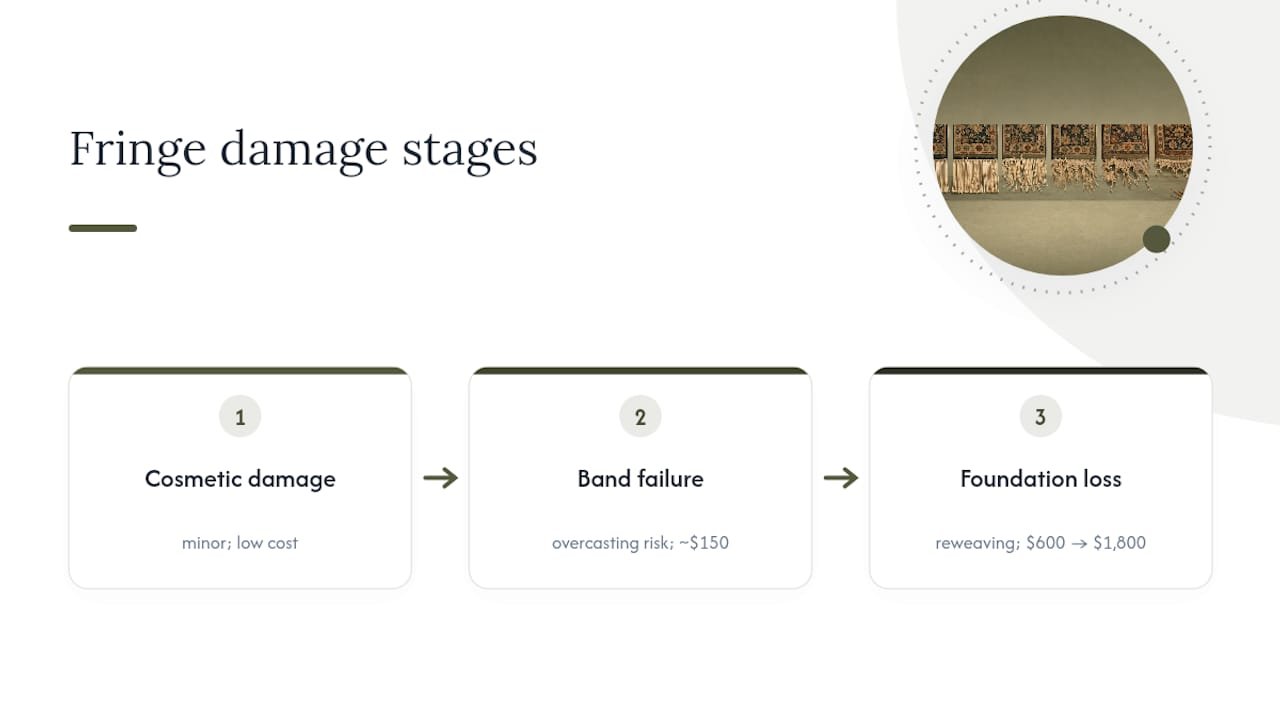
I’d also push back gently on the instinct to always DIY. Saving $150 on an overcasting repair feels good until it’s the reason a $600 reweaving job becomes an $1,800 one.
Sources
- Keeping Rug Fringe Clean | RugPro Oriental Rug Cleaning Services
- Why Your Rug Fringe Is Unraveling (and What to Do About It)
- Understanding Rug Fringe: Purpose and Care – Elevate Your Floor
- Rug fringe: what it is and how to clean it | Woods Rug Laundry
- Rug fringe repair: simple at-home techniques | Decadent Interiors
