



































Regular cleaning and inspection is the single most effective way to prevent rug moth damage, because it strips away the food source moths need to breed. If you spot signs of activity, isolate the rug immediately, vacuum both sides thoroughly, and check nearby textiles before the larvae spread. Beyond that, three habits carry the rest of the work: proper storage, occasional light and air exposure, and periodic professional cleaning for anything you can’t fully handle at home.
TL;DR:
- Regular vacuuming of both sides of the rug weekly and professional cleaning every 1 to 3 years effectively removes eggs, larvae, and organic debris that attract moths.
- Storing cleaned rugs in breathable wrapping and placing pheromone traps in storage areas enable early detection and reduce the risk of infestation.
- Moths primarily feed on keratin in wool, silk, and cashmere, so rugs made from plant fibers or synthetics are naturally resistant unless contaminated with food or skin residue.
- Sunlight can temporarily disrupt larvae but should be limited to prevent fading, and drying out cedar or lavender inside storage containers can provide mild deterrence.
- Calling a professional is essential if visible damage, multiple infested rugs, or repeated trap catches occur, especially with antique or valuable pieces.
Table of Contents
- Rug Moth Prevention Checklist You Can Start Today
- Why Do Moths Eat Wool Rugs and Not Others?
- Early Signs of Moth Damage to Look For
- A Maintenance Schedule That Actually Prevents Infestations
- DIY Treatments That Work (and Ones That Don’t)
- When Should You Call a Rug Cleaning Professional?
- Do Cedar, Lavender, and Mothballs Actually Repel Moths?
- Build a One-Year Rug Moth Monitoring Calendar
- Why Prevention Beats Repair Every Time
- Thinking About Replacing Instead of Repairing?
- Sources
- FAQ
Rug Moth Prevention Checklist You Can Start Today
You don’t need a pest control contract to keep moths out of your rugs. You need consistency. Here’s the order of operations that actually works:
- Vacuum the top weekly. Use suction on a low setting for delicate piles, and get into fringe with an upholstery attachment.
- Flip and check the underside monthly. This is where moths actually breed. Most people never look here.
- Rotate the rug and shift furniture every 3 to 6 months. Static, shaded spots under couches and beds are prime moth territory.
- Before storing anything, clean it, wrap it breathably, and pick a climate-controlled spot.
- Set out a pheromone trap in closets or storage areas as an early-warning system, and call a professional if you get a moth infestation. Trap catches multiple males in a short window.
Pro Tip: Set a recurring phone reminder for the underside check. It’s the step everyone skips, and it’s the one that catches trouble before it becomes expensive.
Why Do Moths Eat Wool Rugs and Not Others?
Moth larvae feed on keratin, the protein found in wool, silk, and cashmere. Plant fibers like cotton and jute, along with most synthetics, aren’t digestible to them at all, unless those fibers are contaminated with food residue, skin cells, or sweat that gives larvae something to chew on, according to NC State Extension. That’s why a wool Persian rug in a rarely cleaned corner is a target and a jute doormat usually isn’t.
Two species cause almost all the damage in homes: the webbing clothes moth and the casemaking clothes moth. Both lay eggs that hatch into larvae within about a week to a month depending on temperature, and those larvae feed for weeks to months before pupating. A few things make any rug more attractive to egg laying adults, regardless of fiber:
- Dust, pet hair, and food crumbs trapped deep in the pile
- Undisturbed, dark, low traffic areas
- Humidity above normal indoor levels
- Rugs left folded or stacked without airflow
Early Signs of Moth Damage to Look For
Catch it early and you’re looking at a small patch repair. Catch it late and you’re looking at a full reweave. The tell-tale signs are small but distinct once you know what you’re looking at.
- Fine, sandy grit called frass, often the first clue
- Silky white webbing or tube-shaped casings tucked into the pile
- Thin, papery, or bald patches on the back of the rug where the foundation shows through
- Loose fibers that pull out in clumps with little resistance
Check under furniture, along baseboards, in closets, and inside any rolled or boxed storage, since these are the spots moths favor because nobody disturbs them. If you find any of these signs, isolate the rug right away, vacuum both sides, empty the canister outside your home, and check every other wool item nearby, including coats, blankets, and upholstered furniture.
A Maintenance Schedule That Actually Prevents Infestations
Prevention isn’t complicated, but it has to be routine. Vacuuming the backside and the floor beneath a rug is the single most effective thing you can do, because it physically removes eggs, larvae, and the organic debris that draws egg-laying moths in the first place, according to the technical guide from Kapetto. Here’s a schedule that fits most households:
- Weekly: Vacuum the top surface, including under low furniture legs when possible.
- Every 1 to 3 months: Flip the rug and vacuum the underside and the floor beneath it.
- Every 3 to 6 months: Rotate the rug 180 degrees and move heavy furniture a few inches to expose hidden edges.
- Every 1 to 3 years: Schedule a professional deep clean, more often in high-traffic homes or humid climates.
On technique, use suction only for older or fragile pieces. Beater bars can shred aging fibers. For fringes, switch to an upholstery attachment so you’re not yanking loose knots. Always empty the canister outdoors so eggs don’t just relocate to your trash can indoors.
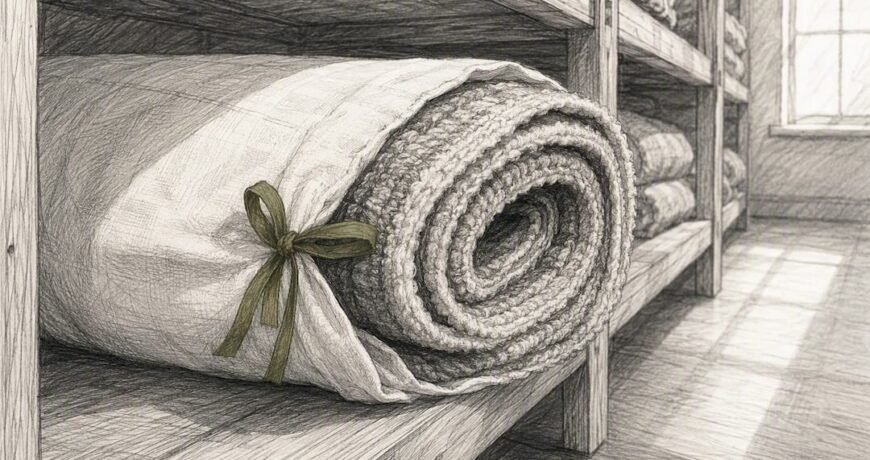
Sunlight helps too, but sparingly. A short session outside on a dry day disrupts moths that dislike light and airflow. Leave a wool rug in direct sun for hours, though, and you risk fading. For storage, clean the rug first, roll it face in around a tube, wrap it in breathable Tyvek or a cotton sheet (never plastic, which traps moisture), and store it somewhere climate controlled. Check on it every 3 to 6 months, a detail specialists at Bogarugs stress repeatedly, because a stored rug you forget about is the most common source of a serious infestation.
Pro Tip: If you’re storing a rug for a season, slip a photo of the front and back into your phone before you wrap it. It makes spotting change at your next check far easier.

DIY Treatments That Work (and Ones That Don’t)
For small rugs or a mild, localized problem, a few nonchemical options genuinely work:
- Freezing: Seal the rug in a plastic bag and freeze it below 0°F (-18°C) for at least 72 hours, then thaw gradually while still sealed to avoid condensation. This kills eggs and larvae in small to medium pieces, per the rug moth treatment guide from Kapetto.
- Sun exposure: A short, controlled session outdoors disrupts larvae, but limit it to avoid fading dyes.
- Pheromone traps: These lure and catch adult males only, so they function as a monitoring tool, not a cure. A catch tells you to inspect further.
What doesn’t work: steam cleaners and surface sprays. Both stay on the surface and can’t reach eggs buried deep in the rug’s foundation. Skip mothballs indoors entirely. They’re toxic, they linger in fibers, and they have no place in an occupied living space.
When Should You Call a Rug Cleaning Professional?
DIY covers a lot of ground, but a few situations call for an expert without hesitation:
- Bare or thinning patches visible on the back or front of the rug
- Multiple rugs or textiles showing damage at once
- Antique, hand-knotted, or otherwise valuable pieces
- Repeated trap catches signaling an active breeding population
Professional treatment typically means isolating the rug, dusting or vibrating out debris and eggs, then full immersion washing followed by a mothproofing rinse, sometimes paired with controlled-atmosphere treatment for stubborn cases. That immersion step matters because surface cleaning alone can’t touch eggs buried in the foundation, a limitation Bogarugs points out as the main reason home sprays underperform. If repair is needed, small damaged areas can often be rewoven locally, while widespread damage requires a larger reweave, a labor-intensive process priced by the hour. Catching damage early is what keeps that repair small. When you’re vetting a cleaner, ask directly about experience with hand-knotted rugs, what chemistries they use, and whether a mothproofing rinse is part of their standard process.
Do Cedar, Lavender, and Mothballs Actually Repel Moths?
Cedar and lavender are real deterrents, but mild ones. They work best inside closed storage containers, and only if you refresh the cedar’s oil every few months by sanding the surface, since dried-out cedar loses its scent and its effect. Neither replaces cleaning, and neither will stop an active infestation once larvae are established, a point echoed by Sharafi and Co’s guidance on wool rug protection.
- Cedar blocks or lavender sachets: fine for storage boxes, not a fix for a living-room rug
- Pheromone traps: useful strictly for monitoring adult males, not for killing larvae
- Mothballs: appropriate only in sealed storage containers, never in an open room where people or pets breathe the fumes
- Insecticidal sprays: test on a hidden patch first, use only wool-safe labeled products, and hand valuable rugs off to a professional rather than experimenting
Pro Tip: If you’re using cedar, keep it away from direct fiber contact. Set it near the rug’s storage wrap instead of pressed against the pile, which can cause discoloration over time.
Build a One-Year Rug Moth Monitoring Calendar
Prevention sticks when it’s a calendar habit, not a one-time panic response.
- Every 3 months: Full inspection of all wool and silk rugs, top and bottom.
- Warmer months (typically spring through early fall): Increase inspection frequency, since moth activity picks up with rising temperature and humidity.
- Ongoing: Check any pheromone traps and log catches. Zero catches means you’re on track. A few catches means inspect immediately. Several catches in one trap means call a professional.
- On detection: Isolate the rug, vacuum both sides, check nearby textiles, and book professional washing if signs persist after your own cleaning pass.
Why Prevention Beats Repair Every Time
Larvae do the damage, and by the time you see bare patches, they’ve already been feeding for weeks. That’s the frustrating part of moth damage: it’s invisible until it isn’t. A rug that gets vacuumed weekly and stored properly almost never reaches the point of needing a reweave, while one left folded in a closet for two years is a coin flip. For deeper fiber-specific guidance, our moth prevention guide for rugs covers care specifics for wool and silk pieces. If a room sees heavy traffic, spills, or kids and pets, consider a washable or synthetic rug there instead. It sidesteps the moth problem structurally rather than managing it constantly.
— Kian
Thinking About Replacing Instead of Repairing?
Sometimes a damaged rug just isn’t worth the reweave cost, especially for a smaller piece in a high-traffic room where moths kept coming back no matter what you tried. Washable and synthetic-blend rugs sidestep the keratin problem entirely, since moth larvae can’t digest those fibers the way they do wool or silk.

If you’re weighing a fresh start for a kids’ room or a busy kitchen floor, browse the kids room rugs or kitchen rugs collections, both built around materials that clean easily and resist the debris buildup that attracts moths in the first place. For a smaller accent piece, the 3×5 area rugs category has practical, low-maintenance options too. And if you’re still deciding what “washable” actually means for your space, our guide on washable rug alternatives breaks down the options. Start browsing, and pick the size and room category that fits your next move.
Sources
For readers who want the underlying research and technical detail behind this guide, these sources cover the science and the professional cleaning side in depth.
Clothes moths & carpet beetles: controlling fabric pests — NC State Extension
Clothes Moths — UC IPM
Rug Moth Prevention and Treatment: A Technical Guide — Kapetto
Moth prevention for oriental rugs — Bogarugs
How to spot moth damage in wool rugs — Fred Remmers Rug Cleaners
For storage space planning beyond the rug itself, this guide on organizing compact storage spaces offers useful layout ideas for keeping wrapped rugs off the floor and away from humidity.
- Clothes moths & carpet beetles: controlling fabric pests — NC State Extension
- Rug Moth Prevention and Treatment: A Technical Guide | Kapetto
- Moth prevention for oriental rugs — Bogarugs
FAQ
How Do I Stop Moths From Eating a Rug?
Vacuum both sides regularly to remove eggs and debris, store cleaned rugs in breathable wrapping, and isolate and treat any rug showing frass, casings, or webbing right away.
How Can I Protect My Rugs From Moths?
Weekly top-side vacuuming, monthly underside checks, periodic sun exposure, and professional cleaning every 1 to 3 years form the core of effective protection, according to UC IPM’s clothes moth guidance.
What Repels Carpet Moths?
Cedar and lavender offer mild deterrence in storage, but they don’t substitute for cleaning. Pheromone traps only monitor for adult males, and mothballs should stay confined to sealed storage containers, never open living rooms.
What Smell Do Moths Hate the Most?
Moths tend to avoid strong cedar and lavender scents, which is why both show up in storage sachets, but neither scent kills eggs or larvae already present in a rug’s fibers.
Can Freezing Really Kill Rug Moths?
Yes, sealing a small rug and freezing it below 0°F (-18°C) for at least 72 hours kills larvae and eggs, though it works best on smaller pieces rather than large area rugs.
