

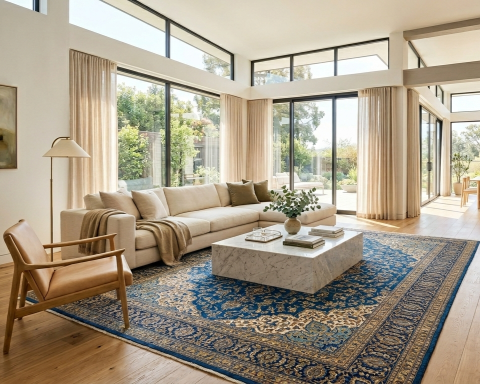
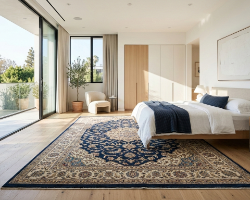
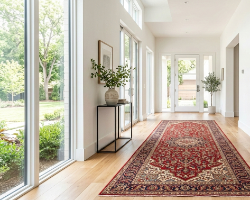


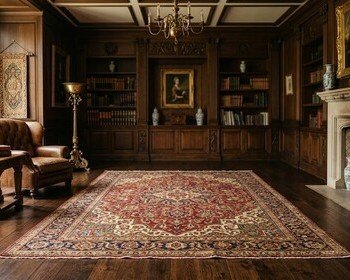
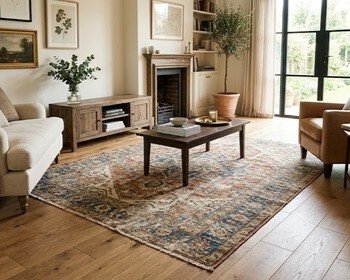
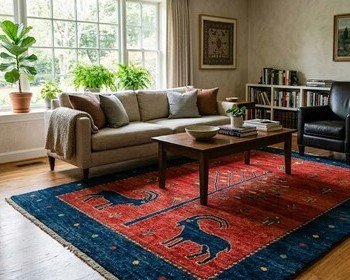
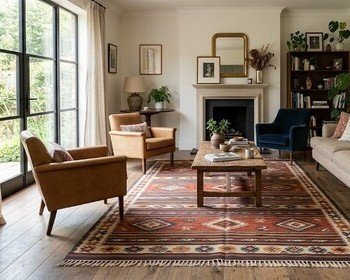

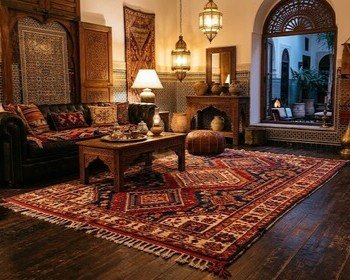
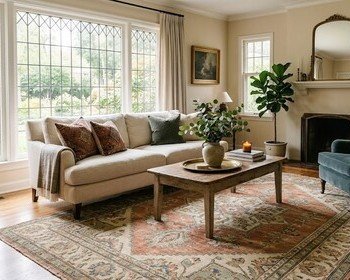
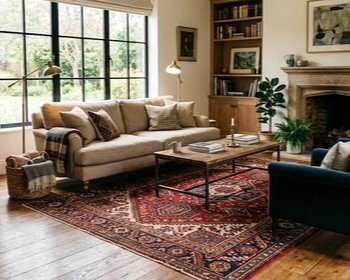
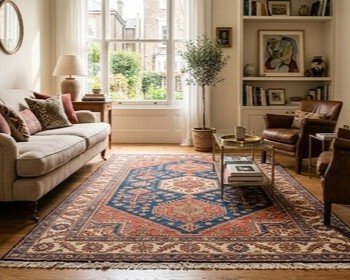

An authentic Persian rug is hand-knotted in Iran, made from natural fibers like wool or silk, and carries visible regional weaving hallmarks that no machine can replicate. The fastest way to confirm one in under five minutes: flip it over.
Quick authenticity checklist:
- Fringe as warp: The fringe extends directly from the rug’s warp threads. If it’s sewn or glued on, the rug is machine-made.
- Knots on the back: Individual knots are visible on the reverse. You can feel them with your fingertips.
- Irregularities: Slight variations in knot size, tension, or color (called abrash) are a positive sign, not a flaw.
- Pile height: Fine Persian rugs often have a noticeably low, dense pile.
- Selvedge: The side edges are hand-overcast, not machine-bound with uniform stitching.
Pro Tip: When buying online, ask the seller for a high-resolution photo of the rug’s back, a close-up of one corner fringe, and a shot of the selvedge with a ruler for scale.
Those three images tell you more than any listing description.
Key Takeaways
Authentic Persian rugs are hand-knotted in Iran from natural fibers, and the back of the rug, the fringe, and knot density are the three fastest checks that separate genuine pieces from machine-made imitations.
| Point | Details |
|---|---|
| Check the back and fringe first | Warp-formed fringe and visible individual knots on the reverse are the fastest authenticity indicators. |
| Know your regions | Tabriz, Kashan, Isfahan, Heriz, Qom, Gabbeh, and Nain each carry distinct motifs, materials, and density ranges that support provenance claims. |
| Knot density signals fineness | Village rugs run 40–120 KPSI; fine city pieces often exceed 250 KPSI; Senneh examples can reach 400 KPSI. |
| Get an appraisal for high-value pieces | For purchases above a moderate threshold, a written appraisal from a qualified appraiser is advisable to protect your investment and insurance coverage. |
| Rugsonlinemarket for vetted selection | Browse natural-fiber and antique Persian rugs with detailed product pages, free shipping over $300, and 30-day returns. |
Table of Contents
- What “Persian” and “authentic” actually mean for U.S. buyers
- How to tell if a Persian rug is real: a practical visual checklist
- Major Persian weaving regions and how to recognize each one
- Materials, knot types, and what knot density tells you about quality
- Antique vs vintage vs new: how age affects price in the U.S. market
- Where to buy in the U.S. and the exact questions to ask any seller
- Care, cleaning, and restoration basics for authentic Persian rugs
- How to avoid common scams and mislabeling when buying “Persian” rugs
- Step-by-step authentication workflow: from self-check to expert appraisal
- A note on buying with confidence
- Rugsonlinemarket makes it easier to buy verified Persian rugs online
- Sources
What “Persian” and “authentic” actually mean for U.S. buyers
“Persian rug” refers specifically to hand-knotted carpets produced in Iran, the geographic region historically known as Persia. The term “Oriental rug” is broader, covering hand-knotted carpets from across Central Asia, Turkey, India, China, and the Caucasus. A Persian rug is always Oriental, but an Oriental rug is not necessarily Persian.
“Authentic” in this context means four things working together:
- Origin: Woven in Iran, not copied in another country using Iranian-style designs.
- Construction: Hand-knotted, not machine-loomed or hand-tufted (tufted rugs use a gun to push yarn through a backing, which is a fundamentally different process).
- Materials: Natural fibers throughout, typically wool pile on a cotton or wool foundation, with silk used in high-end city pieces.
- Design provenance: Patterns that trace to a specific Iranian weaving tradition, whether a city workshop or a nomadic tribal group.
For U.S. buyers, country-of-origin labeling matters. Federal Trade Commission rules require imported rugs to carry accurate country-of-origin labels, so a rug sold as “Persian” should be documented as made in Iran. When buying online, look for product pages that state the country of origin explicitly, list the materials, and include photos of the reverse. A seller who cannot or will not provide those details is a seller worth skipping.
Pro Tip: Ask for the rug’s provenance documentation before purchase. A reputable dealer can provide at minimum a written statement of origin, materials, and approximate age. For pieces over $1,000, a formal appraisal letter is worth requesting.
How to tell if a Persian rug is real: a practical visual checklist
The back of the rug is your single most reliable diagnostic tool. Turn it over and spend sixty seconds there before you look at anything else.
Step-by-step identification checklist:
-
Check the fringe first. On a genuine hand-knotted rug, the fringe is formed by the warp threads that run the length of the rug. They emerge naturally from the weave. On a machine-made imitation, the fringe is sewn or glued onto the finished edge. Pull gently on one fringe strand and trace it into the body of the rug. If it disappears into a seam, it’s not authentic. According to Carpet Wiki’s identification guide, this fringe test is one of the most reliable quick checks available to buyers.
-
Examine the knots on the reverse. Flip the rug over and look at the back in good light. You should see individual knots arranged in rows. Run your fingers across them. They will feel slightly uneven, and you may be able to count them. A machine-made rug has a perfectly uniform, often looped backing that looks almost identical from front to back.
-
Look for abrash. Subtle horizontal bands of slightly different color intensity in the pile are called abrash. They occur because hand-weavers work through one batch of dyed yarn and then start a new one, which never matches exactly. Abrash is a hallmark of authenticity, especially in village and tribal pieces.
-
Assess the selvedge. The side edges of a hand-knotted rug are finished by hand-wrapping the outermost warp threads. The wrapping will be slightly irregular. Machine-made rugs have perfectly uniform, often machine-sewn selvedges.
-
Measure knot density. Count the knots along one inch of the back, then count along one inch in the perpendicular direction. Multiply those two numbers to get knots per square inch (KPSI). Village rugs typically have a moderate knot density, while fine city rugs from Kashan or Isfahan often have a higher knot density.
-
Check pile height. High-quality fine Persian rugs are often surprisingly thin, with a relatively low pile height. Thick, plush pile is more common in machine-made or lower-grade pieces.
-
Look at the design from the back. The pattern on the reverse of a hand-knotted rug should mirror the front, though slightly less vivid. If the back looks completely different from the front, or shows a canvas or latex backing, the rug is hand-tufted or machine-made.
Pro Tip: For online purchases, request photos at a minimum resolution of 1,200 pixels on the short side. Ask for: (1) full back of the rug, (2) a close-up of the fringe at one corner, (3) the selvedge with a ruler, and (4) a macro shot of the back surface showing individual knots. Any seller confident in their product will send these without hesitation.
Major Persian weaving regions and how to recognize each one
Regional origin shapes everything about a rug: its palette, its motifs, its knot density, and its market value. Trade practice commonly labels rugs by their city or region of production, but as the Encyclopaedia Iranica notes, a standardized vocabulary doesn’t exist across the industry, so regional attribution should always rest on multiple structural features, not just design alone.
Here are the seven regions every buyer should know:
Tabriz (northwestern Iran)
Tabriz rugs are among the most technically varied in Iran. They use both the asymmetric (Persian) and symmetric (Turkish) knot, depending on the workshop. Designs range from medallion-and-corner layouts to pictorial scenes. Palette tends toward rich reds, blues, and ivory. Knot density varies widely, from moderate village pieces to very fine workshop examples.
Kashan (central Iran)
Kashan is synonymous with precision. These rugs typically feature a central medallion on a deep red or navy field, with intricate floral arabesques. The pile is fine wool on a cotton foundation, and knot density is high. Kashan pieces are among the most collected Persian rugs in the U.S. market.
Isfahan (central Iran)
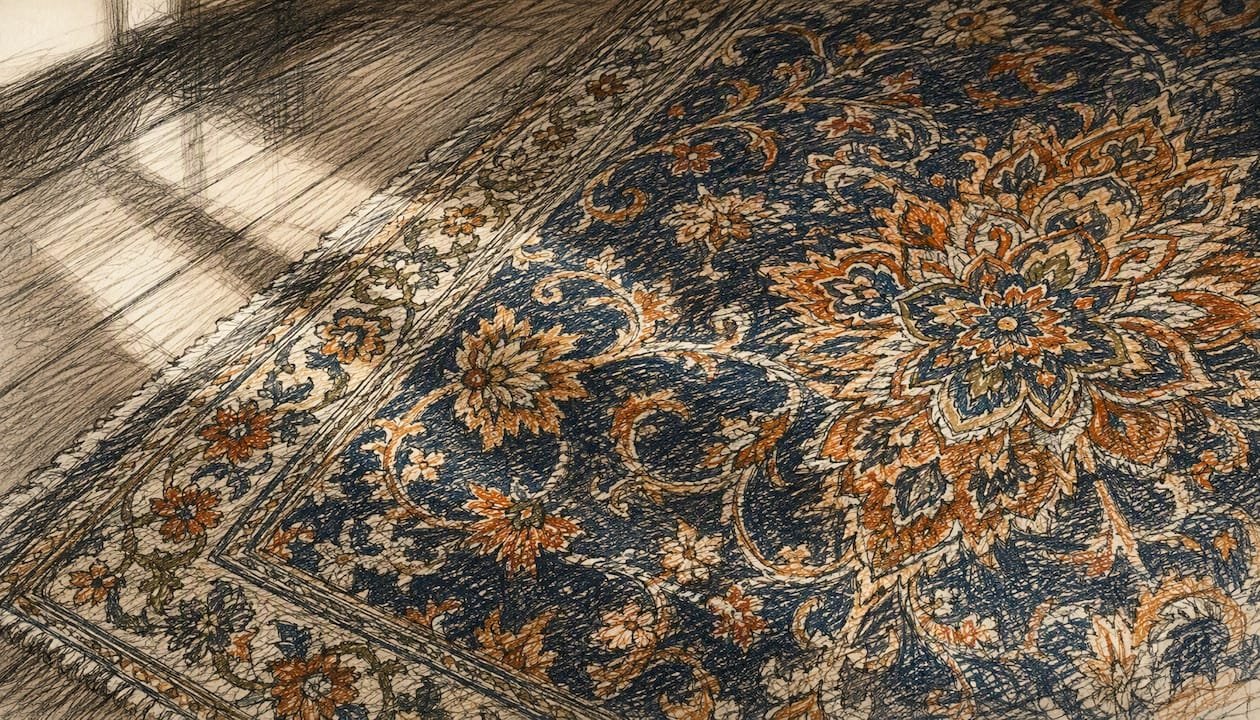
Isfahan rugs share Kashan’s refinement but tend toward softer palettes, often ivory or pale blue grounds with elaborate floral scrollwork. The wool pile is exceptionally lustrous, sometimes described as “cork wool” for its natural sheen. Cotton foundations are standard. These are city workshop rugs at their most polished.
Heriz (northwestern Iran)
Heriz rugs are the workhorses of the Persian world. Woven in villages near Tabriz, they use a geometric medallion design with bold angular lines rather than the curvilinear florals of city rugs. The palette is warm: terracotta, rust, navy, and ivory. Heriz rugs use a coarser wool and lower knot density than Kashan or Isfahan, which makes them exceptionally durable. An antique Heriz is one of the most practical collector pieces available.
Qom (Qum, central Iran)
Qom produces some of the finest silk rugs in the world. Knot density is very high, designs are intricate and often feature hunting scenes or garden layouts, and the silk pile creates a distinctive directional sheen. These are luxury collector pieces, not everyday floor rugs.
Gabbeh (southwestern Iran, Qashqai tribal)
Gabbeh rugs are the opposite of Qom in almost every way. Woven by Qashqai nomads, they have a thick, shaggy pile, simple geometric or abstract designs, and a naive, expressive quality that has made them popular with contemporary interior designers. Abrash is common and expected. The wool is coarse and durable.
Nain (central Iran)
Nain rugs are characterized by extremely fine knotting, often with silk highlights on a wool pile, and a palette of ivory, beige, and pale blue. The designs are intricate floral medallions. Nain pieces are among the most technically demanding Persian rugs to produce and are priced accordingly.
City rugs (Kashan, Isfahan, Nain, Qom) come from organized workshops with consistent designs and materials. Village and tribal rugs (Heriz, Gabbeh) reflect individual weavers and show more abrash and irregularity. Both are authentic. The irregularities in a Gabbeh are not defects; they are evidence of its origin.
Materials, knot types, and what knot density tells you about quality
Fiber types in authentic Persian rugs:
- Wool pile: The most common pile material. Quality ranges from soft, lustrous Kork wool (used in fine Kashan and Isfahan pieces) to coarser village wool. Wool is durable, naturally soil-resistant, and ages well.
- Silk pile: Used in high-end city rugs (Qom, fine Kashan, fine Tabriz). Silk allows extremely high knot density and produces a distinctive directional sheen. Silk rugs are more delicate and should not be used in high-traffic areas.
- Cotton foundation: Standard in city workshop rugs. Cotton warps and wefts provide dimensional stability and allow finer knotting.
- Wool foundation: Common in village and tribal rugs. Slightly less stable than cotton but contributes to the rug’s flexibility and character.
Knot types:
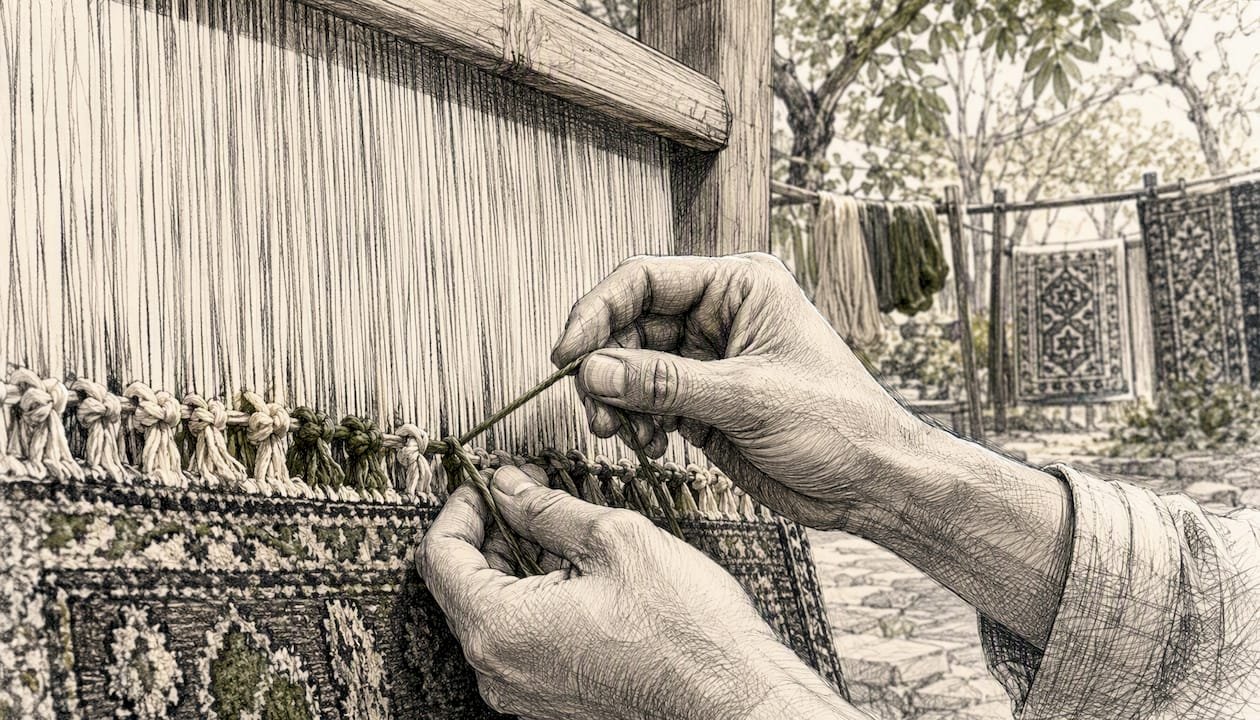
The asymmetric knot (also called the Persian or Senneh knot) wraps around one warp thread and loops under the adjacent one, with both pile ends emerging on the same side. The symmetric knot (Turkish or Ghiordes knot) wraps fully around two adjacent warp threads. On the back of the rug, asymmetric knots look slightly offset; symmetric knots appear as paired bumps. Most Iranian city rugs use the asymmetric knot. Tabriz and some northwestern workshops use both.
Knot density (KPSI):
Knot density is the clearest single indicator of a rug’s fineness and the complexity of design it can carry. To measure it yourself, fold back a small section of the rug and count the knots along one inch in each direction, then multiply. According to Wikipedia’s Persian carpet entry, some Senneh (Sanandaj) rugs reach knot counts of up to 400 knots per square inch in specialist examples, illustrating how dramatically density varies by region and tradition.
Knot density benchmarks: Village rugs typically fall in the 40–120 KPSI range. Mid-grade city workshop rugs run 120–250 KPSI. Fine Kashan, Isfahan, and Nain pieces often exceed 250 KPSI, with exceptional Qom silk rugs pushing well beyond that.
High KPSI enables finer curvilinear patterns and more color gradations, but density alone doesn’t determine value. A high-KPSI rug with weak provenance or poor materials is worth less than a well-documented mid-density piece with excellent wool and clear regional attribution.
One construction note worth knowing: Bijar rugs from Kurdistan use a wet-weaving technique with heavy tamping that produces an exceptionally compact, rigid fabric. A Bijar’s unusual stiffness and weight are features, not defects, and they explain the rug’s legendary durability compared with typical pile rugs.
Antique vs vintage vs new: how age affects price in the U.S. market
Age definitions for rugs:
- Antique: Generally accepted as 100 years or older. These pieces were woven before synthetic dyes became widespread, so natural dye palettes are common. Condition varies enormously.
- Vintage (semi-antique): Roughly 30–100 years old. Many mid-century Persian rugs fall here. They show some wear and patina but are often still structurally sound.
- New: Woven within the last 30 years. Modern production rugs can be fully authentic and hand-knotted; age alone does not determine authenticity or quality.
Age affects value, but it’s rarely the dominant factor. Provenance, knot density, materials, regional origin, and condition all matter more than a rug’s birthday. A well-preserved antique Kashan with documented provenance commands a premium. A worn antique village rug with foundation damage may be worth less than a new, fine-quality Isfahan.
Rough U.S. price drivers by tier:
- Entry-level authentic hand-knotted: Newer village or tribal pieces (Gabbeh, Heriz-style), moderate knot density, wool pile. These start in the hundreds of dollars for small sizes and reach a few thousand for room-size pieces.
- Mid-range quality: Vintage or new city workshop rugs (Tabriz, Kashan), higher knot density, good wool or wool-silk blend. Expect several thousand to tens of thousands of dollars depending on size and condition.
- High-end antique collector pieces: Antique Kashan, Isfahan, Qom silk, or rare tribal pieces with documented provenance and excellent condition. Prices range from tens of thousands into six figures for exceptional examples.
Restoration affects value in both directions. Conservative cleaning and reversible repairs, such as refringing or edge stabilization, generally preserve or improve market value. Heavy reweaving of the pile, especially with non-matching materials, can reduce collector value even when it improves appearance. For pieces you intend to resell or insure, conservative treatment is almost always the better call. Browse antique and collectible rugs to get a sense of what vetted vintage stock looks like at different price points.
Where to buy in the U.S. and the exact questions to ask any seller
Retail types and what to expect:
Specialist rug dealers offer the deepest expertise and often the best provenance documentation, but prices reflect their overhead. Auction houses (Christie’s, Sotheby’s, and regional auction houses) can yield good value on antique pieces, though returns are usually limited. Vetted online retailers offer convenience and, when they maintain detailed product pages with back-of-rug photography, can be as reliable as in-person dealers. Estate sales are a source of genuine finds, but buyer-beware conditions apply: no returns, limited documentation, and no expert on-site.
Questions to ask every seller before buying:
- What is the country of origin, and can you provide documentation?
- What are the materials (pile fiber, foundation fiber)?
- What is the approximate age, and how was it determined?
- What is the knot count or KPSI?
- Has the rug been restored or repaired? If so, where and with what materials?
- Can you provide high-resolution photos of the full back, fringe, selvedge, and a macro shot of the knots?
- What is your return policy, and does shipping include insurance?
- Do you have any provenance records, prior appraisals, or purchase receipts?
Red flags in listings and seller behavior:
- Fringes that look perfectly uniform or are clearly attached at the edge rather than emerging from the weave.
- Multiple identical listings for what is described as a “one-of-a-kind” piece. As Carpet Wiki’s identification guide notes, a genuine hand-knotted rug is essentially unique, so repeated identical listings strongly suggest machine production.
- No photo of the rug’s back, or only a cropped partial back photo.
- Origin described only as “Persian-style,” “Persian-inspired,” or “Oriental” without a specific country.
- Sellers who resist or delay providing additional photos.
- Prices that seem too low for the claimed quality tier.
Trust signals that matter:
Detailed product pages with multiple photos (including the back), explicit material and origin statements, a clear return policy, shipping insurance, and verifiable customer reviews. These are the baseline for any reputable seller, online or in person.
Care, cleaning, and restoration basics for authentic Persian rugs
Authentic hand-knotted Persian rugs are durable, but they reward careful maintenance.
Routine care:
- Vacuum regularly using a suction-only setting. Never use a beater bar or rotating brush on a hand-knotted rug; it stresses the pile and can pull knots loose over time.
- Rotate the rug every 12–18 months to distribute foot traffic and sun exposure evenly.
- Use a quality rug pad underneath. Padding reduces friction against the floor, prevents slipping, and significantly extends the rug’s life.
- Keep the rug out of direct, prolonged sunlight. Natural dyes and even quality synthetic dyes fade with UV exposure.
What not to do:
- Do not use harsh chemical cleaners, bleach, or enzyme-based stain removers on natural-dye or silk rugs. These can strip dye and damage fiber structure.
- Avoid DIY steam cleaning. The heat and moisture can cause wool to shrink, natural dyes to bleed, and cotton foundations to distort.
- Do not fold a rug for long-term storage; roll it instead, pile-side in, around an acid-free tube.
When to call a professional:
Fringe damage, foundation issues (broken warps or wefts), moth damage, or significant pile loss all require professional restoration. A specialist can reweave damaged sections, stabilize edges, and clean the rug with methods appropriate to its specific dyes and fibers. For natural-fiber rugs, professional wet-washing every three to five years is a reasonable maintenance interval for pieces in regular use.
Pro Tip: If a spill happens, blot immediately with a clean white cloth, working from the outside of the stain inward. Do not rub. Document the stain with a photo before you touch it, then call a specialist. The photo helps the restorer assess dye stability before they begin.
How to avoid common scams and mislabeling when buying “Persian” rugs
The Persian rug market has a long history of misrepresentation, and online retail has made it easier to pass off machine-made pieces as hand-knotted originals.
Common scams to know:
- Country-of-origin fraud: Rugs woven in India, Pakistan, or China using Persian designs are sold as “Persian” without documentation. The design is Persian-inspired; the rug is not.
- Power-loomed pieces sold as hand-knotted: Machine-made rugs with a hand-finished look are the most common misrepresentation in the mid-price market. The back is the tell: perfectly uniform, with no individual knot variation.
- Fake provenance documents: Certificates of authenticity can be printed by anyone. A document alone proves nothing without corroborating physical evidence.
- Re-knotted or heavily restored pieces sold as original: A rug that has been extensively rewoven may have a fraction of its original pile. Ask specifically about restoration history.
- Identical “one-of-a-kind” listings: If you find the same rug photo in multiple listings across different sellers or in different sizes, it is almost certainly machine-made.
Practical verification steps:
- Run a reverse-image search on the seller’s rug photos. If the same image appears on multiple sites or in stock photo libraries, walk away.
- Request photos of the back and fringe before committing. A seller who declines has something to hide.
- Ask for provenance paperwork and cross-reference any named appraiser or dealer.
- For purchases over $500, consider having the rug inspected by an independent appraiser before finalizing payment.
Red-flag checklist before sending payment:
- No back photo available.
- Fringe appears sewn on in listing photos.
- Origin described vaguely (“handmade,” “Persian-style,” “Oriental”).
- No return policy or returns explicitly excluded.
- Price is dramatically below market for the claimed quality and size.
- Seller cannot name the specific weaving region.
Step-by-step authentication workflow: from self-check to expert appraisal
No single visual cue proves provenance. Reliable authentication combines multiple signals: weave structure, materials, regional motifs, documented provenance, and, for high-value pieces, expert appraisal. Here is how to escalate systematically.
-
Start with seller-provided materials. Request the full documentation package: high-resolution photos of the front and back, close-ups of the fringe and selvedge, a ruler in at least one shot, the written provenance statement, and any prior appraisal letters. Evaluate these against the visual checklist in the identification section above.
-
Conduct a physical inspection if possible. For any piece above $500, arrange to see the rug in person or request it on approval before final payment. Bring a ruler to measure KPSI yourself. Check the fringe, the back, and the selvedge under good light.
-
Commission a written appraisal for significant purchases. A qualified rug appraiser will examine the piece in person, assess fiber type (sometimes with a burn test), count knots, evaluate condition, and provide a written opinion on origin, age, and estimated market value. The American Society of Appraisers and the Appraisers Association of America both maintain directories of textile appraisers. Expect to pay a flat fee for the appraisal, not a percentage of value (percentage-based fees are an ethics red flag in the appraisal profession).
-
Document condition and chain of custody. Photograph the rug from all four sides, the back, and any areas of wear or repair before it leaves the seller’s hands. Keep all receipts, provenance letters, and appraisal documents together. This chain of custody documentation is what insurers and future buyers will ask for.
Pro Tip: For insurance purposes, have your appraiser note the replacement value separately from the fair market value. These two figures can differ significantly for antique pieces, and most homeowner policies default to actual cash value unless you specify replacement coverage.
A note on buying with confidence
The Persian rug market rewards buyers who ask specific questions and sellers who can answer them. Every rug in a reputable collection should come with clear origin information, material disclosure, and photos that let you verify the basics yourself. When a seller’s product page shows the back of the rug alongside the front, lists the pile fiber and foundation, and states the weaving region, that transparency is the first and most practical trust signal you have.
Rugsonlinemarket makes it easier to buy verified Persian rugs online
Buying a genuine hand-knotted Persian rug online doesn’t have to mean taking a leap of faith. Rugsonlinemarket’s product pages are built around the trust signals that matter: natural-material listings (wool, silk, cotton), detailed condition notes, and photography that lets you assess what you’re getting before it ships.
Every order over $300 ships free, and the 30-day return policy means you can inspect the rug in your own space, under your own light, before committing. For buyers focused on natural fibers, the natural rugs collection is the right starting point. If you’re drawn to antique and collectible pieces, the antique and collectible category brings together vetted vintage stock with the provenance detail serious buyers need. Browse the full selection at Rugsonlinemarket and use the checklist in this guide to evaluate every listing with confidence.
Sources
These references were used to build this guide and are worth bookmarking for deeper research:
- CARPETS iv. Knotted-pile carpets: Designs, motifs, and patterns – Encyclopaedia Iranica
- How to identify Oriental & Persian rugs – Carpet Wiki
- Persian carpet
