









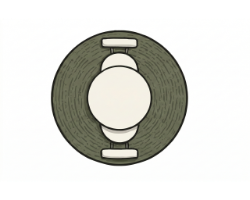




























Take your table’s diameter and add 48 inches. That is the smallest round rug that works under a round dining table, because it leaves 24 inches of rug past the table edge on every side. A 48-inch table pairs with a 96-inch (8-foot) round rug. A 60-inch table needs 108 inches, which in practice means rounding up to a 10-foot rug. The rest of this guide shows you how to check that number against your chairs, your room and your budget, and how the same logic carries over to entryway and foyer rugs.
Key takeaways
- Add 48 inches to the table diameter to find the minimum round rug size. That gives 24 inches of rug beyond the table edge on all sides.
- Every chair leg should stay on the rug when someone sits down and pulls the chair back. A rug that is just barely too small is the most common mistake.
- A round rug does not have to go under a round table. Rectangular and oval rugs also work, as long as they cover the full chair footprint.
- Tape the rug’s outline on the floor first. Do it with the table set and chairs pulled out.
- For an entryway or front door, size by the space and the door swing, not by the dining formula. We cover that near the end.
Table of Contents
- The formula: table diameter plus 48 inches
- Measure chair clearance, not just the table
- Does a round table need a round rug?
- Tape it out before you buy
- Our perspective: size up, and think about the floor around it
- Shopping for a round rug under your table
- Entryway and foyer rug size
- Common questions about dining rug size
- Sources
The formula: table diameter plus 48 inches
Most design guidance lands on the same number. The Spruce says a dining rug should be at least 24 inches bigger than the table on all sides. Houzz gives the same 24 inches as a minimum, so guests can pull out chairs without tripping over the rug’s edge, and adds that an even wider border is ideal.
For a round table, both sides of the table count, so you add 24 inches twice. The result is diameter plus 48 inches.
Here is that math worked out for common round table sizes. The last column is the practical shopping size, since round rugs are usually sold in whole-foot diameters.
| Table diameter | Typical seating* | Minimum rug (diameter + 48") | Size to shop for |
|---|---|---|---|
| 36" | 2 to 4 | 84" (7 ft) | 7 ft or 8 ft round |
| 42" | 4 | 90" (7.5 ft) | 8 ft round |
| 48" | 4 to 6 | 96" (8 ft) | 8 ft round |
| 54" | 5 to 6 | 102" (8.5 ft) | 9 ft round |
| 60" | 6 to 8 | 108" (9 ft) | 9 ft or 10 ft round |
| 72" | 8 | 120" (10 ft) | 10 ft round |
*Seating varies with chair width and how tightly you sit. Treat it as a rough guide.
Notice the pattern in the shopping column. When the formula lands between two sizes, go up. Furniture ergonomics advice summarized by Davies Decor says the same: when in doubt, size up so the chairs have steady footing.
Why “at least” matters
The 24-inch rule is a floor, not a target. It assumes a normal chair that pulls back about 18 to 24 inches when someone stands or sits. Deep upholstered chairs, chairs with arms and benches that slide further all want more rug. If you can afford the extra size, take it. A rug slightly too large reads as generous. A rug slightly too small reads as a mistake.
Measure chair clearance, not just the table
The formula is a starting estimate. Your chairs decide the final number.
Davies Decor describes the most common trap in measuring: miscalculating chair clearance. Rather than trusting the rule blindly, measure from the table edge to the back of a chair when it is fully pulled out for sitting. If that distance is more than 24 inches, you need a larger rug. Otherwise the chair back catches on the rug edge, which creates a tripping hazard and can damage the binding.
A quick way to do it:
- Sit in a chair as you normally would and have someone measure from the table edge to the back of the chair.
- Take the largest reading among all your chairs. Host chairs and armchairs usually pull out farthest.
- Add that number to the table radius, then double it. That is the rug diameter your chairs need.
Example: a 48-inch table has a 24-inch radius. If your deepest chair reaches 28 inches past the edge when pulled out, the rug needs a radius of 52 inches, so a diameter of 104 inches. That points to a 9-foot rug at minimum, and a 10-foot one if the room allows. The plain formula would have sent you to 8 feet, and the chairs would have slipped off the edge.
Watch the half-on, half-off problem
The worst outcome is a rug that catches the back legs of each chair. Davies Decor, citing a furniture ergonomics specialist, calls it a common mistake: the chair sits partly on the rug and partly on the floor. It looks disjointed and feels unstable to the person sitting. Either every leg is on the rug through the full range of motion, or the rug sits entirely clear of the chairs, which only makes sense for a small decorative piece under a pedestal base.
Does a round table need a round rug?
No. Matching shapes is a popular look, but Livingetc reports that it is not a strict rule. Round rugs work particularly well in smaller dining areas, where they soften sharp corners. Rectangular or oval rugs are the standard for long tables. Whatever the shape, the rug has to cover the full footprint of chair movement.
That answers a question many shoppers have: can a round table sit on a rectangular rug? Yes, with one condition. The rug’s shortest dimension must still clear the table by the same 24 inches on each side. A 48-inch round table on a rectangular rug needs at least 96 inches on the short side, so an 8×10 works and a 6×9 does not.
When round is the better choice
- The table is round or a pedestal design. The shapes echo each other. Designer Ghislaine Viñas notes in an Interior Design profile of a Palm Beach home that a round rug and a classic pedestal table help soften hard edges in the room.
- The room is square or nearly so. A round rug avoids four pointed corners fighting the walls.
- Your table has a leaf. Many tables are round with the leaf out and oval with it in. If yours is 42 inches round and stretches to 60 by 42 inches, size the rug for the extended shape if you use it often. A round rug sized only for the closed table will leave chairs at each end hanging off.
When to pick a different shape
- The room is long and narrow, and a round rug would leave awkward bare strips.
- Your dining area is open to the living room and you want a rectangle that follows the lines of the space.
- You regularly extend an oval or rectangular table.
Tape it out before you buy
The masking tape method is the cheapest insurance against a wrong order. Abt’s measuring guide recommends using masking tape and a tape measure to mark the rug’s corners and note the measurements. For a round rug there are no corners, so use a string:
- Find the exact center of the table and mark that spot on the floor, or tie a string to the table’s center post if you have a pedestal base.
- Tie the other end of the string to a pencil or a strip of tape. The string length equals the rug’s radius, which is half the diameter.
- Swing the string in a circle, marking points every few inches, then connect them with tape.
- Set the table fully, with place settings, and pull each chair out as if someone were sitting.
- Check that all four legs of every chair stay inside the tape.
Do this with the table set and the chairs occupied if you can. That shows how much room people really use. Because round rugs are tricky to center, keep the distance from the table center to the rug’s edge the same in every direction. Then walk around the room. Check that the rug does not block a door, a cabinet or a vent, and leave a few inches of bare floor between the rug’s edge and the walls or the nearest furniture, as the plan allows.
Our own Rug Size Rules guide lays out the tape-out routine for other rooms too, and our dining rug placement guide covers positioning and care once the rug is down.
Our perspective: size up, and think about the floor around it
We sell rugs for a living, so we hear the same story often. Someone orders the size the formula says, the rug arrives, and the chairs tip off the edge the first night. Nearly every time, the table was measured but the chairs were not.
Our advice is simple. Treat 24 inches as the minimum. If you are between two sizes, buy the larger one, as long as there are still several inches of bare floor to the walls. A round rug that fills the dining zone also makes a better anchor in an open plan. Davies Decor makes the same point: a larger rug helps define the dining space from the rest of the room.

For material, choose with your daily life in mind. Dining rooms are high-traffic spaces where chairs scrape and food drops. A flat or low pile makes chairs slide easily and is easier to clean. A thick, high pile catches chair legs and crumbs. Wool is a durable natural fiber and a good fit for a room with this much use. If spills are a daily event in your house, a washable rug is the more practical pick.
One last point: the rug is not an afterthought. Order it after you have settled on the table, but before you finalize chair placement and lighting.
— ROM team
Shopping for a round rug under your table
We carry round rugs in several styles and materials, along with traditional, handmade and natural-fiber collections. Our dining room rug collection is the best place to start. If you like the look of knotted wool and want something with character, browse our handmade rugs or traditional rugs. Orders over $300 ship free, and you have 30 days to return a rug that does not work in your room. For a deeper look at placement, see our round rug placement guide.
Entryway and foyer rug size
Many readers who search for dining rug sizes also ask about entryway, foyer and front door rugs. The dining formula does not transfer directly, because an entry has no chairs to clear. Size it by the space and the door:
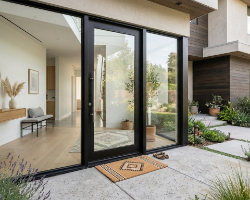
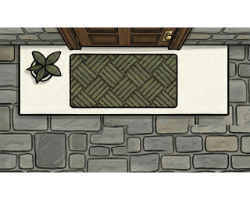
- Front door mat. It should be wide enough to cover the width of the door opening and deep enough for a full stride. Door swing matters: the door must open over the mat without catching. Thick mats can scrape the door, so check the clearance before ordering.
- Small foyer. Our entryway rug guide sets 3×5 feet as the practical minimum for a homeowner who wants a rug that looks intentional rather than lost.
- Narrow hall entry. A runner follows the traffic line. See our runner rugs.
- Open, square foyer. A round rug works well here, especially under a round entry table. Size it by leaving a margin of visible floor around it, roughly the same one you would leave in any room.
For the outer door, a dedicated doormat handles dirt, and a rug indoors then handles the look. If you have a hard floor, a pad keeps small rugs from sliding. Our guide on how to stop a rug slipping covers the options.
Common questions about dining rug size
What size rug goes under a 48-inch round table?
An 8-foot (96-inch) round rug is the minimum, since it leaves 24 inches past the table edge on every side. If your chairs are deep or you want a wider border, a 9-foot or 10-foot round rug is safer. Always check that every chair leg stays on the rug when the chair is pulled back.
Can I use a rectangular rug under a round dining table?
Yes. Shape matching is a common look, not a rule. The rug’s short side still needs to be at least the table diameter plus 48 inches, so a 48-inch table calls for an 8×10 rather than a 6×9.
Should the chairs be on the rug or off it?
On it. Every chair leg should stay on the rug when someone sits down and when the chair is pulled back. A rug that catches only the back legs creates an unsteady seat and a tripping hazard. If a rug that large will not fit, a smaller one that sits clear of the chairs is better than one that is half-on.
How do I measure for a round rug?
Measure the table diameter, then add at least 48 inches. Next, measure from the table edge to the chair back with the chair pulled out, and enlarge the rug if that exceeds 24 inches. Mark the circle on the floor with a string and masking tape before you order.
Sources
- Livingetc: How do I choose the right size round rug?
- Davies Decor: What size rug should you choose for a round dining table?
- Houzz: 10 tips for getting a dining room rug just right
- The Spruce: Should you put a rug under a dining room table?
- Abt: How to measure for a rug
- Interior Design: Ghislaine Viñas creates a calm yet vibrant getaway in Palm Beach
