



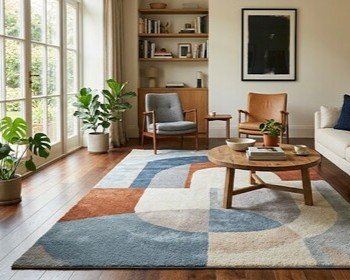

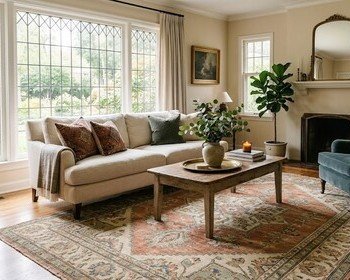
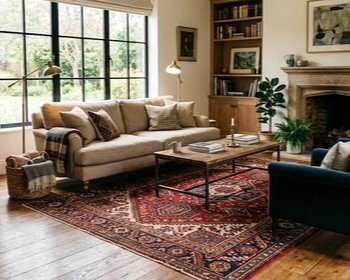
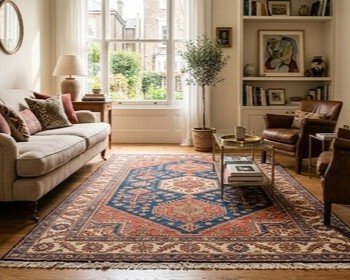

For a commercial entryway, the right spec is a low-profile, loop-pile, solution-dyed nylon rug with a PVC or rubber backing and a face weight near 52 oz./yd². That single combination handles scraper action, moisture, and foot traffic without looking institutional.
TL;DR: Contract-grade entry rugs outperform residential options because of fiber density, backing stability, and tested slip resistance. The Carpet and Rug Institute (CRI) sets the performance baseline most commercial specifiers rely on, and Rugsonlinemarket carries options that meet it without sacrificing aesthetics.
Quick specs to look for before you buy:
- Fiber: Solution-dyed nylon (indoor) or UV-stable polypropylene (semi-outdoor/exterior)
- Pile type: Loop pile or tight low-profile construction
- Backing: PVC or rubber for dimensional stability
- Face weight: ~52 oz./yd²
- Pile height: ≤7mm total thickness
Table of Contents
- What makes a rug truly “commercial” for entryways?
- Which materials and construction details actually matter?
- How do you size and place entry rugs correctly?
- What cleaning schedule keeps a commercial entry rug performing?
- Can you get a residential look with contract-grade performance?
- Your pre-order checklist: eight questions to ask any supplier
- Rugsonlinemarket has the entry rugs your space actually needs
- Key Takeaways
- The spec most designers overlook
What makes a rug truly “commercial” for entryways?
Commercial entry rugs are built for three things residential rugs are not: scraping debris off shoe soles, resisting abrasion under constant foot traffic, and holding their shape without creeping or bunching. A decorative area rug from a home furnishings store simply is not engineered for that job.
The performance baseline comes down to a handful of attributes. High fiber density and strong tuft bind keep pile upright under repeated compression. Loop and low-pile constructions resist crushing and provide a smooth surface for wheeled traffic, which is why the CRI recommends them for corridors and public areas. Solution-dyed fibers lock color into the fiber itself rather than applying it as a surface treatment, so fading and staining are far less of a concern.
Construction method matters too. Tufted construction accounts for 95% of commercial carpet production because it delivers consistent density at scale. Woven constructions exist and can be beautiful, but they are slower to produce and harder to specify at contract grade.
Face weight near 52 oz./yd² is the widely cited threshold for heavy-duty entry mats. Below that, the mat compresses too quickly to scrape effectively and wears through faster in high-traffic zones.
Safety and compliance round out the baseline. The U.S. Consumer Product Safety Commission (CPSC) provides flammability guidance relevant to commercial installations, and fire and smoke-density testing is commonly required for public-facing spaces. A residential rug may lack those certifications entirely, which creates compliance and insurance exposure.
Key attributes that separate commercial from residential:
- High tuft bind and backing density to prevent creeping
- Loop or low-profile pile for scraper effectiveness
- Solution-dyed fibers for colorfastness and stain resistance
- Tested fire resistance and slip resistance ratings
- Indoor air quality certifications such as Greenguard Gold
Which materials and construction details actually matter?

For entryways, solution-dyed nylon is the default choice indoors. It handles abrasion, cleans easily, and holds color under heavy use. For covered porches, vestibule thresholds, or semi-outdoor walk-off zones, UV-stable polypropylene is the smarter call because it resists moisture and sunlight without degrading.
Loop pile is the industry standard for high-traffic scraper areas because it resists crushing and hides dirt better than cut-pile alternatives. Cut pile wears prematurely in scraper zones and is better reserved for low-traffic aesthetic spaces like private offices or boardrooms. When a designer wants a softer residential feel in a boutique lobby, a tight, low-profile cut pile can work, but only if foot traffic stays moderate.

Backing is where many buyers make the wrong call. PVC and rubber backings add dimensional stability and moisture resistance that cushion backings simply cannot match in entry zones. Standard PVC commercial tiles typically run 6–7mm thick, which keeps the profile low enough to clear door sweeps and reduce trip hazards. Cushion backings are worth considering in office interiors where wheeled traffic is light and underfoot comfort is a priority.
Concrete spec targets to bring to any supplier conversation:
- Face weight: specify ~52 oz./yd² for heavy-duty entry use
- Total thickness: ≤7mm for hardback/entry applications; 6–7mm for tile formats
- Tuft bind: ask for the specific value in pounds of force
- Backing: PVC or rubber for entries; cushion only for low-traffic office zones
- Carpet tiles in 24×24 in. or 18×18 in. formats offer modularity and easy spot-replacement in high-wear zones
For outdoor-capable entry mats, UV-stable polypropylene holds up where nylon would degrade from moisture and sun exposure.
Pro Tip: Ask every supplier for the tuft bind value in pounds of force, the specific backing compound (not just “rubber”), and whether the warranty language explicitly covers commercial use. A warranty that only covers residential installation is worthless in a boutique entry.
How do you size and place entry rugs correctly?
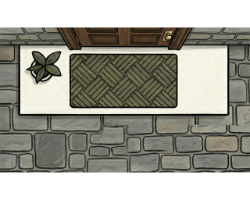
Coverage is the first decision. A single-door entry mat should span the full door width and extend at least 3–4 feet inward so a person takes two full steps on the mat before reaching the interior floor. Double-door entries need proportionally wider coverage, typically matching the combined door opening plus 6–12 inches on each side.
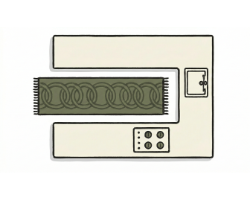
For corridor runners, leave 150–300mm of exposed flooring on each side so the runner reads as intentional rather than undersized. In vestibules, layering a scraper mat at the exterior threshold and a secondary walk-off mat inside the inner door captures more debris and moisture than a single mat can.
ADA clearance requires that rugs not impede accessible routes. Keep pile height at or below ½ inch (approximately 13mm) and secure all edges so they lie flat.
Placement and anchoring options by context:
- Light traffic / boutique retail: double-sided carpet tape or non-slip pad
- Medium traffic / lobby: furniture anchoring plus non-slip pad at edges
- Heavy traffic / vestibule: permanent adhesive or recessed mat well for zero trip-hazard profile
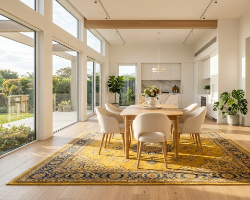
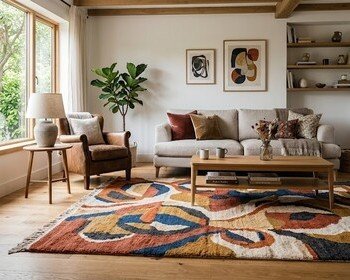
Pattern scale is worth thinking about in commercial spaces. A pattern that reads beautifully at 5 feet in a residential room gets lost at 20 feet in a lobby. Scale up the repeat and choose bolder color contrast for spaces where the rug is viewed from a distance. Runner rugs in corridor applications follow the same logic: a tighter pattern repeat disappears underfoot, while a scaled geometric holds visual presence.
What cleaning schedule keeps a commercial entry rug performing?
Daily vacuuming or mechanical brushing is the baseline for any entry rug seeing regular foot traffic. Skip a few days and the debris that accumulates starts acting as an abrasive, grinding against fiber and backing with every step.
A practical schedule by traffic level:
- Light traffic (boutique, private office entry): vacuum daily, hot-water extraction monthly
- Medium traffic (retail, small lobby): vacuum daily, extraction every 2 weeks, spot-clean immediately
- Heavy traffic (high-volume entry, vestibule): vacuum or brush twice daily, extraction weekly
Contract-grade nylon tiles specified at ~52 oz./yd² can realistically last 10–15 years or more in heavy-use entries when maintained properly. That lifespan drops sharply if the wrong cleaning method is used. Avoid saturating PVC-backed rugs with excessive moisture; the backing can delaminate. Harsh bleaching agents will strip solution-dyed fibers of their color evenness over time, even though solution-dyeing is more resistant than surface dyeing.
For indoor air quality, solution-dyed nylon and low-VOC backings reduce off-gassing. Greenguard Gold certification is the standard to request when IAQ matters, particularly in healthcare-adjacent or hospitality settings. Entry rugs also trap allergens and particulates before they migrate into the interior, which is a genuine air quality benefit when the mat is vacuumed regularly.
When buying for commercial use, confirm the warranty covers commercial installation explicitly and check the returns window. Rugsonlinemarket offers a 30-day hassle-free return policy, which gives you time to verify fit and performance before committing.
Can you get a residential look with contract-grade performance?
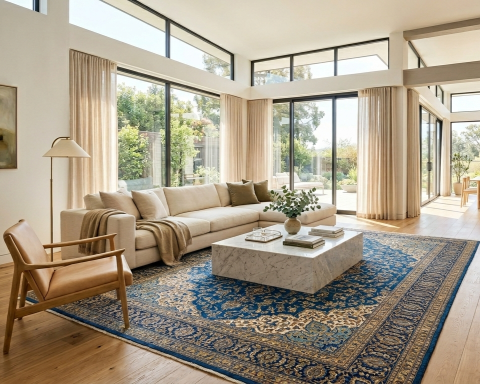
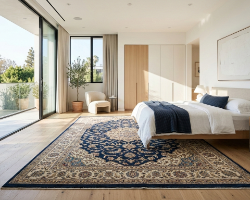
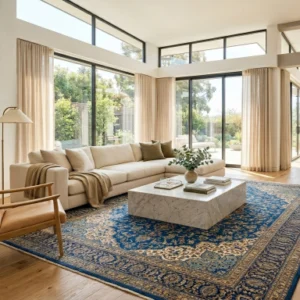
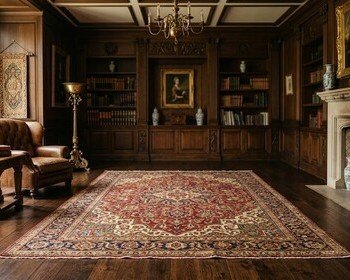
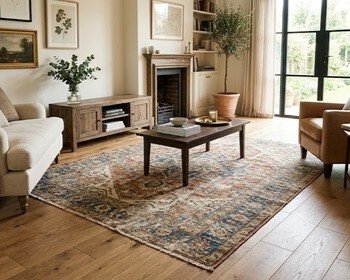
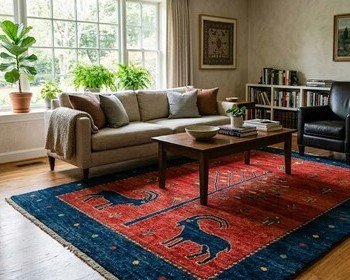
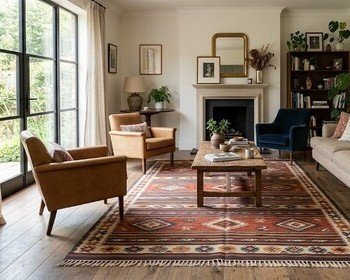
Yes, and the gap between the two has narrowed considerably. Boutique commercial spaces increasingly specify residential-inspired rugs that pair softer aesthetics with contract-grade construction. The key is choosing the right construction for the right zone.
| Rug category | Durability | Aesthetic range | Maintenance | Recommended backing |
|---|---|---|---|---|
| Entry scraper mat | Very high | Limited (functional colors) | Low effort | PVC or rubber |
| Hospitality lobby rug | High | Wide (designer patterns, warm tones) | Moderate | Hardback or cushion |
| Branded logo mat | High | Custom (brand colors, graphics) | Low effort | Rubber |
A wool-nylon blend is the pragmatic middle ground when a designer wants the warmth and texture of wool but needs durability beyond what pure wool delivers. Pure wool is beautiful and naturally soil-resistant, but it compresses under heavy traffic faster than nylon and is harder to clean in a commercial context.
Practical moves for designers specifying boutique entries:
- Choose solution-dyed fibers for colorfastness under cleaning and UV exposure
- Scale pattern repeats up for spaces viewed from more than 10 feet
- Use low-profile borders (≤7mm) to eliminate trip hazards at rug edges
- Explore commercial design trends for color and pattern direction that bridges residential warmth with contract durability
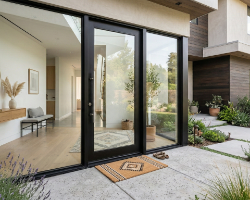
Doorway rugs in low-profile, slip-resistant constructions are a natural starting point for boutique entries that need to look considered rather than utilitarian.
Your pre-order checklist: eight questions to ask any supplier
Confirm these before you pay, not after the rug arrives.
- Fiber and dye method: Is it solution-dyed nylon or polypropylene? Surface-dyed fibers fade faster.
- Face weight: Is it at or near 52 oz./yd² for entry use?
- Pile type: Loop pile for scraper zones, or cut pile for aesthetic-only areas?
- Backing: PVC, rubber, or cushion? Get the specific compound, not a generic label.
- Slip resistance: Is there an anti-slip treatment or rating? Ask for the test standard used.
- Certifications: Fire resistance tested? Greenguard Gold or equivalent IAQ certification?
- Lead time and returns: What is the standard lead time for stock vs. custom? What is the return window?
- Warranty: Does it explicitly cover commercial use, or is it residential-only?
For custom or logo mats, lead times typically run longer than stock goods. Request a physical sample swatch before committing to a large order. Confirm the installation method with your flooring contractor so the backing choice aligns with the substrate.
Rugsonlinemarket has the entry rugs your space actually needs
If you have been piecing together spec sheets from multiple sources, Rugsonlinemarket simplifies the process. The collection spans doorway and entry options in low-profile, slip-resistant constructions alongside runner rugs sized for corridors and vestibules. Free shipping applies to orders over $300, returns are hassle-free within 30 days, and the 100% feedback guarantee backs every purchase.
For designers weighing aesthetics against durability, the best luxury rugs selection includes wool and blended options that bring residential warmth to boutique commercial entries without sacrificing longevity. Browse the full collection at Rugsonlinemarket or request a sample to confirm fit, color, and pile feel before your final order.
Key Takeaways
A contract-grade entry rug specified at ~52 oz./yd² face weight, loop pile, and PVC or rubber backing delivers the scraper performance, dimensional stability, and lifespan a boutique commercial entry demands.
| Point | Details |
|---|---|
| Face weight matters most | Specify ~52 oz./yd² for heavy-duty entry use; lighter weights compress and wear faster. |
| Loop pile for scraper zones | Loop construction resists crushing and hides dirt better than cut pile in high-traffic entries. |
| PVC or rubber backing | These backings prevent creeping and moisture penetration; cushion backings belong in low-traffic offices. |
| Maintenance preserves lifespan | Daily vacuuming and regular extraction can extend a contract-grade rug’s service life to 10–15 years. |
| Rugsonlinemarket | Carries entry-ready doorway and runner options with free shipping over $300 and 30-day returns. |
The spec most designers overlook
The conversation about commercial entry rugs almost always centers on pile type and face weight, which are genuinely important. What gets skipped is the backing, and that is where most premature failures actually start. A rug with excellent fiber and the right face weight will still creep, buckle, and delaminate if the backing is not matched to the substrate and traffic load.
The other underrated factor is scale. Designers who specify beautiful rugs for boutique entries often choose a pattern that reads perfectly in a product photo but disappears entirely once it is on the floor and viewed from across a lobby. Scale the pattern up, push the color contrast, and the rug does the job it was meant to do: anchor the space and signal that someone thought carefully about the entry.
The residential-inspired contract rug is not a compromise. It is a smarter specification. You get the warmth and visual interest of a designed piece with the fiber density, backing stability, and certifications that a commercial entry actually requires. The two goals are not in tension when you know which specs to ask for.
