

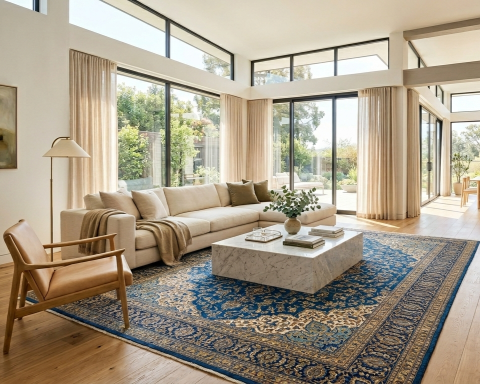

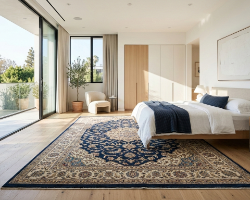





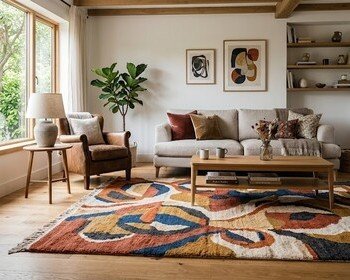

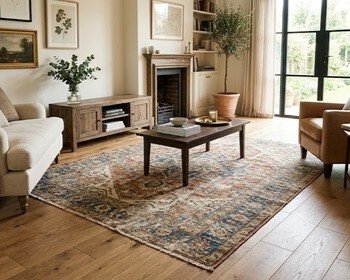
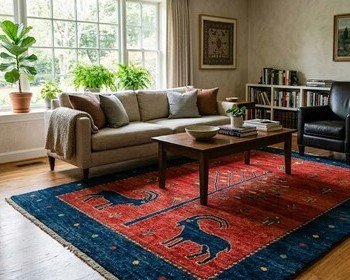
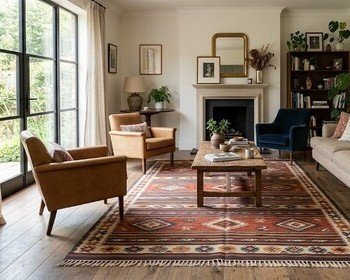

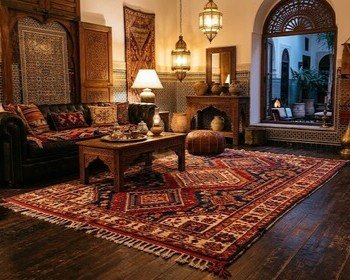

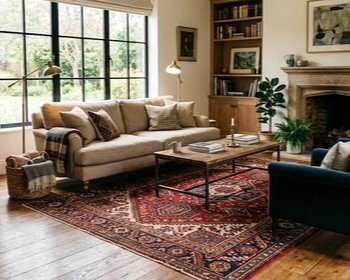
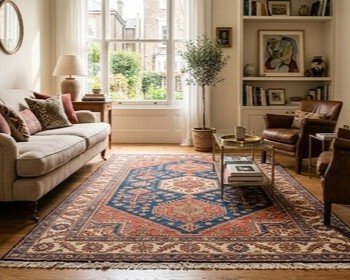
The difference between Turkish and Persian rugs comes down to one thing first: the knot. Turkish weavers tie a symmetrical Ghiordes knot around two warp threads; Persian weavers tie an asymmetrical Senneh knot around one. That single structural choice decides how durable a rug feels underfoot, how fine its pattern can get, and often, which country it came from.
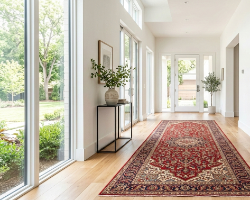
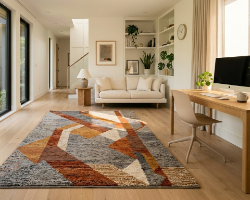
Beyond the knot, the two traditions diverge in fiber choice and pattern language. Persian rugs, especially those from Kashan or Tabriz, lean toward curling vines, garden scenes, and central medallions. Turkish and Anatolian rugs favor geometric shapes, tribal symbols, and the softer, larger-scale motifs seen in Oushak pieces.
- Choose Turkish if you want a rug for a hallway, living room, or anywhere feet actually walk. The tighter, bulkier knot structure holds up to daily wear.
- Choose Persian if you’re collecting, or you want the finest possible detail in a bedroom or formal dining room where traffic is light.
- Both come in wool, silk, and wool/silk blends, so material alone won’t tell you the origin. The knot will.
Key Takeaways
The Ghiordes knot builds durable, boldly patterned Turkish rugs, while the Senneh knot builds finely detailed, more delicate Persian rugs, and that structural difference should drive your buying decision more than country labels alone.
| Point | Details |
|---|---|
| Knot type drives everything | Ghiordes (Turkish) favors durability; Senneh (Persian) favors fine detail. |
| Material isn’t a reliable origin clue | Both traditions use wool, silk, and blends, so check the knot instead. |
| Flip it before you buy | Authentic hand-knotted rugs show irregular knots and integrated fringe on the back. |
| Abrash signals natural dye | Subtle color banding usually beats perfectly uniform synthetic color. |
| Rugsonlinemarket lists the details upfront | Product pages state knot method, fiber, and size, backed by free shipping over $300 and 30-day returns. |
Table of Contents
- Turkish vs Persian Rugs: Knotting and Structure Explained
- Materials and Construction: Wool, Silk, and Blends
- Design, Motifs, and Regional Style Cues
- How to Tell a Real Turkish or Persian Rug: An Inspection Checklist
- Durability, Cleaning, and Care by Rug Type
- Price, Value, and What to Ask Before You Buy
- Publisher Expertise: How Rugs Online Market Helps You Choose
- Weaving Techniques and Craftsmanship Beyond the Knot
- Regional Variations Within Turkish and Persian Rug Traditions
- Collecting vs. Buying to Live With
- How Rugs Online Market Makes This Decision Easier
- Frequently Asked Questions
- Sources
Turkish vs Persian Rugs: Knotting and Structure Explained
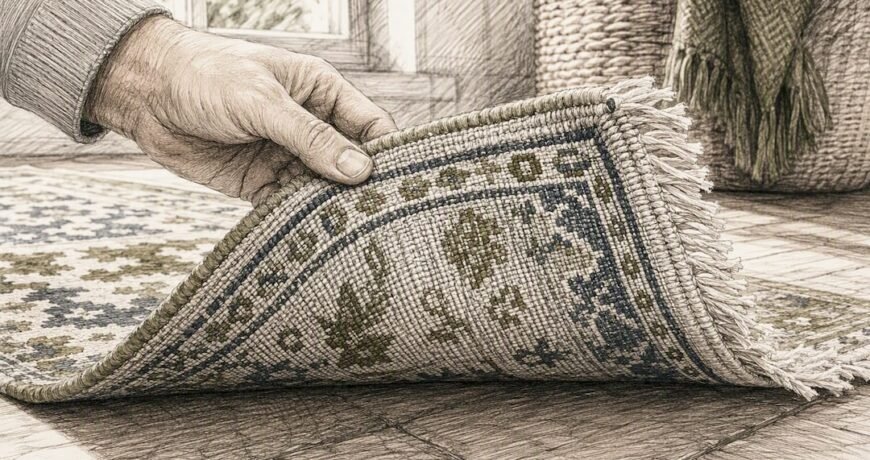
Pick up the corner of a rug and flip it over. What you see on the back is the entire story of how it was made.
The Ghiordes knot, the technique behind most Turkish carpets, wraps yarn around two warp threads and pulls both ends up through the middle, creating a symmetrical loop. That symmetry means each knot takes up slightly more horizontal space, so the pile sits thicker and the pattern edges look a touch bolder. The Ghiordes knot, as Britannica explains, produces exactly this kind of dense, sturdy pile, while the Senneh knot behind most Persian rugs wraps around only one warp thread and leaves the other end free, an asymmetrical structure that lets weavers pack in far more knots per square inch.
That knot density difference is why Persian rugs can render curved vines and shaded medallions that a Ghiordes-knotted piece simply can’t reproduce at the same resolution. It’s also why Senneh-knotted rugs demand more delicate handling.
- Ghiordes (Turkish): symmetrical, wraps two warps, thicker pile, easier long-term maintenance.
- Senneh (Persian): asymmetrical, wraps one warp, finer detail, more delicate to clean and restore.
Pro Tip: Count the knots on the back of a rug within one square inch. A Ghiordes-knotted piece often reads lower and blockier; a Senneh-knotted piece reads finer and more like a photograph up close.
According to rug-education resource Elevate Your Floor, the practical trade-off shows up in daily life: Ghiordes knots hold their shape under heavy foot traffic, while Senneh knots reward a rug that gets admired more than walked on.
Materials and Construction: Wool, Silk, and Blends
Knot type tells you where a rug likely came from. Material tells you what it will feel like, how much it will cost, and where in your home it belongs.
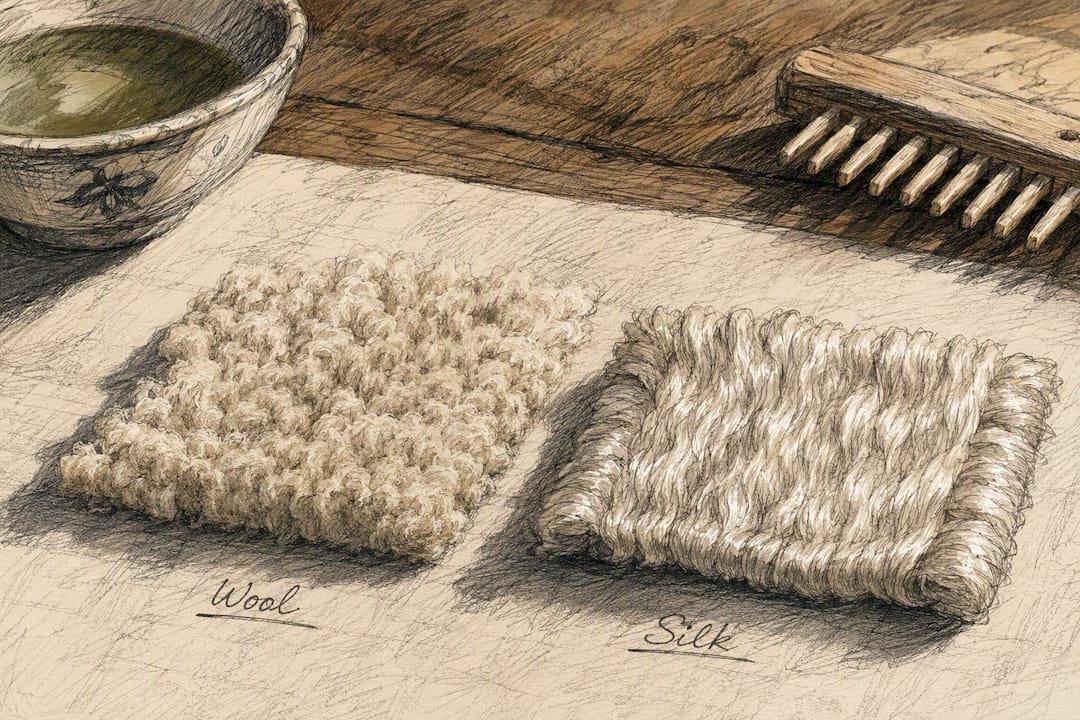
Wool is the workhorse fiber for both traditions. It’s springy, stain-resistant, and forgiving of years of foot traffic, which is why the majority of both Turkish and Persian rugs use hand-spun wool for the pile. Silk shows up when weavers want sheen and unmatched fineness, usually in accent pieces, wall hangings, or small-format rugs rather than a floor covering for a mudroom. Wool-silk blends split the difference, using silk for highlight threads within an otherwise wool field.
The foundation matters just as much as the pile. A cotton warp and weft give a rug more stability and a flatter lie, common in city workshop pieces from both countries. Wool foundations show up more in tribal and village weaving, producing a softer, sometimes slightly irregular hand.
- Wool pile, cotton foundation: the standard for durable, mid-range rugs in either tradition.
- Silk or silk-highlighted pieces: better suited to low-traffic rooms and formal display.
- Wool foundation, wool pile: typical of tribal and nomadic weaving, prized for character over uniformity.
Higher pile height feels plush but crushes and shows traffic patterns faster. A tighter, lower pile, common in finer Persian city rugs, resists matting and cleans more predictably.
Design, Motifs, and Regional Style Cues
Pattern is the fastest way to guess origin before you ever flip the rug over, though it’s not foolproof on its own.
- Persian medallion and garden designs. Look for a central medallion surrounded by curling arabesques, or an all-over garden pattern meant to evoke a paradise landscape. Kashan and Tabriz rugs are the classic examples, known for tight symmetry and curvilinear detail that only a Senneh knot can render cleanly.
- Turkish geometric and tribal motifs. Anatolian village and tribal rugs favor angular hooks, stars, and stylized animal or plant forms built from straight lines rather than curves, a direct result of the Ghiordes knot’s boxier structure.
- Oushak softness. Western Anatolian Oushak rugs break the geometric stereotype with faded, muted palettes and large-scale, loosely drawn motifs. Casual buyers often mistake antique Oushaks for Persian pieces because of that softness, even though the knot underneath is pure Turkish.
- Color palette as a clue. Persian city rugs often lean into deep reds, blues, and ivory grounds with tonal shading. Village and tribal Turkish rugs run warmer and earthier, with rust, camel, and muted greens dominating.
Symmetry is another tell: a rug with mirror-image precision on both halves usually points to an urban Persian workshop, while slight, intentional irregularities suggest tribal or village production on either side of the border.
How to Tell a Real Turkish or Persian Rug: An Inspection Checklist
You don’t need a loupe or a degree in textile history to spot a genuine hand-knotted rug. You need to know where to look.
- Flip the rug over. A hand-knotted piece shows the same pattern, slightly softer, on the back. A machine-made rug shows a uniform woven backing with no visible knots.
- Examine the knots themselves. Irregular knot size and slight asymmetry between rows are good signs of hand production. Perfectly uniform knots in a grid usually mean machine tufting or weaving.
- Check the fringe. Authentic fringe is the extension of the warp threads themselves, not a separate strip sewn on afterward. Tug gently. Sewn-on fringe will show a seam.
- Measure the knot density (KPSI). Count knots per square inch on the back. Higher KPSI generally signals finer detail and, often, a Persian Senneh construction.
- Look for abrash. Subtle color banding across a field, where a dye lot changed slightly between skeins, points to natural dyes and hand-spun wool rather than a uniform synthetic batch. Perfectly even, flat color across a large field is a red flag for synthetic dye or a modern reproduction.
Pro Tip: Photograph the back of the rug in natural light before you buy. Knot irregularity and color abrash both show up far more clearly there than on the face of the rug.
Watch for backing glue, a printed pattern that doesn’t match front to back, or fringe that unravels in a single continuous piece. Any of those means you’re looking at a machine-made or reproduction rug, not a hand-knotted antique.
Durability, Cleaning, and Care by Rug Type
Match the rug to the room, not just the room to the rug. Ghiordes-knotted Turkish rugs, with their denser and bulkier structure, generally handle entryways, living rooms, and stairs better than finer Persian weaves. Their thicker pile forgives grit and daily footsteps without showing wear as fast.
Senneh-knotted Persian rugs, especially silk or fine wool pieces, do best in bedrooms, formal dining rooms, or as wall hangings, anywhere traffic stays light and the detail can actually be appreciated up close.
- Vacuum wool rugs weekly on a low-suction or no-beater-bar setting to avoid pulling knots loose.
- Have silk or fine Persian rugs professionally cleaned rather than attempting spot treatment at home.
- Rotate any rug every six months to even out sun fading and foot traffic wear.
- Address fringe fraying early. Left alone, it can travel into the body of the rug.
Pro Tip: A rug pad extends the life of both knot types, but it matters more for finer Senneh-knotted pieces, since it reduces the friction that wears down delicate, closely packed knots.
Minor repairs, like reweaving a small worn patch or resecuring fringe, are routine for both traditions and worth budgeting for on any rug older than a couple of decades.
Price, Value, and What to Ask Before You Buy
Price on a hand-knotted rug isn’t random. It’s the sum of five factors: material, knot density, age and provenance, condition, and the reputation of the weaving region. A silk Tabriz with high KPSI and documented provenance will always cost more than a wool village rug of the same size, regardless of which country either one came from.
If you want a rug purely for how it looks and how it holds up, a new hand-knotted wool piece in either tradition offers the best value per dollar. If you’re building a collection or expect resale value down the line, vintage or antique pieces with clear provenance carry a premium worth paying for. Machine-made rugs remain the budget option, but they won’t appreciate and won’t carry the same knot-level craftsmanship.
- Ask the seller for knot count (KPSI), fiber content, and dye source (natural vs. synthetic).
- For antiques, ask for any documentation of provenance or prior ownership.
- Confirm return windows and shipping costs before buying sight unseen, especially for larger sizes.
Key factors that move price up or down at a glance:
| Point | Details |
|---|---|
| Material | Silk and wool/silk blends cost more than pure wool of the same size. |
| Knot density | Higher KPSI generally means finer detail and a higher price point. |
| Age and provenance | Documented antiques command a premium over undocumented vintage pieces. |
| Condition | Even wear and intact fringe hold value better than damaged foundations. |
| Region | Named weaving centers like Kashan or Tabriz often carry name recognition pricing. |
Publisher Expertise: How Rugs Online Market Helps You Choose
Rugsonlinemarket carries hand-knotted Persian and Turkish rugs alongside antique, Oushak, and Gabbeh collections, so you can compare knot styles and materials side by side rather than guessing from a single listing.
- Product pages list material, knotting method, and size, the same details this guide tells you to ask for.
- The natural materials collection filters by wool and silk construction.
- Orders over $300 ship free, and every purchase carries a 30-day return window if the rug doesn’t match what the listing promised.
Look for those same details, knot method, fiber, dimensions, and return terms, on any product page before you check out.
Weaving Techniques and Craftsmanship Beyond the Knot
The knot gets most of the attention, but it’s only one part of what a weaver does at the loom. Warp tension, for instance, determines whether a finished rug lies flat or develops a wave along its length. Weavers set the warp on a horizontal or vertical loom, and village weavers working on horizontal ground looms often produce slightly less uniform tension than workshop weavers on fixed vertical looms, which is part of why tribal rugs have more character and less mathematical precision.
Between rows of knots, weavers pass weft threads to lock everything in place, then beat the row down tight with a comb-like tool. How hard and how often a weaver beats the weft affects pile density independent of knot count. A tightly beaten rug, even with a mid-range KPSI, can feel denser and lie flatter than a loosely beaten one with a higher knot count.
Finishing work matters too. Kilim-style flat-woven ends, overcasting on the sides to prevent unraveling, and hand-trimming the pile to an even height all happen after the knotting is technically done. Rugs with hand-clipped pile show slight height variation under raking light, while machine-sheared pile looks perfectly uniform. That’s another authenticity clue worth adding to your inspection routine, alongside the knot and fringe checks covered earlier.
Regional Variations Within Turkish and Persian Rug Traditions
“Persian” and “Turkish” are useful shorthand, but each covers a wide range of distinct regional traditions that don’t all look or feel alike.
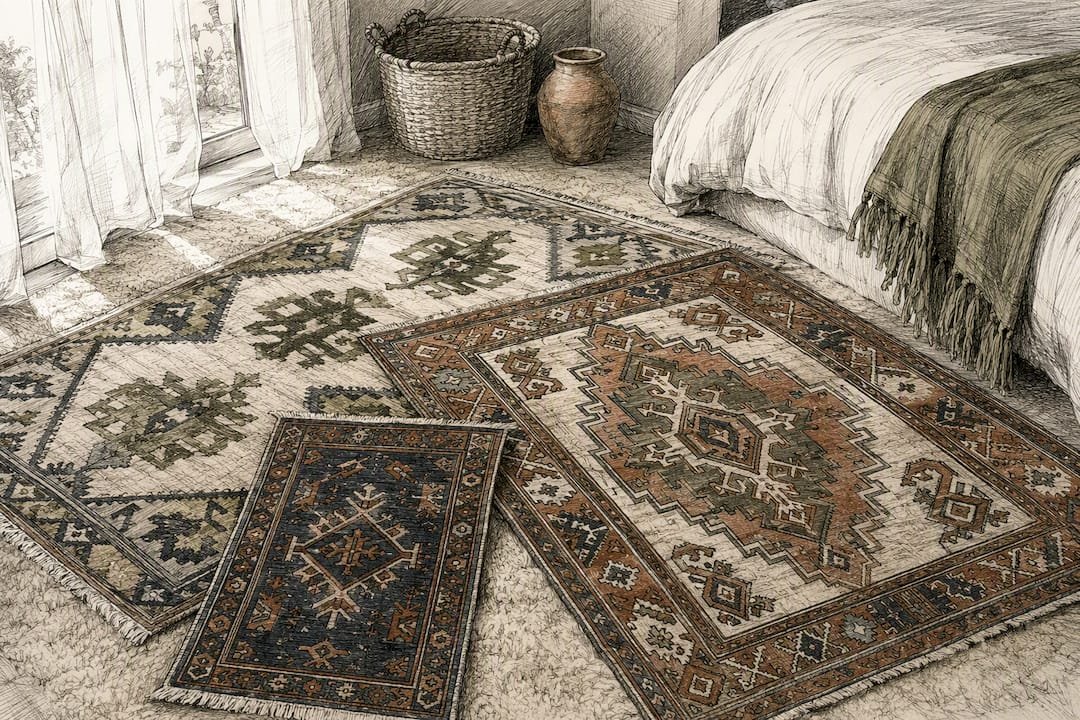
Within Persian weaving, Heriz rugs from northwest Iran use bold, angular medallions that look almost geometric compared to the curling arabesques of Kashan. Qom rugs, often silk, push knot density to extremes for museum-quality detail, while Baluch rugs from the eastern regions use darker, earthier palettes and tribal motifs closer in spirit to nomadic Turkish weaving than to formal city Persian work.
Within Turkish weaving, the range is just as wide. Hereke, near Istanbul, produces some of the finest silk rugs in either tradition, rivaling Persian city workshops on knot density despite using the Ghiordes structure. Konya and central Anatolian village rugs stay geometric and boldly colored, while western Anatolian Oushak rugs go the opposite direction with soft, faded palettes and oversized motifs.
The lesson: don’t assume every rug from one country looks the same, and don’t assume soft, curvilinear design automatically means Persian. Hereke silk and Oushak wool prove both traditions contain far more range than the broad country labels suggest.
Collecting vs. Buying to Live With
If you’re collecting, prioritize knot type, provenance, and condition over how the rug matches your sofa. If you’re buying to actually use the rug, prioritize durability and material fit for the room. Either way, run the checklist above before you hand over payment.
How Rugs Online Market Makes This Decision Easier
Comparing knot types and provenance on your own takes time most shoppers don’t have, especially when listings elsewhere skip the details that actually matter. Rugsonlinemarket built its catalog around the exact factors this guide covers: knotting method, fiber content, and region, listed plainly on every product page instead of buried in fine print.

Browse the Persian and Turkish antique collection if provenance and collector value matter most to you, or the handmade rugs category if you want confirmed hand-knotted construction without digging through vague listings. Every order over $300 ships free, and you have 30 days to return a rug that doesn’t match what you expected once it’s on your floor. Start by filtering the natural materials collection by wool or silk, cross-check the knot description against the checklist above, and add the piece to your cart with confidence.
Frequently Asked Questions
What is the main difference between Turkish and Persian rugs?
The core difference is the knot. Turkish rugs use the symmetrical Ghiordes knot for a denser, sturdier pile, while Persian rugs use the asymmetrical Senneh knot for finer pattern detail.
Which rug is better, Turkish or Persian?
Neither is universally better. Turkish rugs tend to hold up better in high-traffic areas, while Persian rugs offer finer detail that suits collectors and low-traffic display rooms.
How can I tell if a rug is hand-knotted?
Flip it over. Hand-knotted rugs show the pattern faintly on the back with slightly irregular knots, and the fringe is an extension of the warp threads rather than sewn on separately.
Do all Persian rugs use silk?
No. Most Persian rugs use wool, with silk reserved for finer city pieces, accent rugs, or wool-silk blends where silk highlights specific design elements.
What does abrash mean, and why does it matter?
Abrash is subtle color banding caused by natural dye lot variation between skeins. It’s a strong sign of hand-spun wool and natural dyes rather than a uniform synthetic batch.
Sources
- Ghiordes knot — Britannica
- Knotting techniques: Turkish (Ghiordes) vs Persian (Senneh) — Elevate Your Floor
- What is the difference between Persian and Turkish rugs? — 1stDibs Q&A
