

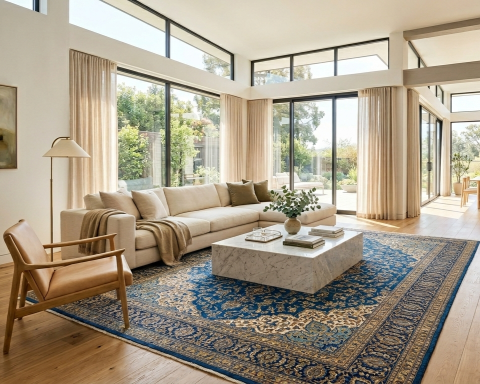
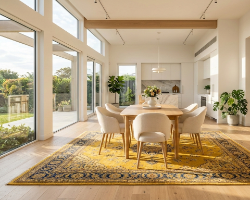
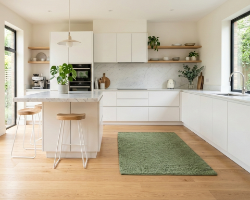
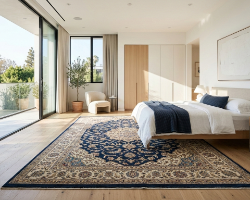
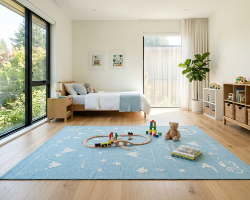
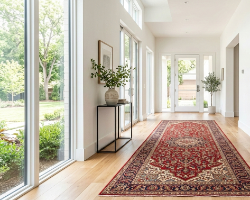
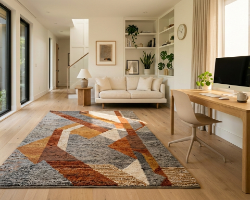
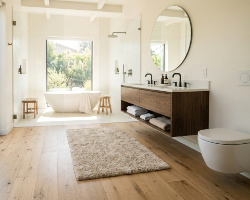






































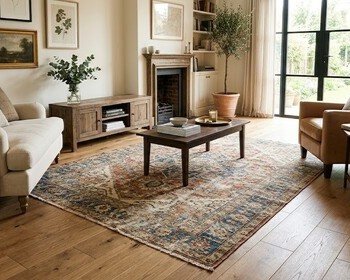
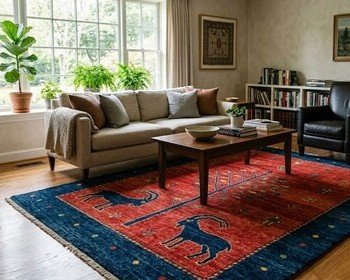
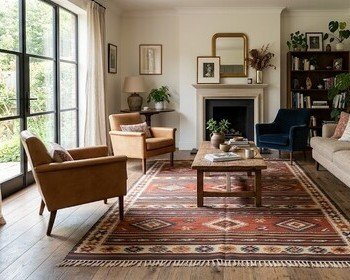
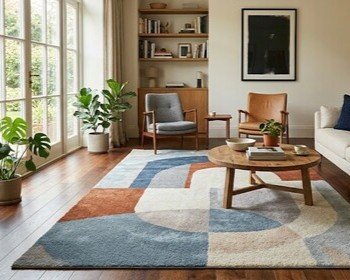
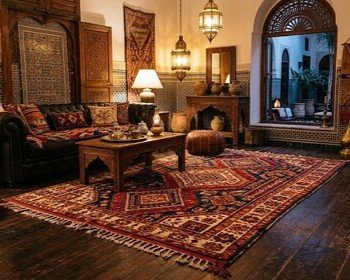
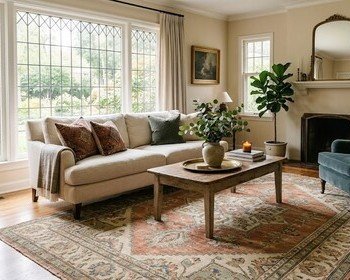
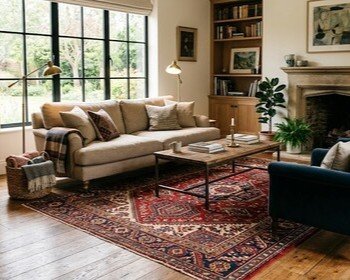
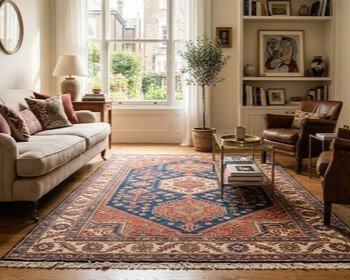

The best transitional rug is a softened traditional pattern in a quiet, low-contrast palette, made in a fiber that fits how hard your room is used. For most homes that means wool or a washable synthetic in ivory, gray, blue-gray or muted sage. It should be sized so at least the front legs of your seating sit on it. Below you will find what the style actually is, how popular machine-made options compare, where our own collection fits, and how to size, place and clean one.
Key Takeaways
- A transitional rug takes a classic motif (medallion, floral, lattice, vine) and simplifies, enlarges and mutes it so it works in both traditional and contemporary rooms.
- Wool is the durable, easy-to-clean natural choice. Washable polyester suits renters, kids and pets, and often costs far less.
- Low pile is easier to keep clean. Pet owners should avoid looped pile that claws can snag.
- Choose the rug size from your furniture layout first, then the color and pattern from your walls, sofa and floor.
- Our Oushak, Turkish, Gabbeh, distressed, washable and natural-fiber rugs are good places to start looking for this style.
Table of Contents
- What makes a rug transitional
- How to choose: the five criteria that matter
- Popular transitional-friendly rugs compared
- Where Rugs Online Market fits
- Wool, silk or synthetic: which fiber for which room
- Choosing by room
- A quick sizing guide
- Ready to shop?
- Styling a transitional rug so it looks intentional
- Caring for your rug
- FAQ
- Sources
What makes a rug transitional
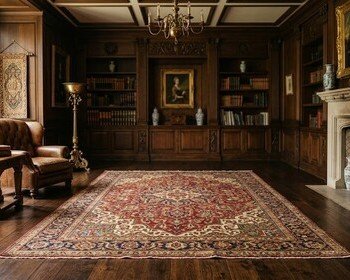
Transitional design sits between old and new. A transitional rug borrows traditional weaving motifs such as medallions, florals, lattices and botanical vines, then simplifies and recolors them to suit contemporary rooms. The usual signs are softened patterns, muted or tonal palettes, a larger design scale and borders that echo the field pattern rather than framing it sharply.

Color is the quickest tell. One US guide lists ivory, beige, light gray, taupe, blue-gray and muted sage as typical transitional shades, with sparse florals, thin borders and low-contrast medallions. Many designs also have a distressed or vintage-look finish, deliberately overdyed or faded so a brand-new rug looks as if decades of sunlight have mellowed it.
A simple check when you shop: squint at the product photo. If the pattern blurs into a gentle texture and you can still tell it descends from a classic design, it is transitional. If you see bold geometry or saturated color blocks, it is contemporary. If you see tight, dense, high-contrast ornament, it is traditional.
How to choose: the five criteria that matter
Price and photos get most of the attention, but these five decisions decide whether the rug still looks right in three years.
- Fiber. Wool is an all-around designer favorite: durable, cozy, with scaled fibers that hide dirt, and naturally fire-retardant. Lanolin in the fiber also acts as a natural stain repellent. Polyester and polypropylene cost less and often come in softer, more faded-looking colors.
- Construction. Hand-knotted rugs offer durability unmatched by most other floor coverings, and finer yarns with more knots per square inch give a more defined pattern. Power-loomed and machine-made rugs trade that longevity for price and uniformity.
- Pile height. Pile is as much about looks as function. A short, flat pile is easier to clean, even if it feels less plush underfoot.
- Palette. Pick the rug color from what is hardest to change: the floor, the sofa, the wall color. Neutral, tonal rugs forgive a later redecorating decision.
- Use. Entryway, dining room, bedroom and nursery each ask different things of a rug. More on that below.
Popular transitional-friendly rugs compared
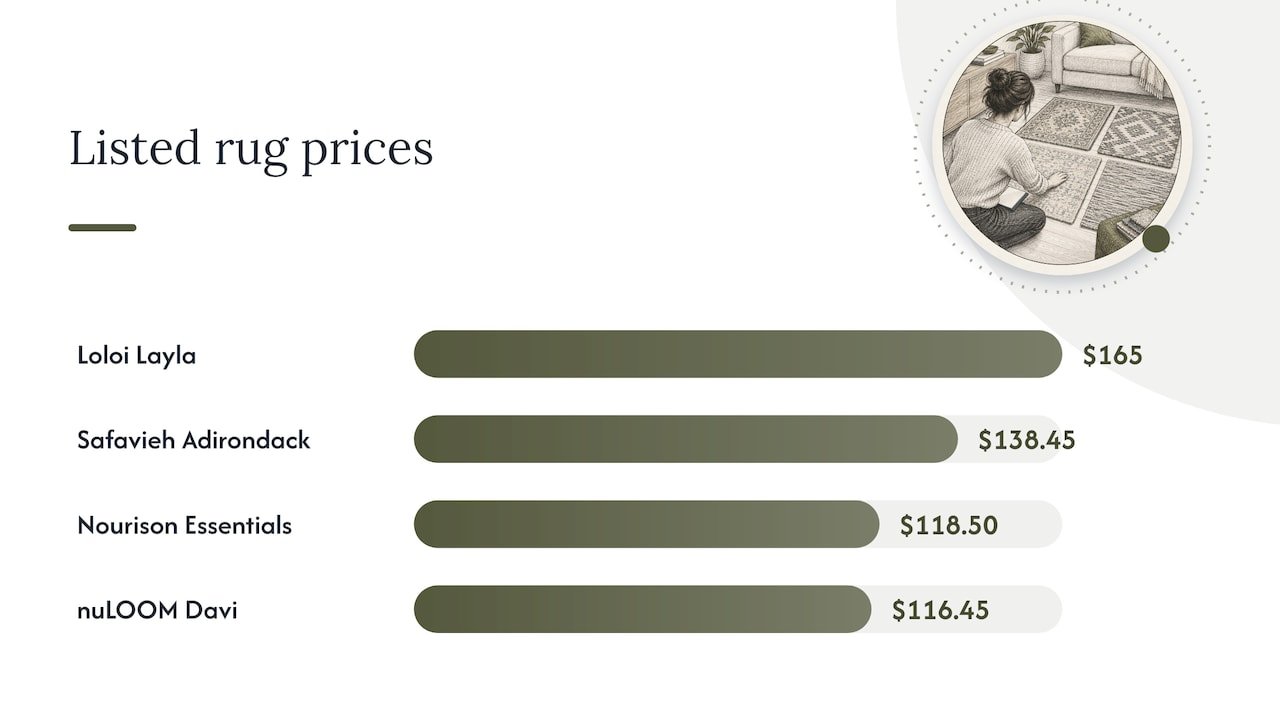
These four widely sold machine-made rugs show what the mid-priced end of the market looks like. All figures come from a November 2026 comparison of 8×10 living room rugs. Prices move constantly, so confirm the current price on each brand’s page before you order.
| Rug | Price listed | Size | Construction and fiber | Pile |
|---|---|---|---|---|
| Loloi Layla | $165 | 7’6" x 9’6" | Power-loomed, 100% polyester, canvas backing | 0.13 in |
| Safavieh Adirondack | $138.45 | 8’ x 10’ | Power-loomed polypropylene, jute and polyester | 0.35 in |
| Nourison Essentials | $118.50 | 8’ x 10’ | Power-loomed polypropylene | 0.25 in |
| nuLOOM Davi | $116.45 | 8’ x 10’ | Machine-made polyester, washable | Not listed |
How to read the table. The Loloi Layla has the flattest pile, which suits easy vacuuming and sliding chairs. The Safavieh has the deepest pile of the four and the most texture. The Nourison is a plain, budget-minded option. The nuLOOM is the one to look at if washability is your priority.
What the table does not show is how these rugs age. Synthetic power-loomed rugs are priced for a few years of use, not for decades. If you want a rug that can be cleaned, repaired and passed on, step up to wool and hand-knotted or handmade construction.
Where Rugs Online Market fits
We are an online rug shop, and the transitional look is built from styles we carry. Rather than one catch-all label, we organize by style, material and room, so you can approach the look from whichever angle you already know.
- Oushak, Turkish and Gabbeh rugs. These soft, often faded-looking classics are close relatives of the transitional palette. Start with our traditional rug collection and filter toward lighter, quieter colorways.
- Distressed and vintage-look rugs. The overdyed, worn-in finish described above is a signature of the style.
- Handmade rugs. If you want the wool and construction quality that lasts, browse handmade rugs.
- Natural-fiber rugs. For a relaxed, textural base that pairs with patterned pieces, see our natural rugs.
- Washable rugs. For households with kids and pets, our guide to washable rug alternatives walks through the options.
We also sell by shape and size, including runners and round rugs, which matter for halls, entries and dining nooks.
Wool, silk or synthetic: which fiber for which room
Wool is the safe default for living rooms and bedrooms. One National Post expert guide describes wool as hardwearing and easy to clean for busy areas. It also feels warm underfoot, which is why it is the usual choice for bedrooms where your bare feet land first.
Silk blends add sheen and a soft, luminous look. They suit low-traffic rooms such as a formal sitting room or bedroom, where the shimmer can be appreciated and the rug is not dragged across daily.
Cotton works in flat-woven and casual designs, especially in kitchens and kids’ rooms where a rug may need frequent laundering. See our kitchen rug collection for room-specific options.
Synthetics (polyester, polypropylene, nylon) are the budget and washability option. Nylon has good resiliency, cleanability and stain resistance, which makes it a practical pick for entries and family rooms.
Choosing by room
Living room
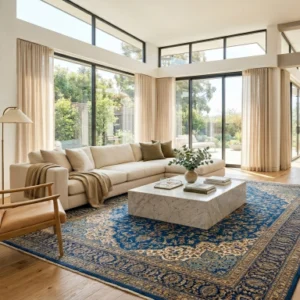
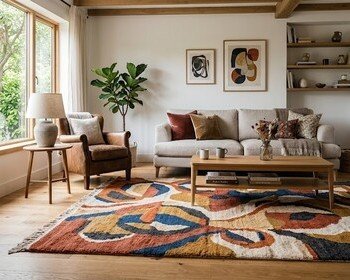
The living room is where a transitional rug earns its keep, because it has to bridge the sofa, side tables and often a mix of old and new furniture. Choose a design with enough pattern to hide crumbs and footprints, but a low-contrast palette so it does not compete with the sofa. Browse our living room rugs for sizes and colors.
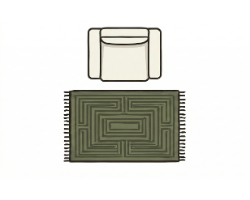
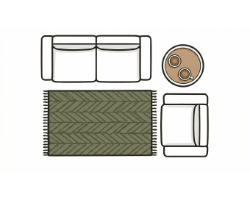
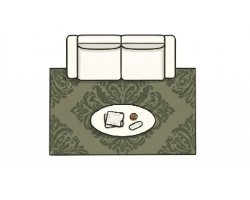
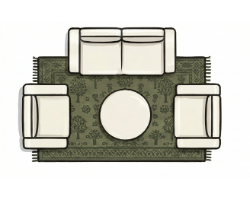
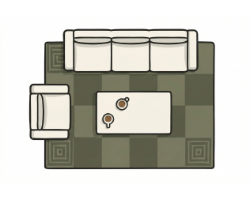
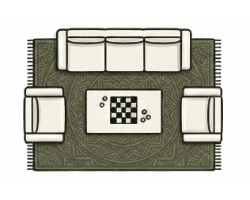
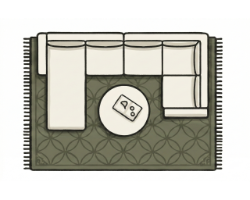
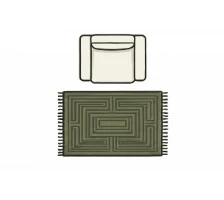
A widely used layout puts at least the front legs of the sofa and each chair on the rug, so the seating group reads as one unit. A rug that sits entirely in front of the sofa makes the room look smaller. For the paint and wall side of the decision, these accent wall ideas for 2026 show how neutral and muted palettes can work together.
Dining room
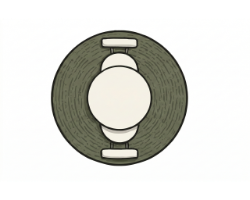
Choose a rug large enough that chairs stay on it when pulled back from the table. Flat or low pile is the practical option, since chair legs and dropped food are part of daily life. Pick a mid-tone, patterned design that hides spills. Our dining room rugs cover the common shapes.
Bedroom
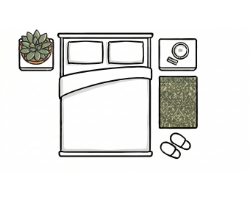
Here softness matters most. A wool or wool-blend rug with a slightly deeper pile feels good underfoot, and muted blue-gray or ivory keeps the room restful. Place it so it extends beyond both sides of the bed, or runs along each side.
Hallways and entries
A runner is the right shape, and a low pile helps doors clear it. Entryways take the most abuse, so durability and an easy-clean surface come first. Our shop includes runner rugs in a range of lengths, and our 3×5 rugs suit smaller landings and doorways.
Pets and children
For households with pets or children, washable, low-pile or stain-resistant rugs handle or hide messes and vacuum easily. A National Post expert also points out that pet owners should avoid looped piles, because claws can snag and pull them. Cut pile is the safer choice. We cover this in more depth in our guides to rugs for pets and cat-proof rugs.
A quick sizing guide
Start with the furniture, not the floor. Measure the seating group, then choose the largest standard size that leaves a visible border of bare floor around the rug.
- Small living room or apartment: a 5×8 or 6×9 can anchor a compact sofa and chair.
- Average living room: an 8×10 is the most common size, with the front legs of the furniture resting on it.
- Large or open-plan room: a 9×12 or larger allows all the furniture legs on the rug.
- Dining table: measure the table, then add room for the chairs to slide back.
- Hall: choose a runner that leaves a little bare floor at each end.
If you are unsure, lay painter’s tape on the floor in the rug’s footprint and live with it for a day. It costs nothing and shows quickly whether the proportions feel right.
Our perspective
We see the same pattern again and again: shoppers fall for a rug’s photo, then find out that the pile, fiber or color does not suit the room it is going into. That is why we group our collection by style, material, room and size, and why we publish care guides next to the products.
Our view is that a transitional rug should be chosen like a piece of furniture, not an accessory. Start from how the room is used, then pick a fiber and construction that match. Wool and handmade rugs are designed to give you years of use, and the washable and natural-fiber ranges give families and renters options at different budgets.
We also think the best transitional look has a little history in it. A softened Oushak, a faded Turkish design or a Gabbeh with calm color gives a modern room warmth that a flat, printed pattern rarely does.
ROM team
Ready to shop?
If you already know your room, size and palette, you can narrow the choice quickly. Browse the traditional rug collection, or go straight to the room you are furnishing. Orders over $300 ship free, and returns are accepted within 30 days. We also back our service with a 100% feedback guarantee.
If you are designing for a client or staging a home, our wide range of sizes, shapes and colors makes it easier to find several coordinating options in one place. Start on our main site.
Styling a transitional rug so it looks intentional
The style succeeds when the rug connects what is already in the room. Three habits help.
Echo one color. Pull a single shade from the rug into a pillow, a throw or a lampshade. You do not need a match, only a relationship.
Mix old and new. A softened traditional rug is a good partner for clean-lined furniture, and a modern rug can calm a room full of antiques. Calm, carefully chosen objects work well on top of this base. Pieces such as Southeast Asian sculpture add a quiet focal point without competing with the rug’s pattern.
Keep one pattern in charge. If the rug has a pattern, keep the curtains and upholstery to solids or small textures. Let the rug lead.
Caring for your rug
Good care keeps muted colors looking clean rather than dingy. A CNN Underscored cleaning guide recommends frequent vacuuming, immediate spot treatment and a deep clean every 12 to 18 months, or twice a year for homes with pets or children.
For spills, the same guide advises blotting liquids with a white cloth, gently scraping solids, following the care label and avoiding bleach and harsh chemicals. Rinse after spot treatment and let the rug air-dry before furniture goes back.
Our own guides go deeper:
- How to remove rug stains without making them worse
- Persian rug care at home
- Jute rug cleaning with low moisture
- Antique rug cleaning and preservation
For a wool rug, check the care label first, and when a stain is large or the rug is valuable, ask a professional rug cleaner.
FAQ
What is the difference between a transitional and a traditional rug?
A traditional rug keeps dense, detailed ornament and strong contrast. A transitional rug uses the same motifs but simplifies and enlarges them, with softer, tonal colors and thinner borders. The result fits both classic and modern rooms.
Are transitional rugs a good choice for homes with pets?
Yes, if you choose the right construction. Look for low pile, cut pile rather than loops, and a washable or stain-resistant fiber. Mid-tone patterns also hide hair and small marks better than solid pale colors.
What colors are most common in transitional rugs?
Ivory, beige, light gray, taupe, blue-gray and muted sage are the usual palette. Faded terracotta and soft blues also appear in distressed and vintage-look designs. They are easy to pair with most wall colors and wood floors.
Should I buy wool or synthetic?
Choose wool if you want a long-lasting, naturally stain-resistant rug for a living room or bedroom. Choose a washable synthetic if your priority is a lower price and easy laundering, such as for a kids’ room or a rental. Either can look transitional if the pattern and color are right.
Sources
- What Makes a Rug “Transitional” Style? (Rug Academy)
- Transitional Rugs: Classic Meets Contemporary (RugAZ)
- Best 8×10 Rugs for Living Rooms 2026
- The Expert-Approved Guide to Buying a Rug (House Beautiful)
- Rug Construction: From Hand-Made to Machine-Made (FiberSeal)
- Which rug is best for your room? (The Guardian)
- How to choose the right rug for every room (National Post)
- 13 Best Area Rugs for Stylish Living Rooms (Architectural Digest)
- How to clean your rugs at home (CNN Underscored)
- Living Room Accent Wall Ideas for 2026
- Bring Stillness Home with Southeast Asian Sculpture
