































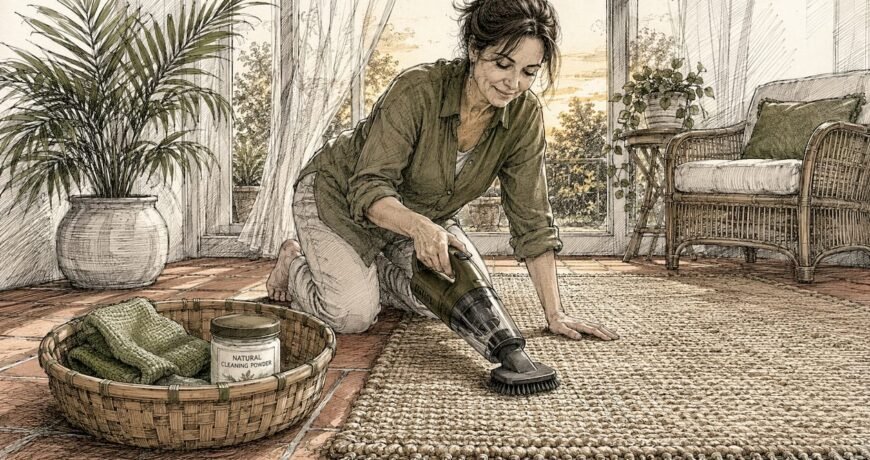
Clean a jute rug with a dry-first, low-moisture approach. That is the single most important rule, and everything else follows from it. The moment you introduce too much water, you risk brown water rings that textile experts describe as often permanent, even with professional chemical treatment. So the goal here is not “washing” your rug. It is managing dry soil, blotting wet spills fast, and drying aggressively after any damp work.
For a fresh spill, here is what to do right now:
- Scoop or scrape off any solid material with a dull knife or spatula.
- Blot the liquid immediately with a clean white towel, pressing down firmly. Do not rub.
- Lift the rug edge if you can, so air reaches the underside.
- Sprinkle baking soda or a dry-absorbent compound over the damp area.
- Point a fan directly at the spot and leave it running until the rug is completely dry.
That sequence handles most everyday spills without permanent damage. The rest of this guide covers every scenario in detail, from routine vacuuming to pet accidents to knowing when a professional is the only realistic option.
Table of Contents
- What tools and supplies do you need for safe jute care?
- How often should you vacuum and rotate a jute rug?
- How do you spot-clean a jute rug without causing damage?
- How do you handle pet urine on a jute rug?
- How do you remove odors from a jute rug without soaking it?
- What mistakes cause irreversible damage to jute rugs?
- When should you call a professional cleaner?
- Why does moisture cause browning in jute?
- How do you protect a jute rug long-term?
- Key Takeaways
- The part most guides skip: prevention beats rescue every time
- Rugsonlinemarket: natural rugs and care support in one place
- Useful sources for deeper reading
What tools and supplies do you need for safe jute care?
Getting the right kit together before a spill happens is half the battle. The wrong tools, used in a panic, cause more damage than the original stain.
Safe cleaning tools
- High-suction vacuum with a brush attachment or bare-floor setting. Avoid the beater bar on a jute rug; the rotating brush frays the open weave over time.
- Soft natural-bristle brush for working dry compounds gently into fibers.
- Microfiber towels (white or unbleached) for blotting. Colored towels can transfer dye.
- Dull knife or spatula for lifting solids before they press deeper into the weave.
- Small spray bottle for applying diluted solutions in a controlled mist, never a pour.
- Portable fan or air mover for forced-air drying after any damp treatment.
Dry-cleaning supplies
- Baking soda: the go-to dry deodorizer. Baking soda absorbs oils and odors when left to dwell and then vacuumed out thoroughly.
- Absorbent dry-clean compound: a powder-based product designed for natural fibers. Brush it in, let it dwell, vacuum out. Adds virtually no free water.
- 50/50 white vinegar and water solution: a mildly acidic spotter for light stains. Apply to a cloth only, never spray directly onto the rug.
- pH-neutral mild dish soap diluted in water: a secondary option for grease-based stains.
What to keep away from your rug entirely
- Steam cleaners and carpet shampooers
- Hot-water extraction machines
- Bleach or any strong alkaline cleaner
- Spray bottles used to saturate rather than mist
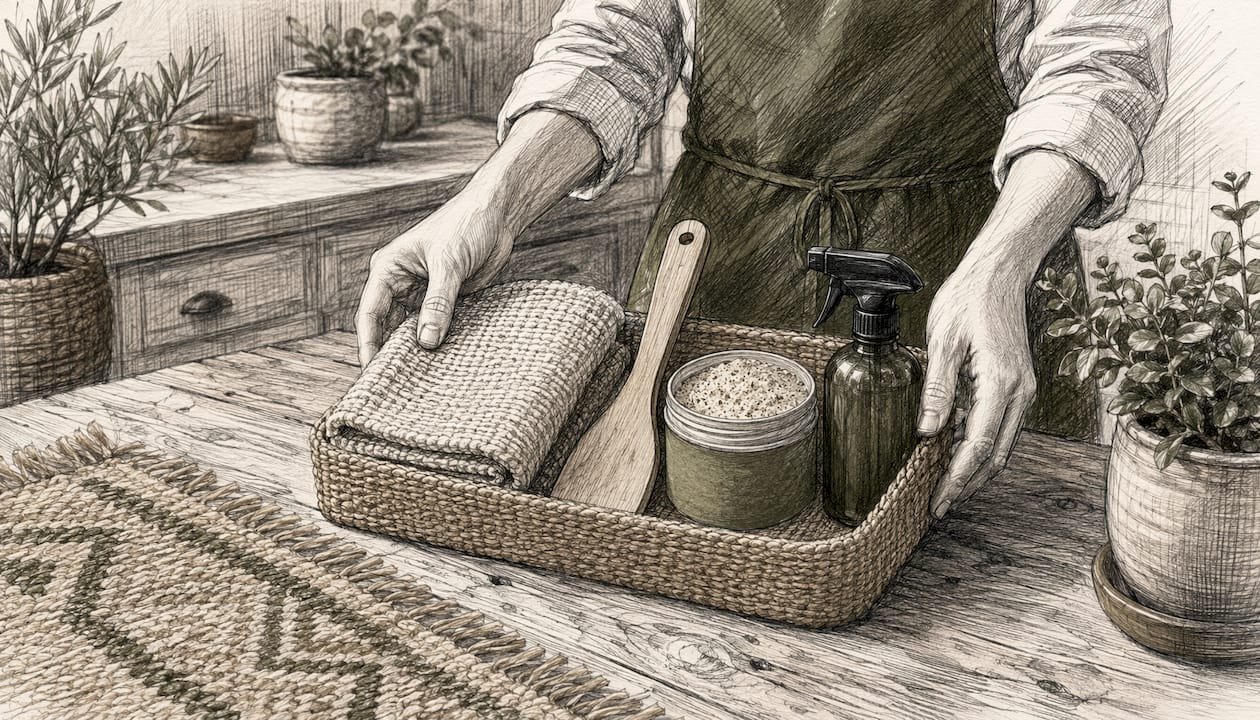
Pro Tip: Keep a small “jute kit” in a zip bag near wherever the rug lives: a microfiber towel, a small container of baking soda, a spatula, and a spray bottle with your vinegar solution. Response time is everything with natural fibers.
How often should you vacuum and rotate a jute rug?
Routine care is where most of the long-term protection happens. Natural-fiber rugs hold a surprising amount of fine sand and grit, and that embedded abrasive cuts the fibers from the inside out with every footstep.
Weekly tasks
- Vacuum the top surface using suction only or a brush attachment on a low setting.
- For smaller rugs, take them outside and give them a light shake or gentle beating.
- Spot-check high-traffic paths for any new stains or damp areas.
Monthly tasks
- Flip the rug and vacuum the underside to remove trapped grit.
- Inspect the rug pad: look for crumbling, moisture trapping, or compression.
- Lift a corner and check for dark spots or any musty smell that signals trapped moisture.
Seasonal tasks (every 3–6 months)
- Rotate the rug 180° to even out wear from foot traffic and sun exposure.
- Apply a dry-compound refresh if the rug smells stale or looks dull.
- Check for worn edges or shedding that may need attention. For more on managing fiber loss, the Rugsonlinemarket guide on jute rug shedding covers the specifics.
- Replace the rug pad if it has compressed or started to deteriorate.
Placement rules that prevent most problems
- Jute performs best in dry, low-traffic areas away from kitchens, bathrooms, and exterior doors.
- Never place jute in a humid basement or directly under a potted plant.
- Use a breathable, non-slip pad that allows airflow underneath. Dense rubber pads trap moisture and accelerate mildew.
- Avoid prolonged direct sunlight on one side, which fades color unevenly.
How do you spot-clean a jute rug without causing damage?
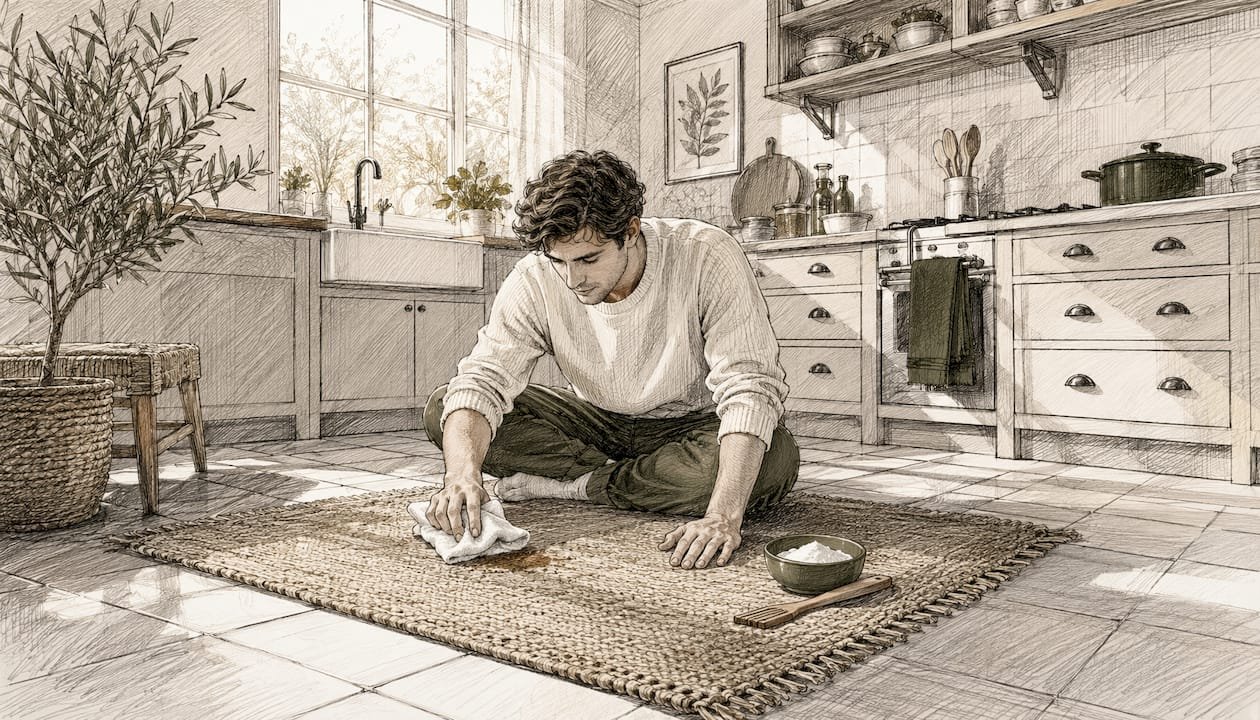
Spot treatment on jute is surgical work. The goal is to remove the stain with the least possible moisture, then dry the area completely before any wick-back can occur.
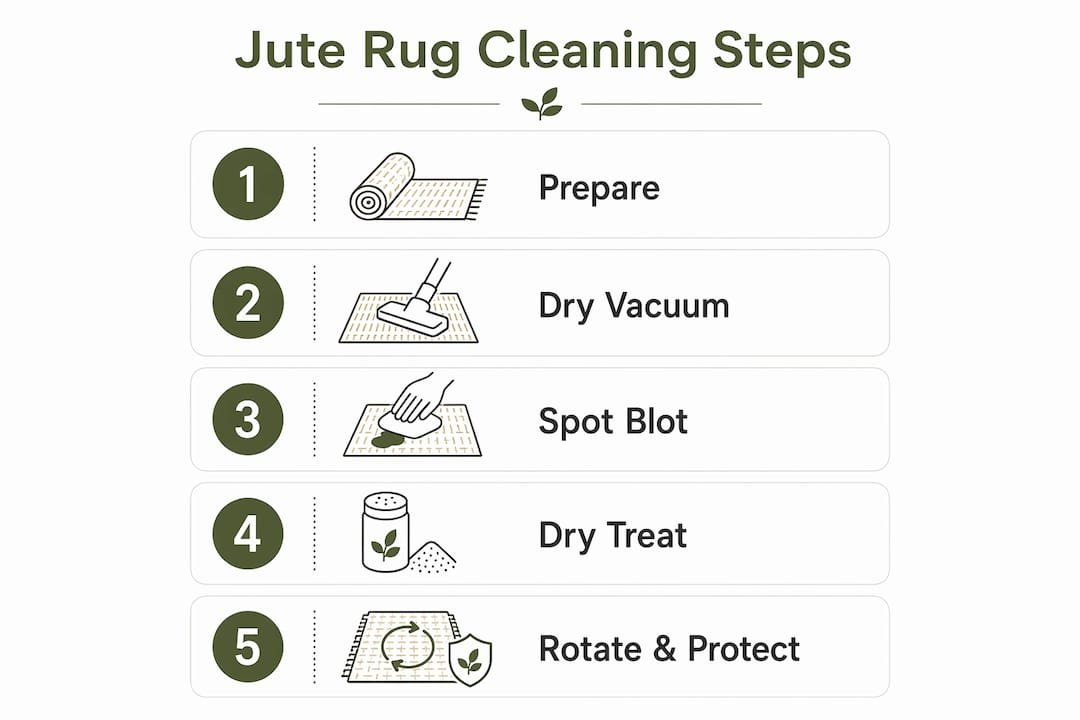
Step-by-step spot treatment
- Remove solids first. Use a dull spatula to lift any solid material. Work from the outside edge toward the center to avoid spreading.
- Blot liquids immediately. Press a clean white microfiber towel firmly onto the wet area. Do not rub. Swap to a dry section of the towel as it absorbs moisture.
- Lift the rug if possible. Propping the affected area off the floor lets both sides dry faster and prevents moisture from wicking through the backing.
- Apply dry absorbent. Sprinkle baking soda or a dry-clean compound over the damp spot. Let it sit for at least 15 minutes, then vacuum.
- If a stain remains, apply a minimal damp treatment. Dampen (do not soak) a clean cloth with your 50/50 vinegar solution or diluted mild detergent. Blot the stain gently from the outside in. Never pour solution directly onto the rug.
- Dry aggressively. Point a fan at the area immediately. The faster the rug dries, the lower the risk of browning. For more on safe stain removal techniques, Rugsonlinemarket’s stain guide covers delicate fibers in detail.
Stain reference: what to try and when to stop
| Stain type | First approach | When to escalate |
|---|---|---|
| Coffee / tea | Blot immediately, then diluted vinegar on a cloth | Brown ring forms or stain sets after drying |
| Red wine | Blot fast, apply dry absorbent, then minimal damp blot | Color remains after two attempts |
| Grease / oil | Dry absorbent first (baking soda), then diluted dish soap on cloth | Oily residue persists or spreads |
| Ink | Blot only, do not rub; minimal damp blot with rubbing alcohol on cloth edge | Ink spreads or fiber discolors |
Dos and don’ts
- Do test any solution on an inconspicuous corner first.
- Do blot from the outside of the stain toward the center.
- Do use a fan immediately after any damp work.
- Don’t scrub, rub, or use a stiff brush on wet fibers.
- Don’t pour any liquid directly onto the rug surface.
- Don’t let the rug sit damp. A wet ring that dries slowly is often permanent.
How do you handle pet urine on a jute rug?
Pet accidents are the hardest scenario for jute. Urine soaks through quickly, and the combination of moisture, ammonia, and organic compounds creates both a browning risk and a persistent odor that is genuinely difficult to eliminate at home.
Step-by-step pet urine protocol
- Act within minutes. The longer urine sits, the deeper it penetrates the backing.
- Remove solids (for feces or vomit) with a spatula before touching the liquid.
- Blot aggressively. Stack several dry towels on the spot and press down with your body weight. Replace towels as they saturate. Keep blotting until no more moisture transfers.
- Apply an enzymatic cleaner sparingly. If the product label confirms it is safe for natural fibers, apply a small amount to a cloth and blot the area. Do not pour it on the rug. Enzymatic cleaners break down the organic compounds causing the odor.
- Dry immediately and completely. Point a fan directly at the spot. If you have a dehumidifier nearby, run it in the room. Lift the rug edge so air circulates underneath.
- Assess honestly. If the urine soaked through to the backing or the odor persists after drying, professional help or replacement is the realistic next step.
Realistic expectation: Fast blotting and immediate drying can limit the damage from a pet accident, but professionals note that persistent odor or deep saturation often cannot be fully removed at home. Repeated wetting in the same spot accelerates fiber breakdown and risks permanent browning. Document the rug’s condition with photos before attempting heavy treatment.
How do you remove odors from a jute rug without soaking it?
Most everyday odors in a jute rug come from trapped oils, dust, and minor moisture events. The fix is dry, not wet.
Dry deodorizing steps
- Vacuum the rug thoroughly on both sides to remove loose soil first.
- Sprinkle a generous, even layer of baking soda across the entire surface.
- Let it dwell for 30–60 minutes for light odors, or overnight for anything stronger.
- Vacuum the baking soda out completely, going over the surface twice.
- If the odor persists, repeat the process or consider a dry-clean compound designed for natural fibers.
What to use and what to skip
- Use: baking soda, dry rug powders formulated for natural fibers, good airflow and sunlight (brief, indirect exposure).
- Avoid: heavy spray deodorizers that introduce moisture. They often mask mildew rather than eliminate it, and the added moisture creates the exact conditions that cause browning.
- Avoid: scented fabric sprays. The perfume fades; the moisture stays.
For persistent odors that survive two dry-treatment cycles, a controlled professional deodorizing service is the better call. A pro can apply targeted chemistry in very small, controlled amounts and force-dry the rug immediately.
What mistakes cause irreversible damage to jute rugs?
Some cleaning choices do not just fail to help. They permanently ruin the rug. Here is what to avoid without exception.
- Hot-water extraction (steam cleaning): floods jute with moisture it cannot tolerate. The result is shrinkage, browning, and foundation distortion. This is the fastest way to destroy a jute rug.
- Machine washing: the agitation and soaking cause shrinkage, warping, and fiber breakdown. No jute rug should go in a washing machine.
- Pouring cleaning solutions directly on the rug: even a mild detergent applied this way saturates the backing and triggers wick-back.
- Heavy scrubbing with stiff brushes: breaks down the open weave structure and causes pilling and fiber loss.
- Bleach or strong alkaline cleaners: cause cellulosic browning and weaken the fiber permanently.
- Letting the rug sit damp: slow drying is the direct cause of wick-back. Any moisture event requires immediate forced-air drying.
Stop immediately if a wet brown ring forms. Once a wick-back ring appears, home treatment is unlikely to reverse it. Textile experts confirm that brown rings on natural-fiber rugs are often permanent, even with professional chemical neutralization. At that point, photograph the rug and contact a professional who specializes in natural fibers before attempting anything else.
When should you call a professional cleaner?
Home care handles most routine maintenance and fresh spills. But some situations genuinely require professional equipment and expertise.
Signs it is time to call a pro
- A large or set-in stain that did not respond to two rounds of home treatment.
- Visible discoloration or brown wick-back rings that appeared after a spill or cleaning attempt.
- Any sign of mold, mildew, or a persistent musty smell that dry treatment did not resolve.
- Structural damage: warping, shrinkage, or backing separation.
- Pet urine that soaked through to the floor beneath the rug.
Questions to ask before hiring a cleaner
- Do you use a dry-compound or low-moisture process specifically for natural fibers?
- Can you provide a condition report and photo documentation before and after?
- Do you accept liability for browning that results from your process?
- Will you refuse steam or hot-water extraction for this rug?
A reputable professional will answer yes to the first and last questions without hesitation. Professional cleaners who specialize in natural fibers use controlled, very low-moisture dry-compound extraction, targeted acid-side spotters when appropriate, and rapid forced-air drying. They will often decline to take on a jute rug if the only method available to them is steam or shampoo. That refusal is a good sign, not a red flag. You can also review carpet cleaning methods to understand what low-moisture professional processes actually involve before you make a call.
For a small area rug, professional cleaning typically takes one to three days including drying time. Larger rugs or those requiring plant-floor controlled treatment may take longer. Costs vary by region and rug size; always get a written estimate that specifies the method before authorizing work.
Why does moisture cause browning in jute?
Jute is a cellulose-based fiber. That matters because cellulose fibers contain natural sugars and lignins, and those compounds behave in a specific, damaging way when the fiber gets wet and dries slowly.
The mechanism: When jute absorbs water, the natural sugars and lignins dissolve and begin migrating through the fiber toward the surface. As the rug dries, these compounds redeposit at the surface, creating the characteristic brown discoloration known as wick-back. The slower the drying, the further the migration, and the darker and more permanent the mark.
This is why the cleaning goal for jute is preventing migration, not achieving wet removal. Here is how that principle translates into method:
- Dry-compound cleaning works by binding oils and particulates to an absorbent powder. The powder is brushed in gently, allowed to dwell, and then vacuumed out. It adds almost no free water, so the sugars and lignins never dissolve and never migrate.
- Forced-air drying after any damp work cuts the drying window dramatically. The faster the fiber returns to its dry state, the less time the compounds have to travel.
- Acid-side spotters, used by professionals in very small controlled doses, can sometimes neutralize alkaline-induced browning. These require precise application and immediate drying. They are not a homeowner tool.
The practical takeaway: treat every drop of water on a jute rug as a timer. The clock starts the moment the fiber gets wet.
How do you protect a jute rug long-term?
Prevention is genuinely more effective than any cleaning method. Most jute rug damage is avoidable with the right placement and a few simple habits.
- Choose the right room. Jute belongs in dry, low-traffic spaces: a living room, a bedroom, a study. Keep it away from kitchen sinks, bathroom doors, exterior entryways, and anywhere a potted plant might drip.
- Use a breathable rug pad. A good pad reduces abrasion, prevents slipping, and allows airflow underneath. Dense rubber pads trap moisture and create the exact conditions that cause mildew and browning. Replace the pad when it starts to compress or crumble.
- Rotate every 3–6 months. Even wear and even sun exposure extend the rug’s life and keep it looking consistent.
- Run a dehumidifier in humid climates. If your home regularly exceeds 60% relative humidity, jute is working against the environment every day. A dehumidifier in the room makes a measurable difference.
- Dry any damp event immediately. If the rug gets wet from a spill, a leak, or even a damp mop nearby, point a fan at it right away. Do not wait to see if it dries on its own.
Pro Tip: Keep a compact spotting kit in the room where the rug lives. A spatula, two microfiber towels, a small container of baking soda, and a spray bottle with diluted vinegar solution. The first two minutes after a spill determine whether you have a minor inconvenience or a permanent stain.
Key Takeaways
Jute rug cleaning requires a dry-first, low-moisture approach at every stage: dry soil management, fast blotting, dry-compound refreshes, and forced-air drying after any damp work.
| Point | Details |
|---|---|
| Dry-first is non-negotiable | Moisture triggers wick-back browning that is often permanent, even with professional treatment. |
| Vacuum regularly, both sides | Embedded grit abrades jute’s open weave; regular vacuuming on both sides prevents fiber damage. |
| Blot and dry fast | After any spill, blot immediately, apply dry absorbent, and point a fan at the spot until fully dry. |
| Know when to stop DIY | Large stains, wick-back rings, mold, or pet urine that soaked through require a low-moisture professional. |
| Rugsonlinemarket for natural rugs | Rugsonlinemarket carries a curated range of natural-fiber rugs and provides care guidance for homeowners choosing quality materials. |
The part most guides skip: prevention beats rescue every time
Most jute cleaning advice focuses on what to do after something goes wrong. That framing misses the bigger point. Jute is not a forgiving fiber. It does not bounce back from a bad cleaning attempt the way a synthetic rug does. Once a brown ring sets, or once the backing distorts from too much moisture, you are managing the damage, not reversing it.
The homeowners who keep their jute rugs looking good for years are not the ones with the best stain-removal kit. They are the ones who placed the rug in a dry room, put a breathable pad underneath, vacuumed it weekly, and blotted spills within the first sixty seconds. That is the whole strategy.
Where professional cleaning genuinely earns its cost is not in routine maintenance. It is in the situations where home treatment has already failed or where the risk of making things worse is too high: large set-in stains, wick-back discoloration, mold, or pet urine that went deep. A good natural-fiber cleaner using low-moisture professional services will assess the rug honestly, document its condition, and tell you upfront if the damage is beyond what cleaning can fix. That honesty is worth paying for.
If you are weighing whether a jute rug is right for a particular space in your home, the answer often comes down to how much foot traffic and moisture risk that space carries. A jute rug in a dry bedroom or study can last a decade with basic care. The same rug in a kitchen or near a front door will struggle from day one.
Rugsonlinemarket: natural rugs and care support in one place
If you love the look of natural fiber but want more flexibility in high-traffic or spill-prone rooms, Rugsonlinemarket offers a curated selection of natural-fiber rugs alongside washable alternatives that handle moisture far more forgivingly. Every order over $300 ships free, returns are hassle-free within 30 days, and the customer service team can help you match the right material to the right room before you buy.

For rooms where jute is a real risk, the washable rug alternatives guide on the site walks through the best options by room type. If you already own a jute rug and want to explore complementary pieces or replacements, browse the full natural rug collection at Rugsonlinemarket and filter by size, style, and material to find what fits your space.
Useful sources for deeper reading
| Source | What it covers |
|---|---|
| Jute Rug Cleaning: A Pro Operator Guide | Professional dry-compound methods, cellulosic browning chemistry, and hard prohibitions on steam/hot-water extraction |
| How to Clean a Jute Rug, According to Experts | Expert-backed homeowner steps, baking soda deodorizing, and warnings about permanent wick-back rings |
| How to Clean Jute Rugs, Sisal Rugs Direct | Pet accident protocols and realistic expectations for biological stains on natural fibers |
| How to Clean a Sisal, Jute or Seagrass Rug | Placement guidance, rotation schedules, and breathable pad recommendations |
| How to Clean a Jute Rug, Home Depot | Step-by-step homeowner instructions with product suggestions available in the US |
| Rugsonlinemarket Natural Rugs | Category page for natural-fiber rugs including jute; useful for replacement or complementary purchases |
| Rugsonlinemarket Stain Removal Guide | Safe spot-cleaning techniques for delicate and natural-fiber rugs |
