

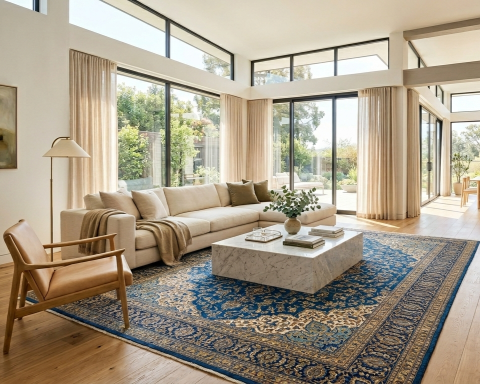
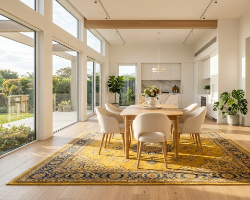
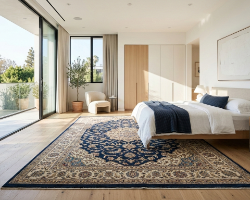
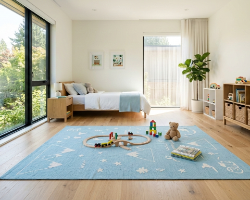
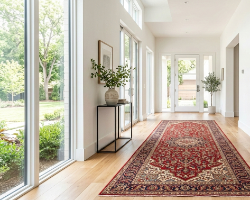
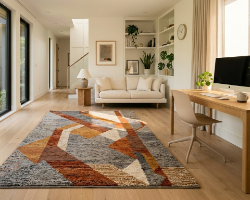
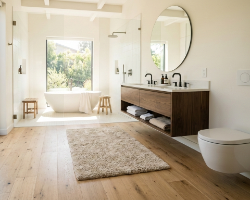

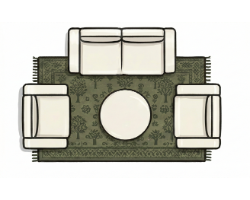
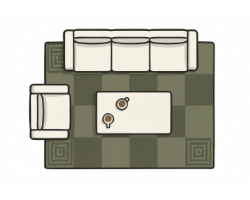
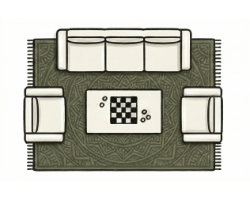
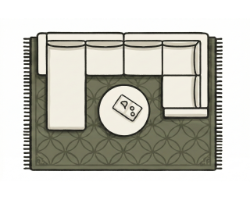
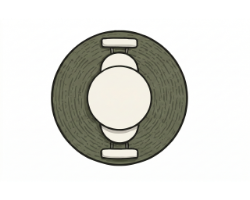
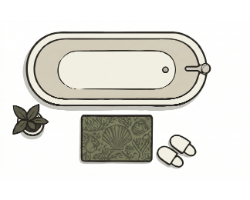
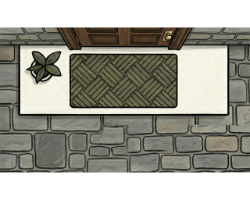
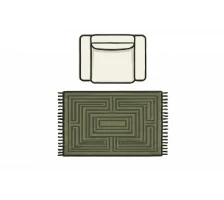

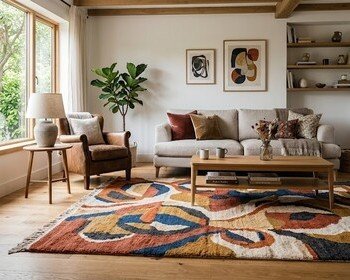
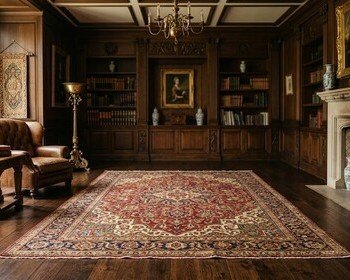
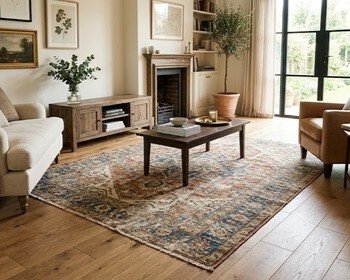
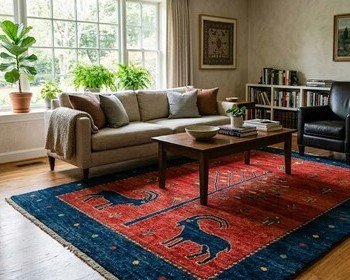
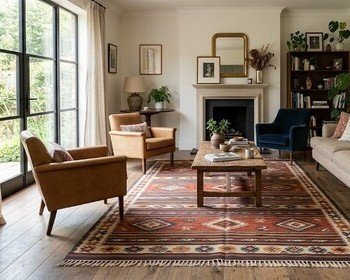
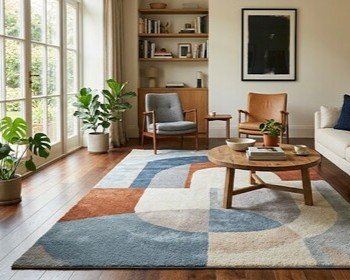
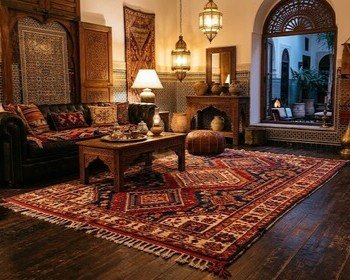
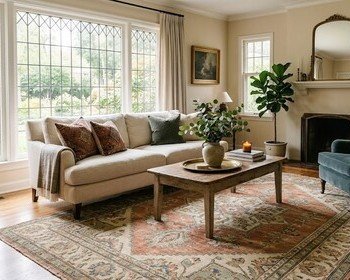
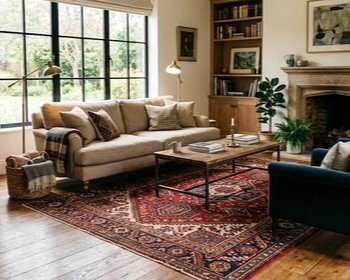
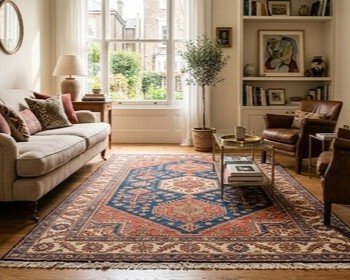

The ten Moroccan rug families you will encounter most often are Beni Ourain, Azilal, Boucherouite, Kilim/Hanbel, Boujad, Beni M’rirt, Taznakht, Zanafi, Marmoucha, and Rabat/R’Bati, each distinct by region, weave structure, and material. Beni Ourain stands apart through thick undyed ivory pile; Azilal through bold abstract color on a light ground; Boucherouite through recycled fabric strips rather than spun wool; and Kilim/Hanbel through flat reversible construction with no pile at all. Taznakht is dense-knotted with warm saffron tones; Boujad is loose-pile with saturated pinks and reds; Zanafi mixes flatweave and pile bands; Marmoucha uses heavy natural wool with angular tribal geometry; and Rabat/R’Bati is a formal urban pile rug with Persian-influenced medallion layouts.
When you pick up a listing or walk into a dealer’s showroom, the fastest three-point check is: material (undyed wool, recycled fabric, or cactus silk?), weave (pile or flatweave?), and regional cues (mountain, plains, or coastal city?). Those three questions narrow the field before you read a single word of the description.
- Beni Ourain: thick ivory pile, undyed wool, minimalist geometric lines, Middle Atlas origin
- Azilal: light natural ground, bold abstract or neon motifs, High Atlas, family symbolism
- Boucherouite: recycled textile strips, unpredictable color, no spun-wool pile, near Marrakesh/Beni Mellal
- Kilim/Hanbel: flatweave, reversible, lightweight, nomadic tradition, no pile
- Boujad: loose shag pile, saturated pinks, reds, and oranges, Khouribga plateau
- Beni M’rirt: dense high pile, natural undyed or earth-toned wool, Middle Atlas
- Taznakht: dense hand-knotted pile, warm yellows and saffron, Siroua region
- Zanafi: alternating flatweave and pile bands, mixed texture, High Atlas
- Marmoucha: heavy natural wool, angular tribal geometry, northeastern Middle Atlas
- Rabat/R’Bati: formal urban pile, medallion layouts, Persian-influenced, Atlantic coast workshops
Key Takeaways
Moroccan rug styles are defined by tribe, region, weave type, and material, and knowing those four factors is the only reliable way to authenticate a piece, price it correctly, and care for it properly.
| Point | Details |
|---|---|
| Four-axis classification | Every Moroccan rug is best understood by tribe/region, weave type, material, and dye method, not by the catch-all “Berber” label. |
| Back-of-rug authentication | Request close-up photos of the knotted back, fringe, and selvedge before any online purchase; these reveal hand-knotting, repairs, and construction type. |
| Natural dye abrash is a feature | Slight color variation (abrash) across the pile signals authentic hand-dyed natural wool; perfectly uniform color usually means synthetic dyes. |
| Care by fiber type | Vacuum pile rugs with the pile direction on low suction; never steam-clean natural wool; roll (never fold) for storage with cedar or lavender for moth prevention. |
| Rugsonlinemarket | Offers curated natural-fiber Moroccan rugs with free shipping over $300, 30-day returns, and a 100% feedback guarantee across the United States. |
Table of Contents
- How are Moroccan rugs named and classified?
- A catalog of major Moroccan rug styles
- What materials and techniques define these rugs?
- How to buy Moroccan rugs in the United States
- How to care for your Moroccan rug
- Why does Morocco produce so many distinct rug styles?
- An editorial perspective on buying Moroccan rugs
- Rugsonlinemarket’s curated Moroccan rug collection
- Sources
How are Moroccan rugs named and classified?
The terminology around Moroccan rug styles trips up even experienced buyers. A seller listing a rug as “Berber” has told you almost nothing useful. “Berber” is a broad cultural label applied to the Amazigh peoples of North Africa, not a weave type or a regional style. Dozens of Amazigh tribal groups produce entirely different rugs, and collapsing them under one commercial shorthand obscures origin, technique, and value. As MarocMama documents, buyers who ask for the specific tribe or region and the weaving technique get far more useful information than those who accept “Berber” at face value.
Classification actually works on four overlapping axes:
- Tribe or confederation: Beni Ourain, Beni M’rirt, Marmoucha, and Azilal all refer to specific Amazigh tribal groups or confederations, not generic styles.
- City or market name: Rabat, Ourika, and Taznakht are place names where rugs are sold or produced in organized workshops, which can mean more consistent quality control but also more commercial production.
- Weave technique: Hand-knotted pile (most Beni Ourain, Rabat, Taznakht) vs. flatweave/kilim/hanbel (no pile, reversible) vs. mixed-technique (Zanafi) vs. rag construction (Boucherouite).
- Material: Undyed sheep wool, hand-dyed wool, recycled textiles, or cactus silk (sabra) each signal a different tradition and care requirement.
“Moroccan” is simply the country of origin. “Amazigh” is the ethnically correct term for the people historically called Berber. “Berber” persists as commercial shorthand, especially in Western markets, but it carries no technical meaning about weave, material, or region.
Quick classification checklist for decoding a listing:
- Does the listing name a tribe or region, or just say “Berber/Moroccan”?
- Is the weave described as hand-knotted pile, flatweave, or rag-woven?
- What material is stated: wool, cactus silk, recycled fabric, or synthetic blend?
- Are photos of the rug’s back included? (The back reveals knot type and density.)
- Does the seller provide provenance documentation or a condition report?
Pro Tip: When a listing says only “Berber rug,” treat it as a starting point, not a description. Reply with two questions: “Which tribe or region?” and “Can you send a photo of the back?” Those two answers tell you more than the entire listing.
A catalog of major Moroccan rug styles
Beni Ourain
Beni Ourain rugs come from a confederation of Amazigh tribes in the northern Middle Atlas mountains. The defining feature is thick, undyed ivory or cream pile made from the natural wool of local sheep, with minimalist geometric lines in dark brown or black. That combination of heavy pile and neutral palette was originally functional: the rugs insulated against cold mountain winters. Today they read as effortlessly modern, which is why they became a fixture in mid-century and Scandinavian-influenced interiors. Authentic pieces have an irregular, slightly uneven pile because they are hand-knotted on a vertical loom, and the back shows visible asymmetric knots. Vintage examples (pre-1980s) tend to have softer, slightly felted wool; contemporary pieces are often thicker and fluffier. Common sizes run from small accent rugs (roughly 3×5 ft) to large living room formats (8×10 ft and above).
Authenticity cues: Look for natural ivory (not bleached white), slight pile height variation, and a knotted back. Synthetic reproductions often have uniform pile and a latex backing.
Azilal
From the High Atlas northeast of Marrakesh, Azilal rugs pair a light natural wool ground with abstract motifs that can range from muted earth tones to surprisingly vivid pinks, oranges, and greens. The patterns historically recorded family symbols and personal narratives, so no two are identical. The pile is medium-height and hand-knotted, though some Azilal pieces incorporate flatweave sections. The color combinations can look almost playful compared to Beni Ourain’s restraint, which makes them popular in eclectic and bohemian interiors. Sizes are typically small to medium (3×5 ft to 6×9 ft).
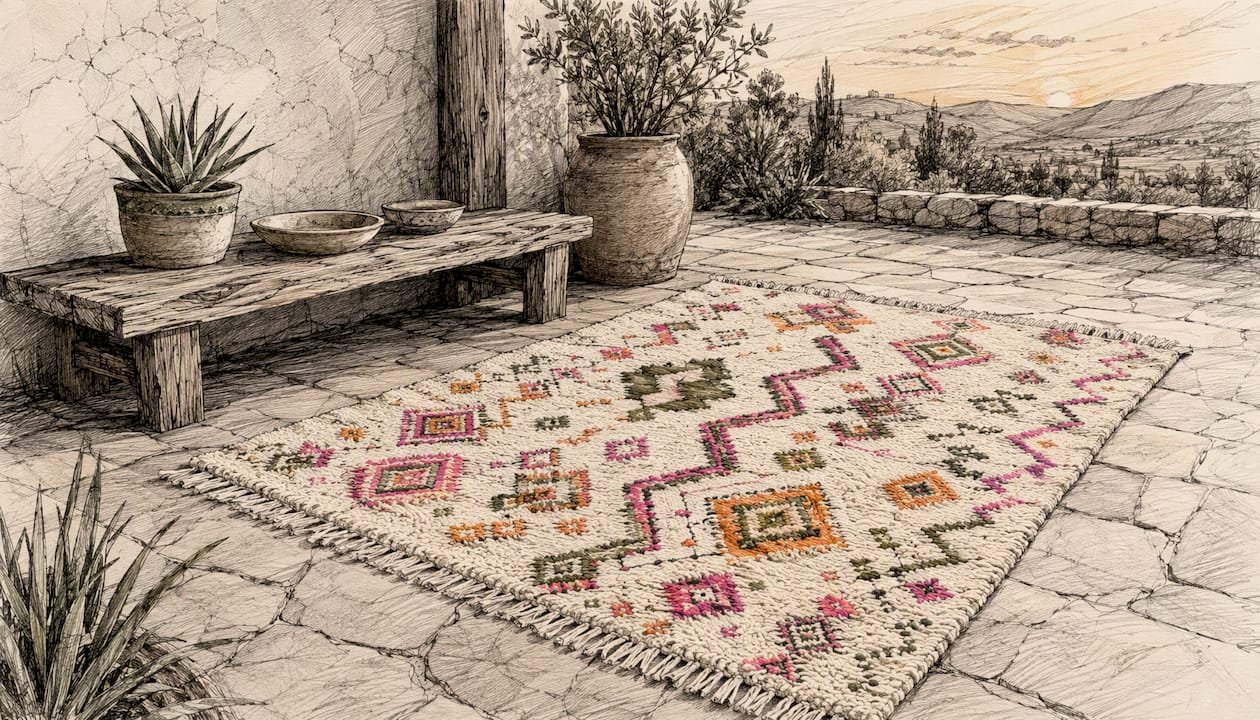
Authenticity cues: Irregular, asymmetric motifs are a good sign. Perfectly symmetrical repeating patterns suggest commercial production. Check that the ground wool is natural (off-white or cream), not chemically whitened.
Boucherouite (Bouchaouite)
Boucherouite rugs are rag rugs, woven from strips of recycled clothing, cotton, nylon, and other fabric scraps rather than spun wool. They are produced near Marrakesh, Beni Mellal, and Azilal, and their color combinations are entirely unpredictable because the palette depends on whatever fabric was available. The result is often vivid, chaotic, and visually striking. Construction is typically flatweave or low-pile, and the texture is softer and lighter than a wool pile rug. Because they use recycled materials, they are not investment-grade collectibles in the traditional sense, but vintage examples from the mid-20th century have attracted serious collector interest for their outsider-art quality.
Authenticity cues: Feel the surface. Real Boucherouite has a mixed-texture, slightly rough hand from varied fabric types. A uniform, soft pile suggests synthetic imitation.
Kilim and Hanbel
Kilim and Hanbel are flatweave traditions with no pile. The weave is reversible and lightweight, originally made by nomadic groups who needed portable floor coverings. Kilim uses a slit-weave or dovetail technique to create geometric patterns in the weft; Hanbel is a heavier flatweave, sometimes with supplementary weft decoration. Both are durable and easy to clean. Common uses include hallway runners, layering under pile rugs, and wall hangings. Kilim runners work particularly well in narrow spaces, and Rugsonlinemarket’s runner rug category includes flatweave formats suited to these uses.
Authenticity cues: Flip the rug. A genuine kilim looks nearly identical on both sides. A machine-made imitation has a fabric backing or visible glue residue.
Boujad
Boujad rugs come from the Khouribga plateau in central Morocco and are among the most colorful of all Moroccan rug types. The pile is loose and shaggy, and the palette runs heavily toward saturated pinks, reds, oranges, and purples, often with abstract or figurative motifs. Many Boujad rugs were made by women as personal expression pieces, which gives them an improvisational quality similar to Azilal. Vintage Boujad rugs from the mid-20th century are particularly sought after because the natural dyes have faded to warm, complex tones that synthetic dyes cannot replicate.
Authenticity cues: Vintage pieces show natural dye fading (uneven, warm, layered color). Synthetic dyes fade uniformly or bleed when wet. The pile should feel hand-spun and slightly irregular.
Beni M’rirt
Beni M’rirt rugs are produced by the Beni M’rirt tribe in the Middle Atlas, and they share Beni Ourain’s preference for natural undyed wool and heavy pile. The key difference is pattern density: Beni M’rirt rugs often feature more complex geometric arrangements and a slightly lower pile than Beni Ourain. The wool tends toward cream, brown, and gray natural tones. They are less widely known outside Morocco than Beni Ourain, which means comparable quality often comes at a lower price point.
Authenticity cues: Natural color variation in the wool (no two batches of undyed wool are identical) is a positive sign. Uniform, bright white pile suggests bleaching or synthetic fiber.
Taznakht (Tazenakht)
Taznakht rugs come from the Siroua region south of the High Atlas, near the town of Tazenakht. They are technically demanding: dense hand-knotting with a tight, low pile. The palette is dominated by warm yellows, saffron, and rust tones derived from local natural dyes including saffron, henna, and plant-based pigments. Geometric patterns are precise and symmetrical compared to the more improvisational styles of the High Atlas. Collector interest is strong for vintage pieces because the natural dye palette ages beautifully and the dense knotting holds up over decades of use.
Authenticity cues: Count the knots per square inch on the back. Taznakht rugs are notably dense. Loose, irregular knotting on a rug sold as Taznakht is a red flag.
Zanafi
Zanafi rugs are produced in the High Atlas and are visually distinctive because they alternate bands of flatweave and knotted pile within the same piece. That mixed construction creates a striped texture that is unique among Moroccan rug types. Colors tend toward natural earth tones with occasional bold accents. The alternating technique makes them lighter than a full-pile rug of the same size, and the flatweave bands add durability in high-traffic areas.
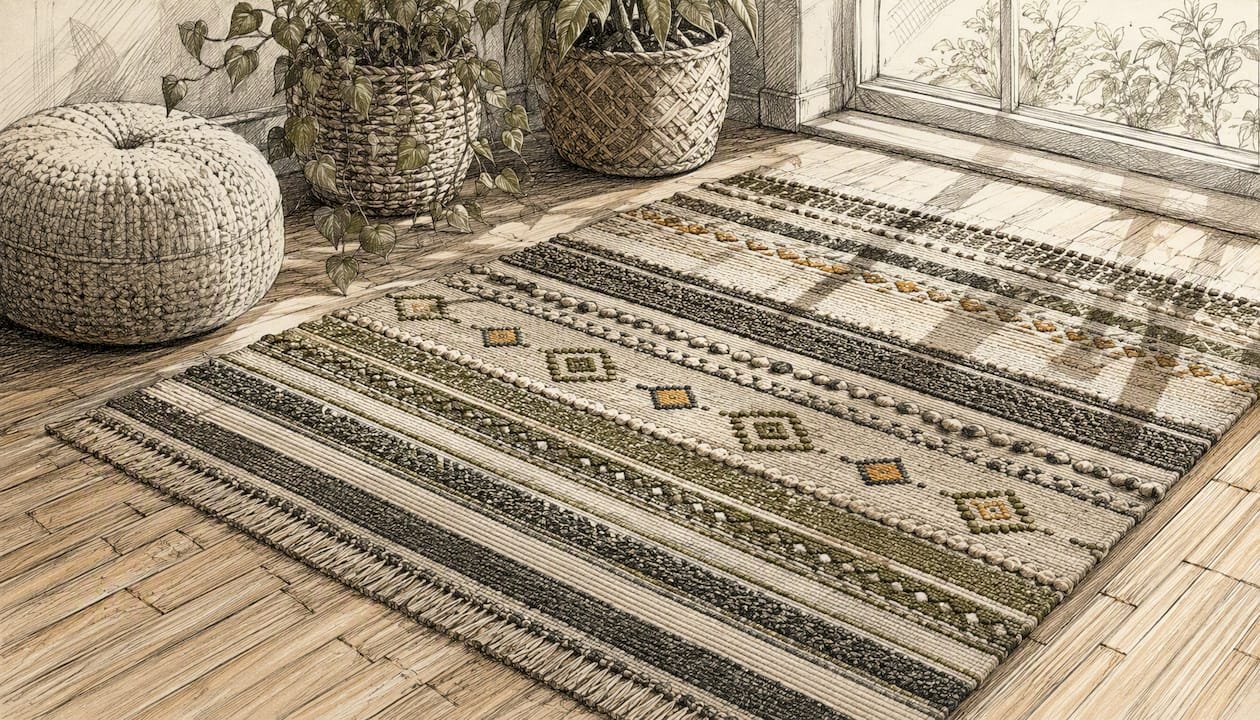
Authenticity cues: The alternating texture should be clearly visible and consistent. If the rug appears uniformly pile throughout, it is not a genuine Zanafi.
Marmoucha
Marmoucha rugs originate from the northeastern Middle Atlas, from the Marmoucha tribal confederation. They feature heavy natural wool with angular, bold geometric patterns in natural undyed tones: ivory, brown, black, and gray. The pile is dense and the weave is tight, built for durability in a cold mountain environment. Marmoucha rugs are less commercially promoted than Beni Ourain but share a similar aesthetic, making them a strong value option for buyers who want the look without the premium name recognition.
Authenticity cues: The back should show tight, even hand-knotting. The wool should feel dense and slightly coarse, not soft and uniform like machine-made fiber.
Rabat / R’Bati
Rabat rugs are urban workshop rugs produced in the Atlantic coast city of Rabat. They are the most formally structured of all Moroccan rug types, with Persian-influenced medallion layouts, floral borders, and a palette that often includes deep reds, blues, and ivory. The pile is medium-height and the knotting is fine and regular. Rabat rugs were historically made for the royal court and wealthy urban households, which gives them a different cultural context than tribal mountain rugs. They are the closest Moroccan equivalent to a traditional Persian carpet.
Authenticity cues: Fine, regular knotting and a formal symmetrical layout are expected. Irregular or asymmetric patterns in a rug sold as Rabat suggest misattribution.
Ourika Valley
Ourika Valley rugs come from the valley south of Marrakesh and tend to feature bright, saturated colors with bold geometric patterns. The pile is medium-height and hand-knotted. They are often produced in small family workshops and sold at the Marrakesh souks, which means quality varies considerably. The color palette is typically more vivid than Middle Atlas styles.
Authenticity cues: Ask about the specific workshop or family. Ourika Valley rugs from established family producers hold value better than anonymous souk pieces.
Middle Atlas region (general)
The Middle Atlas as a whole is the heartland of Moroccan pile rug production, encompassing Beni Ourain, Beni M’rirt, Marmoucha, and several smaller tribal traditions. Rugs from this region share a preference for natural undyed wool, heavy pile, and geometric patterns, but each tribal group has distinct pattern conventions. When a seller describes a rug simply as “Middle Atlas,” ask for the specific tribe.
Style comparison at a glance
| Style | Region / Tribal Origin | Weave Type | Materials | Pile Height / Texture | Colors and Patterns | Typical Uses | Collector Value |
|---|---|---|---|---|---|---|---|
| Beni Ourain | Northern Middle Atlas, Beni Ourain confederation | Hand-knotted pile | Undyed natural wool | Thick, plush | Ivory/cream, dark geometric lines | Living rooms, bedrooms | High; vintage commands premium |
| Azilal | High Atlas, northeast of Marrakesh | Hand-knotted pile (some flatweave sections) | Hand-dyed wool | Medium | Light ground, bold abstract/neon motifs | Accent, living rooms | Medium-high; vintage with family symbols |
| Boucherouite | Near Marrakesh, Beni Mellal, Azilal | Flatweave or low pile | Recycled textiles, fabric strips | Low, mixed texture | Unpredictable, vivid, chaotic | Accent, wall art | Growing; mid-century vintage sought |
| Kilim / Hanbel | Nomadic groups, various regions | Flatweave (reversible) | Wool, sometimes cotton | None (flat) | Geometric, bold color bands | Runners, layering, wall hangings | Moderate; antique pieces valued |
| Boujad | Khouribga plateau, central Morocco | Hand-knotted pile | Hand-dyed wool | Loose, shaggy | Saturated pinks, reds, oranges, abstract | Living rooms, bedrooms | High for vintage; natural dye fade |
| Beni M’rirt | Middle Atlas, Beni M’rirt tribe | Hand-knotted pile | Undyed natural wool | Dense, high | Cream, brown, gray, geometric | Living rooms, bedrooms | Moderate; undervalued vs. Beni Ourain |
| Taznakht | Siroua region, south High Atlas | Dense hand-knotted pile | Wool, natural plant dyes | Low, tight | Warm yellows, saffron, rust, geometric | Living rooms, formal spaces | High; natural dye palette ages well |
| Zanafi | High Atlas | Mixed flatweave and pile bands | Wool | Mixed (banded) | Earth tones, occasional bold accents | Living rooms, high-traffic areas | Moderate |
| Marmoucha | Northeastern Middle Atlas, Marmoucha tribe | Hand-knotted pile | Undyed natural wool | Dense, heavy | Ivory, brown, black, angular geometric | Living rooms, bedrooms | Moderate; strong value |
| Rabat / R’Bati | Atlantic coast, Rabat city workshops | Fine hand-knotted pile | Wool (sometimes silk accents) | Medium, regular | Deep reds, blues, ivory, medallion/floral | Formal rooms, dining rooms | High; royal/court tradition |
| Ourika Valley | Ourika Valley, south of Marrakesh | Hand-knotted pile | Hand-dyed wool | Medium | Vivid, saturated, bold geometric | Living rooms, accent | Variable; depends on workshop |
| Middle Atlas (general) | Middle Atlas mountains, multiple tribes | Hand-knotted pile | Undyed or lightly dyed wool | Dense, heavy | Natural tones, tribal geometric | Living rooms, bedrooms | Moderate to high by tribe |
What materials and techniques define these rugs?
The fiber vocabulary
Wool is the dominant material across nearly all Moroccan pile rug traditions. The quality varies significantly by sheep breed and altitude: high-altitude Atlas sheep produce a denser, lanolin-rich fleece that wears exceptionally well. Undyed wool retains its natural oils, which gives Beni Ourain and Marmoucha rugs their characteristic soft-but-resilient hand. Hand-spun wool has slight irregularities in thickness that machine-spun fiber lacks, and those irregularities are visible in the pile as subtle texture variation.
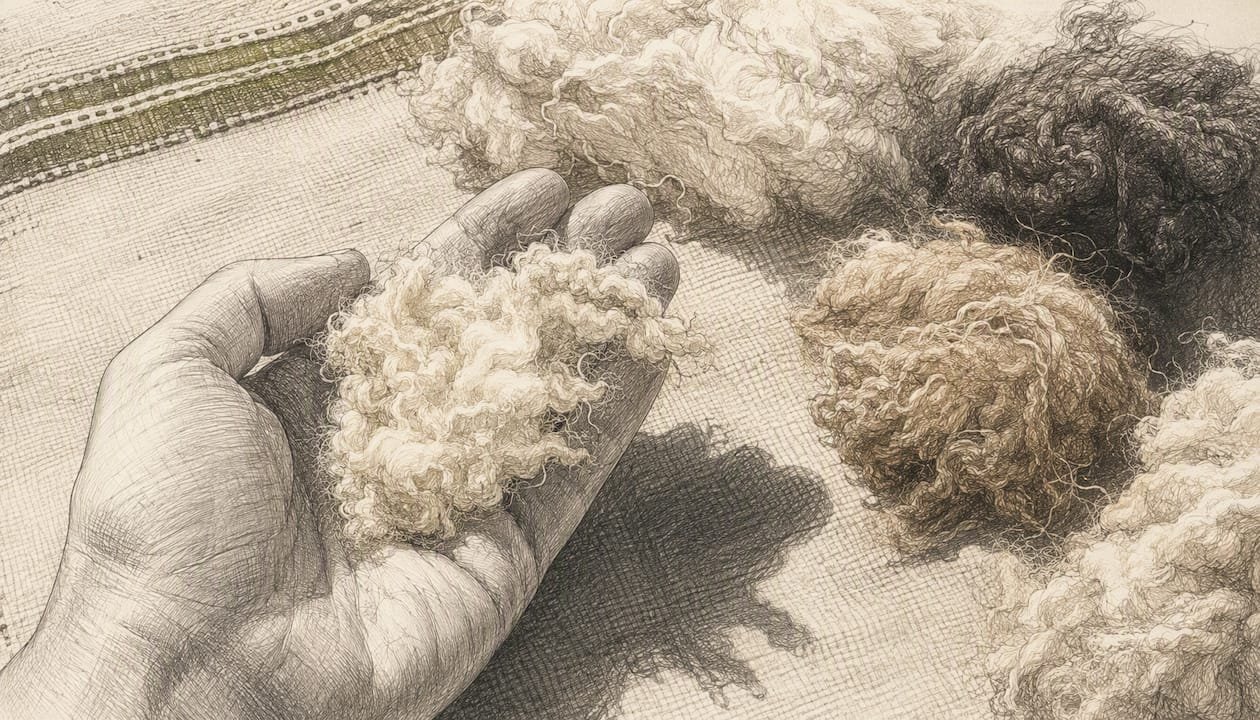
Sabra (cactus silk) is derived from the agave plant. Fibers are hand-extracted and spun into a lustrous, durable thread that resembles silk but is plant-based. Sabra is often used in combination with wool and is sometimes embroidered onto a woven ground after the base is complete. The sheen is distinctive: brighter and more reflective than wool, with a slight stiffness. Sabra rugs are generally not suitable for high-traffic areas because the fiber can flatten under heavy foot traffic, but they are striking as accent pieces or wall hangings.
Recycled textiles in Boucherouite rugs include cotton, nylon, polyester, and whatever fabric scraps were available. The result is a rug that is lighter than a wool pile piece and has a mixed, slightly rough texture. Care requirements differ significantly from wool: recycled fabric strips can include synthetic fibers that react poorly to heat or harsh cleaning agents.
Weave and construction terms
- Warp: the vertical threads stretched on the loom, which form the structural backbone of the rug.
- Weft: the horizontal threads woven through the warp; in flatweaves, the weft carries the pattern.
- Pile: the cut or looped yarn that creates the surface texture; pile height is measured in millimeters.
- Hand-knotted: each knot is tied individually around warp threads by hand, then cut to create pile. The back of a hand-knotted rug shows the knot structure clearly.
- Kilim / flatweave: no pile; pattern is created entirely by the weft. Reversible and lightweight.
- Hanbel: a heavier Moroccan flatweave, sometimes with supplementary weft decoration for texture.
- Tufted: a gun-tufted rug has loops or pile punched through a backing fabric, not knotted. The back is covered with a secondary fabric layer to hide the construction. Tufted rugs are not hand-knotted and are generally less durable.
How to tell hand-knotted from tufted or machine-made: flip the rug. A hand-knotted rug’s back shows individual knots in rows, with the pattern visible in reverse. A tufted rug has a flat fabric backing (often canvas or latex) glued over the construction. A machine-made rug has perfectly uniform knot rows with no variation.
Dyes: natural vs. synthetic
Traditional natural dyes in Moroccan rugs include saffron (yellow/gold), henna (warm orange-brown), indigo (blue), pomegranate rind (yellow-green), and madder root (red). Natural dyes age in a process called abrash: slight color variation across the rug from batch-to-batch dye differences, and gradual, uneven fading that produces warm, complex tones over decades. That fading is considered desirable in vintage pieces.
Synthetic dyes, introduced widely in the 20th century, produce more uniform and saturated color but fade differently: they can bleed when wet and often shift toward harsh or flat tones over time. A quick field test: press a damp white cloth firmly against the pile for 30 seconds. Significant color transfer suggests synthetic dyes with poor fastness. Some color transfer from natural dyes is normal, but it should be minimal.
Pro Tip: Natural dye abrash (slight color variation across the rug) is not a defect. It is one of the clearest signs of authentic hand-dyed wool. If a rug’s color is perfectly uniform from edge to edge, it was almost certainly dyed with synthetic pigments.
How to buy Moroccan rugs in the United States
Authentication checklist
Before committing to a purchase, work through these points:
- Request back photos. Close-up images of the knotted back, fringe, and selvedge are among the most useful visual proofs for authentication in online listings, as Rugsonlinemarket’s 2026 buying guide details.
- Ask for provenance. Where was the rug made? Which tribe or region? When was it acquired? A seller who cannot answer these questions is selling a rug, not a story.
- Check the fringe. On a genuine hand-knotted rug, the fringe is an extension of the warp threads, not sewn on separately. Sewn-on fringe is a red flag.
- Inspect the selvedge (side edges). Hand-finished selvedges are slightly irregular. Machine-made rugs have perfectly uniform edges.
- Request a condition report for any vintage piece, noting moth damage, repairs, color loss, or pile wear.
- Confirm the return policy before purchasing. Reputable sellers offer at least 30 days.
Typical price ranges
Prices vary widely by style, size, age, and condition. These are broad bands based on the current U.S. market:
- Contemporary Beni Ourain (new production), 5×8 ft: roughly $400–$900
- Vintage Beni Ourain (pre-1980s), 5×8 ft: $1,200–$3,500 and above depending on condition and provenance
- Azilal (contemporary), 4×6 ft: $300–$700
- Vintage Boujad, 5×8 ft: $800–$2,500
- Boucherouite (vintage mid-century), small accent: $200–$600
- Kilim/Hanbel flatweave, 6×9 ft: $250–$800
- Taznakht (contemporary), 5×8 ft: $500–$1,200
- Rabat/R’Bati (fine antique), 8×10 ft: $2,000–$8,000+
These ranges assume natural fibers and genuine hand production. Synthetic-blend or machine-made pieces sold under the same style names can cost a fraction of these prices but hold no collector value.
Where to buy
Specialist dealers and curated online sellers who provide provenance documentation, condition reports, and clear return policies are the safest route for buyers spending over $500. Marketplace listings (auction platforms, general resale sites) can yield genuine finds but require you to do your own authentication work. For buyers who want the convenience of online shopping with buyer protections built in, curated sellers who stock natural-fiber rugs with clear material descriptions and return windows are the practical choice.
Shipping and returns for U.S. buyers
Large rugs shipped from Morocco or from U.S.-based importers typically arrive rolled and wrapped. Customs duties on handmade rugs imported into the United States vary by declared value and country of origin; for most Moroccan handmade rugs, the duty rate is low, but confirm with the seller whether the listed price is duty-inclusive. Insurance on high-value shipments is worth requesting explicitly.
When buying from Rugsonlinemarket, orders over $300 ship free, and returns are accepted within 30 days, which covers the standard “unroll and inspect” period most buyers need.
Top questions to ask a seller before purchasing:
- Which tribe or region produced this rug?
- What is the approximate age or production period?
- What fiber is the pile: natural wool, synthetic blend, or recycled fabric?
- Are the dyes natural or synthetic?
- Can you provide photos of the back, fringe, and selvedge?
- Has the rug been repaired? If so, where and how?
- What is your return policy and who covers return shipping?
- Is the price inclusive of shipping and any applicable duties?
Pro Tip: For vintage rugs priced above $1,000, ask the seller to provide a UV light photo of the back. Repairs and re-piling show up clearly under UV because new wool fluoresces differently from aged fiber. Most reputable dealers will do this without hesitation.
How to care for your Moroccan rug
Pile rugs (Beni Ourain, Azilal, Boujad, Taznakht, Marmoucha, Rabat)
Vacuum pile rugs weekly on a low-suction setting, always in the direction of the pile, never against it. Avoid the beater-bar attachment on high-pile rugs like Beni Ourain and Boujad: it stresses the knots and accelerates pile loss. For spot cleaning, blot (never rub) with cold water and a small amount of mild wool-safe detergent. Rinse with cold water and blot dry. Professional cleaning is recommended every two to three years for rugs in regular use.
Flatweaves (Kilim, Hanbel, Zanafi)
Flatweaves are more forgiving. Vacuum both sides periodically. Spot-clean with cold water and mild soap. Because they are reversible, rotating them every six months distributes wear evenly. For deeper cleaning guidance on natural-fiber rugs, Rugsonlinemarket’s jute rug cleaning guide covers low-moisture techniques that apply equally well to wool flatweaves.
Boucherouite
Boucherouite rugs contain mixed fibers, some of which may be synthetic. Avoid hot water and steam cleaning, which can shrink or distort synthetic fabric strips. Spot-clean with cold water only. Air-dry flat, never in direct sunlight, which fades recycled fabric faster than it fades natural wool.
Sabra (cactus silk) rugs
Sabra is more delicate than wool. Vacuum gently with a soft brush attachment. Avoid saturating with water. Professional cleaning is strongly recommended for anything beyond light spot treatment.
Storage and seasonal care
Roll rugs for storage, never fold them. Folding creates permanent creases in pile and can crack the foundation of older rugs. Roll pile-side in, wrap in acid-free paper or breathable cotton muslin, and store horizontally in a dry, cool space. Avoid plastic wrapping, which traps moisture and encourages mold.
For moth prevention, cedar blocks or lavender sachets placed near stored rugs deter moths without the chemical residue of mothballs. Check stored rugs every three months: moths prefer undisturbed dark spaces and can cause significant damage before you notice.
Water damage emergency: If a rug gets wet, lift it off the floor immediately, blot as much moisture as possible with clean towels, and lay it flat in a well-ventilated space to dry. Do not place it back on the floor until fully dry, which can take 24–48 hours depending on pile thickness.
Do/don’t summary:
- Do use a rug pad under all Moroccan pile rugs to prevent slipping and reduce wear on the foundation.
- Do rotate rugs every 6–12 months to even out sun exposure and foot traffic.
- Do blot spills immediately with a clean, dry cloth.
- Don’t steam-clean natural wool pile rugs: heat shrinks wool fibers.
- Don’t use enzyme-based cleaners on natural wool: they break down protein fibers.
- Don’t hang heavy pile rugs by the fringe for extended periods: the weight stresses the warp threads.
Pro Tip: A quality rug pad does more than prevent slipping. It lifts the rug slightly off the floor, improving airflow underneath and dramatically reducing the risk of mold in humid climates. For high-pile rugs like Beni Ourain, choose a thin, non-slip pad rather than a thick cushioned one, which can make the rug feel unstable underfoot.
Why does Morocco produce so many distinct rug styles?
The short answer is geography. Morocco’s geographic and tribal diversity produces an unusually wide range of regional rug traditions, from the cold Atlas mountain ranges where thick undyed wool pile was a practical necessity, to the warmer plains and pre-Saharan south where lighter flatweaves and plant-dyed textiles made more sense. Each region’s available resources shaped its rug tradition directly: Atlas mountain sheep produce dense, lanolin-rich fleece; the Siroua region near Taznakht has access to saffron and other local plant dyes; the agave-rich areas of southern Morocco developed the sabra/cactus silk tradition; and the urban recycling economy near Marrakesh gave rise to Boucherouite.
Tribal identity reinforces geographic differentiation. The Beni Ourain confederation, the Marmoucha, the Beni M’rirt, and the Azilal tribes each developed pattern languages that served as visual identity markers, recording family lineage, fertility symbols, and protective motifs. Those patterns were not decorative choices in the modern sense; they were a form of communication within a community that had no written tradition.
The “Berber” myth-buster:
- “Berber” is a broad cultural and linguistic label for the Amazigh peoples of North Africa. It is not a rug style, a weave type, or a regional designation.
- Sellers use it as shorthand because it signals “handmade Moroccan tribal rug” to Western buyers, but it collapses dozens of distinct traditions into one word.
- A rug labeled “Berber” could be a Beni Ourain, a Boujad, a Kilim, a Boucherouite, or something else entirely. The label tells you nothing about construction, material, or value.
- As MarocMama notes, there are dozens if not hundreds of regional and tribal rug types in Morocco. Asking for the specific tribe or region and the weaving technique is the only way to assess what you are actually buying.
- When a seller cannot or will not specify beyond “Berber,” that is useful information: it suggests either limited provenance knowledge or a commercially produced piece with no specific tribal origin.
An editorial perspective on buying Moroccan rugs
The single biggest mistake buyers make is treating Moroccan rugs as a category rather than a collection of distinct traditions. Beni Ourain became a design world darling in the 2010s, and that popularity created a flood of machine-made and synthetic-blend imitations that carry the name but none of the craft. The same pattern is now repeating with Azilal and Boucherouite as those styles gain mainstream attention.
The rugs that hold value and age well share two characteristics: natural fiber and documented origin. A contemporary Beni Ourain made from genuine undyed Atlas wool will outlast a synthetic imitation by decades and develop a patina that improves with age. A vintage Boujad with natural dye fade is worth three times a new piece with synthetic colors, not because it is older, but because the material quality and the dye chemistry are fundamentally different.
The “Berber” label problem is not just a semantic annoyance. It actively costs buyers money. When you cannot distinguish a Marmoucha from a Beni M’rirt from a generic “Berber pile rug,” you cannot price them correctly, and sellers know it. The buyers who get the best pieces at fair prices are the ones who walk in knowing the specific style names, the regional origins, and the authentication questions. That knowledge is the only real leverage you have in a market where provenance is often underdocumented and the visual differences between authentic and imitation can be subtle.
At Rugsonlinemarket, the focus is on natural-material rugs with clear descriptions, buyer protections that include free shipping on orders over $300 and 30-day returns, and a curated selection that makes it easier to find a genuine piece without the guesswork of marketplace listings. The Best Moroccan Rugs: Your 2026 Buying Guide on the site walks through evaluation criteria in detail.
Rugsonlinemarket’s curated Moroccan rug collection
Knowing the styles is half the work. Finding a genuine piece at a fair price, with buyer protections that cover you if the rug looks different in your living room than it did on screen, is the other half.
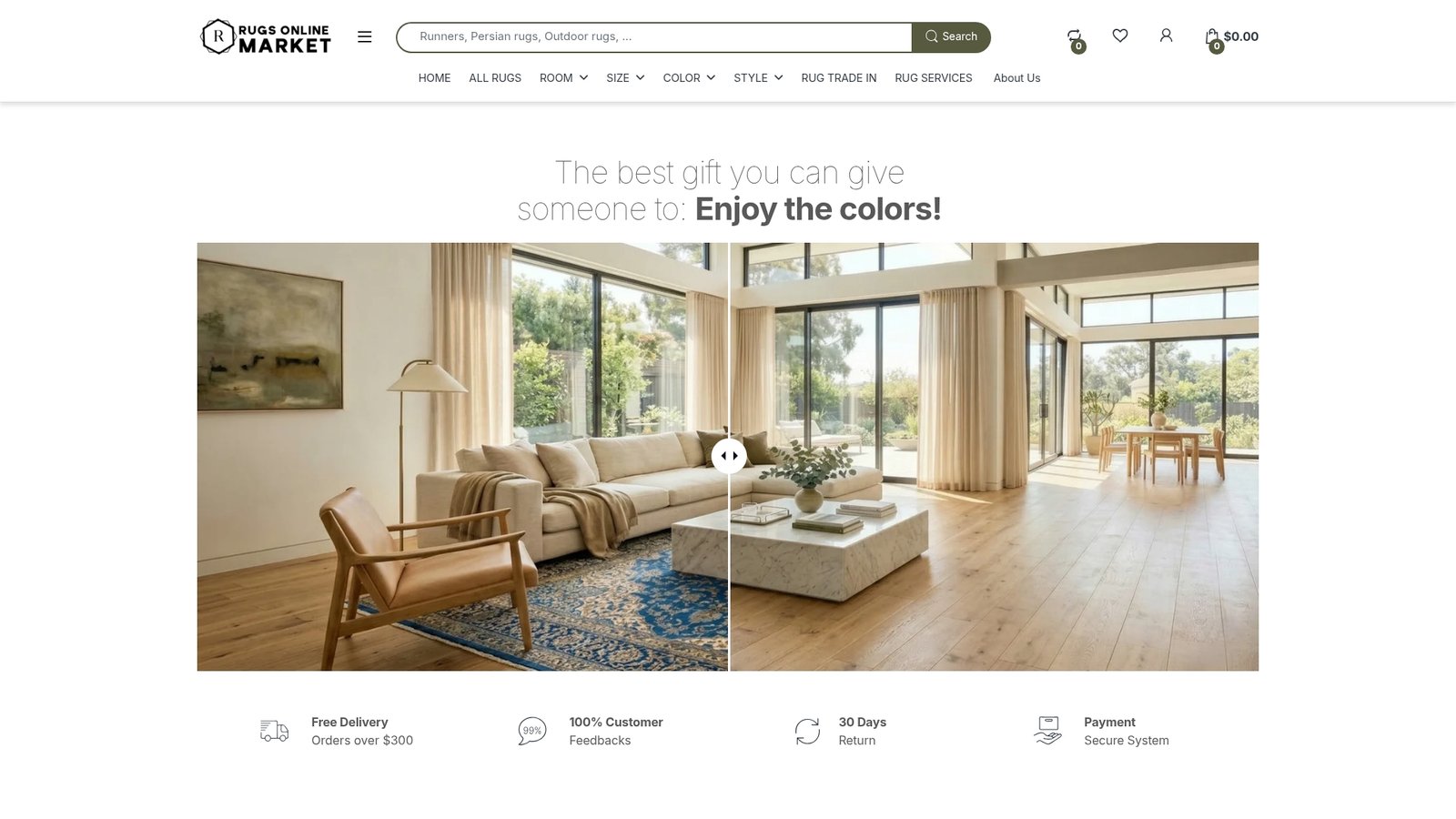
Rugsonlinemarket carries a curated selection of Moroccan and natural-fiber rugs, including wool pile and flatweave options across the styles covered in this guide. Every listing includes material descriptions, size filters, and clear photography. Orders over $300 ship free across the United States, and returns are accepted within 30 days, giving you time to unroll, inspect, and live with the rug before committing.
- Free shipping on orders over $300
- 30-day hassle-free returns
- Natural-material options in wool, cactus silk, and flatweave formats
- Expert customer support for sourcing and style questions
- 100% feedback guarantee
Browse the natural rugs collection to filter by material, or explore the runner rug category for kilim and flatweave formats suited to hallways and layering. For antique and collectible pieces, the antique collection is the right starting point.
