

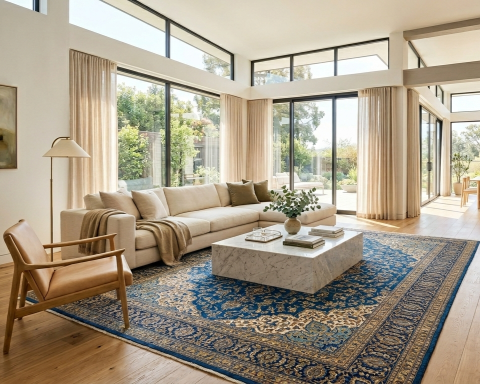

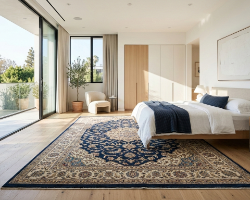
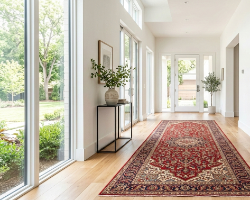








Persian rug motifs are a traditional visual alphabet: repeatable design families like the boteh, the medallion, and the arabesque, organized into a compositional structure that carries conventional symbolic meanings. Read together, these motifs tell you what a weaver was communicating about nature, faith, or fortune, and where each symbol sits in the rug’s layout changes how it is meant to be understood. The families below give you a working vocabulary for identifying and interpreting them.
TL;DR:
- The placement of motifs like medallions and trees of life significantly influences the rug’s overall message, either as a focal statement or a background reference.
- Recognizing motif families such as Herati, boteh, or arabesque requires analyzing pattern structure, repetition, and orientation, not just identifying their shapes.
- Motif names are trade terminology and do not confirm geographic origin; proof of provenance relies on weave structure, materials, dyes, and documentation.
- Understanding the internal layered system of background, framework, and narrative motifs enhances the ability to interpret a rug’s symbolic storytelling.
- Seeing genuine examples and studying their knotting and motif placement provides better insights than relying solely on pattern books or motif labels.
Table of Contents
- Understanding Persian Rug Patterns as a Visual Language
- Common Persian Rug Motifs and What They Symbolize
- How Motif Placement Changes the Meaning
- Why Motif Names Don’t Prove Where a Rug Was Made
- How to Identify Motifs on a Rug You Own or Are Considering
- Where to See Real Examples of These Motifs
- What the Conventional Motif Guides Get Wrong
- Bring These Motifs Home
- Sources
- FAQ
Understanding Persian Rug Patterns as a Visual Language
Scholars who study Iranian decorative arts describe motif design as a layered system rather than a random assortment of pretty shapes. Research on traditional Iranian visual composition identifies seven main motifs functioning as a kind of alphabet, arranged in three structural layers: a background layer, a framework layer, and a narrative layer. Once you see that structure, a rug stops looking like decoration and starts reading like a composed page.
The main motif families you’ll encounter across Persian carpet designs include:
- Arabesque (eslimi): flowing, vine-like scrollwork that fills backgrounds
- Floral (khatayi): stylized blossoms, leaves, and vines drawn from Persian garden imagery
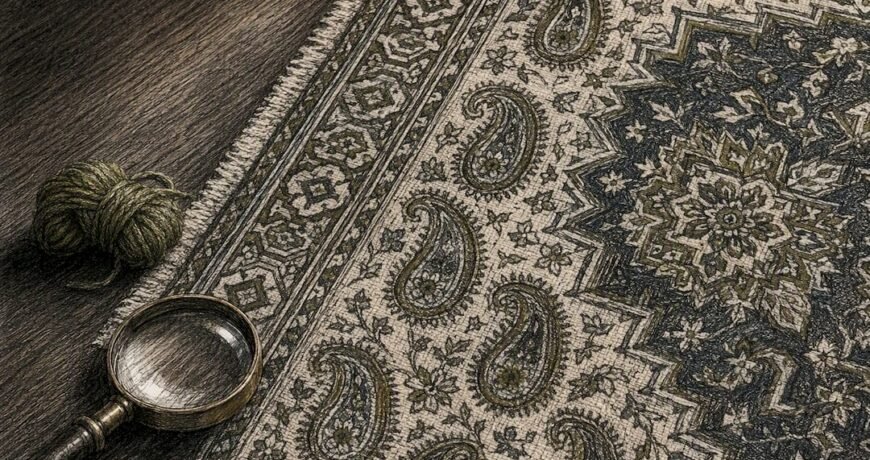
- Boteh: the teardrop shape familiar in the West as paisley
- Medallion (toranj): a central emblem anchoring the whole field
- Palmette: a fan-shaped leaf motif often bordering other elements
- Afshan (scattered): loose, all-over floral sprays without a fixed axis
- Rosette: a stylized flower, often eight-petaled, used as a focal accent
In the three-layer model, the arabesque typically forms the background, the medallion and spandrels form the framework that organizes the field, and figural elements like animals or hunting scenes supply the narrative content layered on top. A single rug might use all three at once, which is part of why the same motif can feel different from one piece to the next.
Common Persian Rug Motifs and What They Symbolize
Persian carpet designs draw from a set of recurring motifs, each with its own visual signature and conventional meaning. Here’s how to spot and read the ones you’ll see most.
-
Boteh. A curved, teardrop shape with a bent tip, usually repeated in rows across the field or border. It’s widely read as a symbol of fertility, life, or a flame, and it’s the ancestor of the paisley pattern you know from Western textiles. Identification tip: look for the consistent bend direction across a row. A field of boteh with alternating tilts often signals a specific regional weaving tradition rather than a random pattern.
-
Herati. A small diamond enclosing a rosette, flanked by curved “fish” leaves at each corner, repeated in a dense all-over grid. Weavers and dealers commonly associate it with abundance and are sometimes called the “fish pattern.” Identification tip: count the leaf pairs at each diamond corner. Symmetry there tells you the grid was drafted, not freehand.
-
Medallion (toranj). A large, often symmetrical emblem placed dead-center in the field, sometimes echoed by smaller medallions at the corners. It usually represents a garden pool, the sun, or a point of spiritual focus, depending on regional tradition. Identification tip: trace the medallion’s outer edge. A stepped or scalloped edge often points to a lock-based geometric weaving style, while a curvilinear edge points to a curved-line tradition.
-
Eslimi (arabesque). Continuous, interlocking scrollwork with no clear beginning or end. The design evolved from earlier natural and animal forms into an abstract motif conveying eternity and paradise, with roots that predate the Islamic period. Identification tip: follow one scroll line with your finger. If it loops back on itself endlessly, you’re looking at eslimi, not floral khatayi.
-
Palmette. A fan-like leaf cluster, often used to punctuate borders or flank a medallion. It generally signals abundance or divine favor and frequently pairs with rosettes. Identification tip: palmettes almost always appear in mirrored pairs, so check for symmetry across a central axis.
-
Tree of life. A single, often asymmetrical tree, sometimes populated with birds, shown rising from the field or anchoring a prayer rug’s design. It represents the connection between earth and paradise, or the passage of the soul. Identification tip: this motif is almost always singular and vertical, unlike the repeating boteh or Herati grids.
-
Animal motifs. Birds, gazelles, lions, and especially the ibex or ram’s horn appear as narrative-layer elements, often in hunting scenes or scattered through the field. The ibex is one of the oldest motifs in Iranian decorative art, tied to fertility and protection, and its horn curvature likely shaped some later arabesque forms. Identification tip: look for the curled horn shape hiding inside what looks like an abstract scroll.
-
Rosette. A stylized flower, usually with six or eight petals arranged in radial symmetry, used as a standalone accent or nested inside Herati diamonds. Ancient Persian monuments used rosette and lotus forms as solar and fertility symbols, a lineage that carried into later carpet design. Identification tip: count the petals. Perfect radial symmetry usually means it was drawn on a grid before knotting began.
-
Evil eye (nazar). A circular or diamond-shaped motif, often blue and white, meant to ward off misfortune. It shows up as a small protective accent rather than a dominant field pattern. Identification tip: it’s almost never repeated in a grid; it appears as a singular guard element.
-
Afshan (scattered florals). Loosely distributed floral sprays across the field with no rigid symmetry or central axis. It generally suggests an open garden or paradise imagery rather than a specific narrative. Identification tip: if the field has no obvious repeat unit and no medallion, you’re likely looking at an Afshan layout.
A word of caution: dealers and even some weavers use these names loosely, and a motif described as “Herati” in one shop might look structurally different from the “Herati” in another. Treat the names as useful shorthand, not fixed definitions.
Pro Tip: When a rug combines motifs, don’t try to force a single meaning onto the whole piece. Read it in layers: what’s in the background, what frames the field, and what sits in the narrative layer. A boteh field with a Herati border and a tree of life medallion is telling three overlapping stories, not one.
How Motif Placement Changes the Meaning
A motif’s location in a rug’s composition changes how it’s meant to be read, and Persian rug patterns follow a fairly consistent internal logic. The medallion (toranj) usually sits at the geometric center, acting as a focal point, a garden pool, or a stand-in for the sun. Spandrels (lachak), the quarter-shapes tucked into each corner around the medallion, complete the visual frame and often echo the medallion’s motifs at a smaller scale.
Field and border play different roles too:
- The field carries the primary narrative: a scattered Afshan garden, a repeating Herati grid, or a hunting scene
- The border frames that narrative, typically using palmettes, rosettes, or running vine patterns in tight repetition
- A motif placed centrally as a medallion (say, a tree of life) reads as a focal spiritual statement
- The same motif scattered loosely across the field, without a medallion, reads as an ambient garden reference instead
That distinction matters when you’re trying to identify a rug. A single tree of life anchoring the composition is a very different visual statement than a dozen small trees scattered as filler.
Why Motif Names Don’t Prove Where a Rug Was Made
Motif terminology functions as trade language, developed by weavers and dealers over generations, and that history has a real limitation. According to the Encyclopaedia Iranica’s survey of carpet design, names like Herati, boteh, and toranj are established scholarly and commercial conventions, not standalone proof of a rug’s geographic or workshop origin. A “Herati” pattern doesn’t guarantee a rug came from Herat any more than a “paisley” tie guarantees Scottish manufacture.
Regional and workshop tendencies exist, but they’re patterns of preference, not fixed rules. If you want to make a real provenance claim, motif identification is only the starting point:
- Weave and knot structure, including knot count and knotting technique
- Material composition, wool versus silk versus cotton foundation
- Dye type, natural versus synthetic, which can help date a piece
- Documentation, provenance papers, auction history, or dealer records
Pro Tip: If a seller leans hard on a motif name as proof of origin, ask what else backs that claim. Motif vocabulary is a great starting point for appreciation, but it’s a weak foundation for authentication on its own.
How to Identify Motifs on a Rug You Own or Are Considering
You don’t need formal training to start reading a rug intelligently. Work through it methodically.
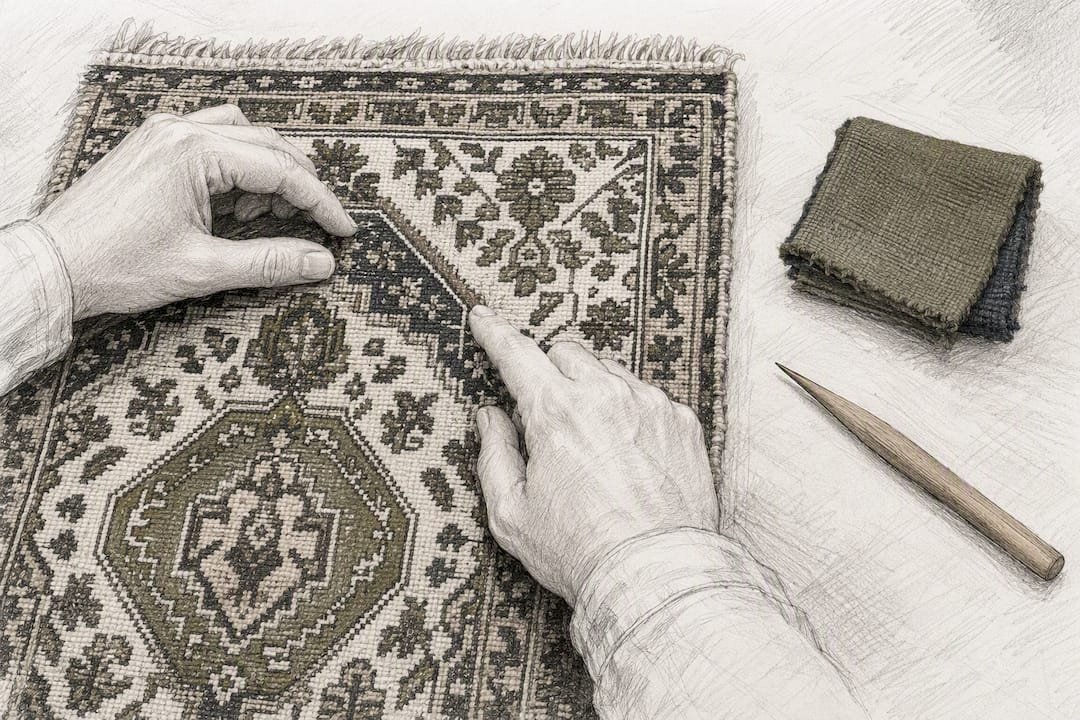
- Photograph the whole rug, then take close-up shots of the medallion, border, and any repeating unit in the field.
- Note the repeat pattern and its axis. Is the design symmetrical along one line, radially symmetrical, or scattered with no axis at all?
- Mark or sketch distinctive traits, like the curl direction of a boteh or the leaf count on a Herati diamond.
- Compare what you find against the motif descriptions above, starting with the shape that dominates the field.
- Watch for hybrid or heavily stylized motifs. A weaver working from memory or regional tradition often simplifies a motif until it barely resembles the textbook version. When in doubt, look at how it’s placed rather than trying to force an exact visual match.
- Call in a professional when it matters. If the rug shows real damage, or you’re weighing a high-value attribution claim, an appraiser or textile conservator can examine weave structure and materials in ways a photo never will.
Where to See Real Examples of These Motifs
Pattern books only get you so far. Seeing motifs on actual woven pieces, where you can study the knotting and the scale of a medallion against its spandrels, teaches you more in five minutes than a diagram does in an hour. Rugsonlinemarket’s traditional rug and handmade rug collections showcase these motif families across genuine wool and silk pieces, giving you a practical reference point beyond photographs in a textbook.
What the Conventional Motif Guides Get Wrong
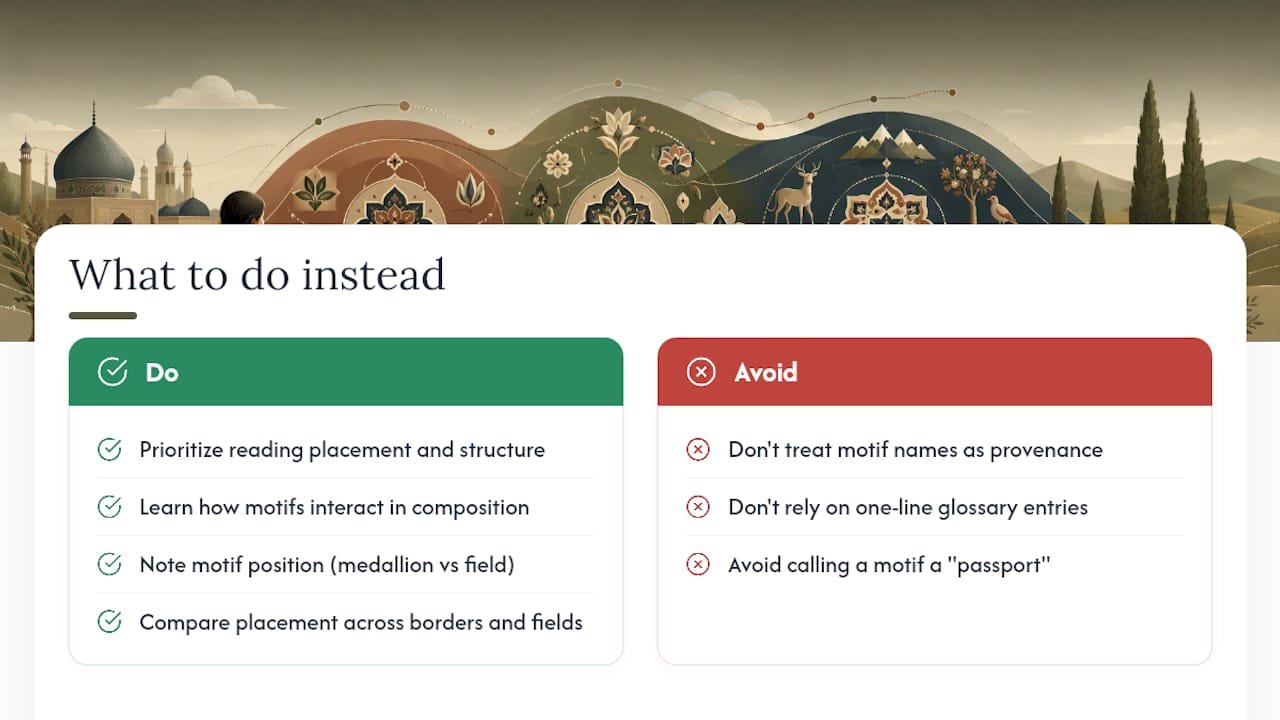
Most guides to Persian rug patterns treat motifs like a glossary. Look up “boteh,” get a one-line definition, move to the next term. That approach misses the actual skill involved, which is reading how motifs interact within a composition. A boteh scattered loosely across a field means something different than a boteh locked into a tight repeating grid inside a border, and no glossary entry captures that.
The bigger gap is in how confidently people talk about origin. I’d argue the motif-name-as-passport habit is the single most overused shortcut in how these rugs get marketed and discussed. Calling a rug “Herati, therefore from Herat” sounds authoritative, but the Encyclopaedia Iranica is direct about this: it’s trade vocabulary, not forensic evidence. If you take one thing from this piece, prioritize learning to read placement and structure over memorizing names. A weaver’s choice to put the tree of life in the medallion instead of scattering it across the field tells you more than any label ever will.
— Kian
Bring These Motifs Home
Reading a symbol on a plate or in a museum case is one thing. Living with it in your own space is another, and that’s where Rugsonlinemarket fits. Rather than sending you to hunt through scattered auction listings or unverified online marketplaces trying to match a motif you liked, Rugsonlinemarket puts an extensive collection of genuine traditional rugs in one place, organized by style and material, with real customer support if you have questions about a specific motif or piece.

If you’re drawn to hand-knotted pieces carrying medallions, boteh fields, or Herati borders, the handmade rug collection is built specifically around that kind of authenticity, with options in wool and silk. Orders above a certain value may qualify for free shipping, and return policies vary; please check Rugsonlinemarket’s website for current details to confirm before purchasing. Browse the traditional rugs category now to see which motifs speak to your own room.
Sources
- Integrated System of Motif Design in Traditional Iranian Arts: From Visual Alphabet to Narrative Compositions | EciEco
- The Arabesque Motif and its Evolution in Iranian Art from Antiquity to the Seljuk Period
- Plants as Symbols of Power in the Achaemenid Iconography of Ancient Persian Monuments – PMC
- CARPETS iv. Knotted-pile carpets: Designs, motifs, and patterns – Encyclopaedia Iranica
FAQ
What do the different motifs on Persian rugs symbolize?
Motifs generally symbolize concepts tied to nature, fertility, and spirituality: the boteh suggests life or flame, the rosette and lotus carry solar and fertility symbolism, and the tree of life represents a connection between earth and paradise. Meaning shifts depending on where the motif sits in the rug’s composition.
What is the pattern on Persian rugs called?
There isn’t one single pattern name, since Persian carpet designs combine multiple motif families in a single piece. Common named patterns include Herati, boteh, medallion (toranj), and eslimi (arabesque), each identifiable by its own repeating shape and placement.
How can I tell if a rug is authentically Persian?
Motif recognition is a useful starting clue, but the Encyclopaedia Iranica notes that motif names alone don’t prove origin. Reliable identification also requires checking knot structure, material composition, dye type, and provenance documentation, ideally with help from a qualified appraiser for higher-value pieces.
What is the “Persian flaw” in rugs?
The “Persian flaw” refers to a small, deliberate irregularity a weaver leaves in an otherwise symmetrical design, often tied to the belief that only perfection belongs to the divine. It’s a folk tradition discussed among collectors and dealers rather than a formally documented rule in every weaving region, so treat it as a charming convention rather than a strict authentication marker.
