

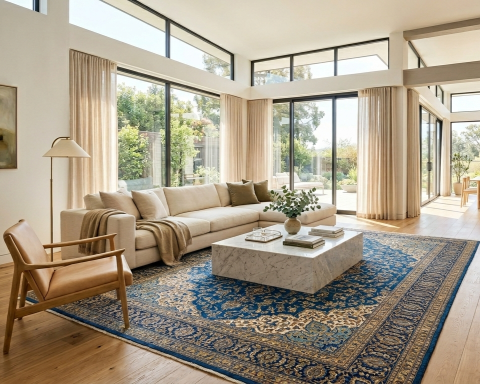
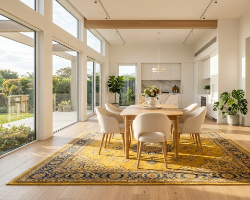
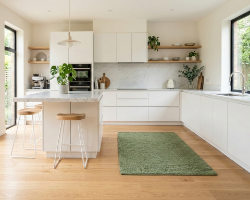
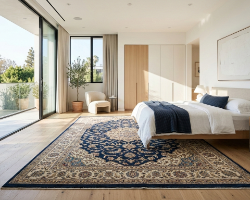
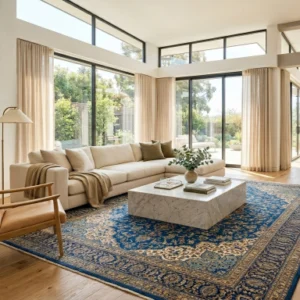

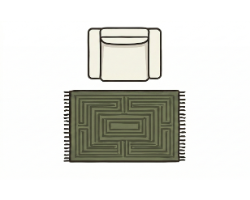
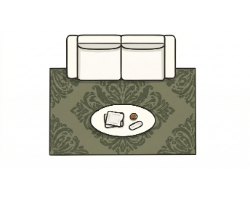
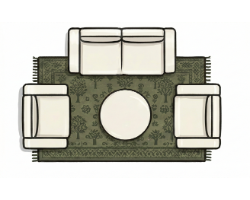
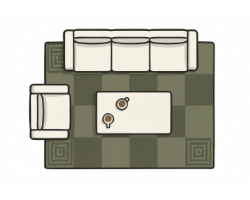
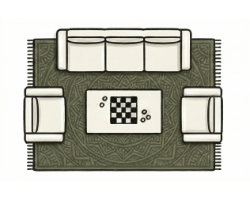
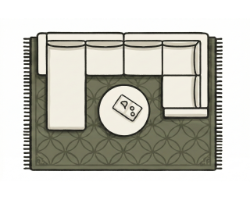
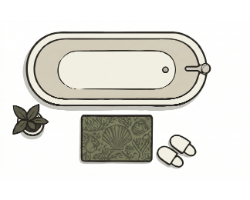
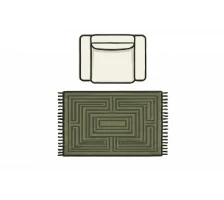





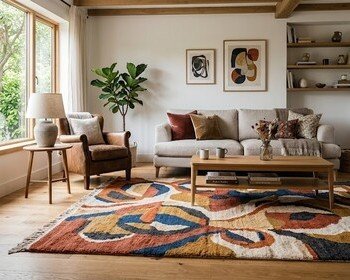

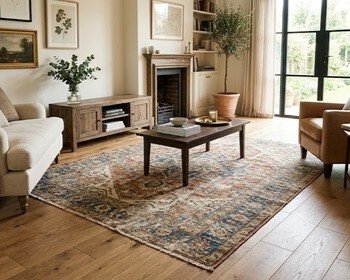
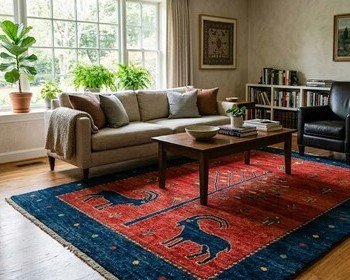
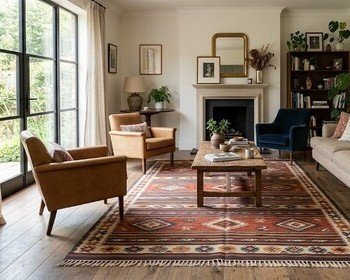
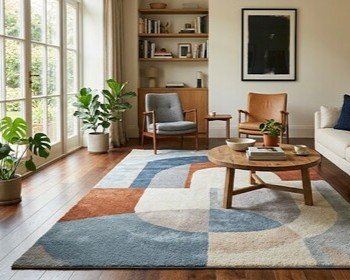

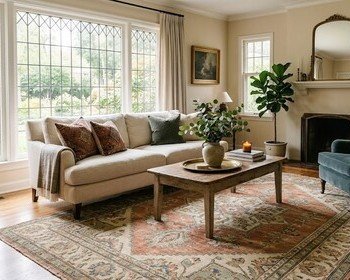
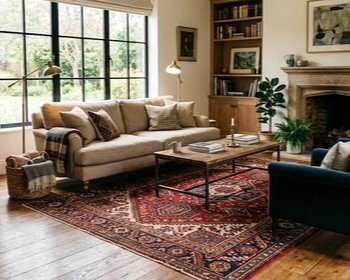
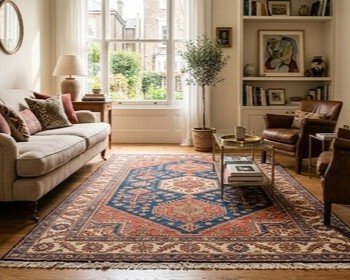
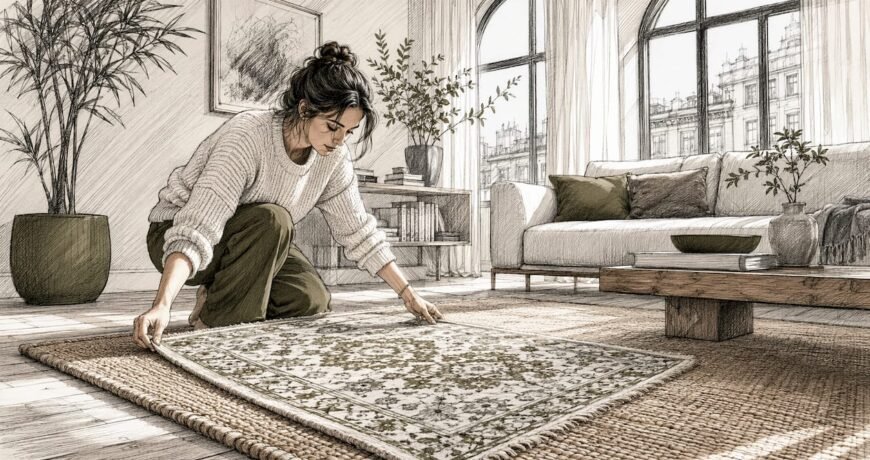
Start with a large, low-profile base rug that anchors your furniture group, then place a smaller, textural or patterned top rug that leaves at least 12–18 inches of the base visible on all sides. That single formula covers 90% of what makes layered rugs look intentional rather than accidental.
A few quick rules before you go further:
- Size gap: The top rug should be roughly 60–70% the size of the base. Over an 8×10 base, a 5×7 or 5×8 top rug hits the right proportion.
- Texture contrast: Pair a flat-weave or natural-fiber base (jute, sisal, dhurrie) with a higher-pile or patterned top. Two high-pile rugs stacked together create an unstable, bunching surface.
- Pile-height warning: Never place a thick shag on top of another plush rug. The combined softness creates a tripping hazard.
- Anchor it: Weight the top rug with furniture legs, or use a carpet-on-carpet gripper pad between the two layers.
- Pattern rule: One rug carries the pattern; the other stays neutral or subtly textured.
TL;DR: Layer rugs when you want to zone an open space, protect existing carpet, or introduce a bold pattern without committing to a large statement rug. The base anchors the room; the top rug is the personality.
Table of Contents
- What are the right size and placement formulas for layering rugs?
- How do you pair rug materials and pile heights?
- How do you mix patterns and colors so layers look intentional?
- Which shape and layout combinations work best?
- Can you put a rug on carpet, and how do you do it safely?
- Room-by-room layering examples you can copy
- How to keep layered rugs safe, clean, and long-lasting
- Designer-tested combinations and why they work
- Environmental considerations and maintenance for layered rugs
- Common mistakes to avoid when layering rugs
- How to style layered rugs in modern, boho, and traditional interiors
- Key Takeaways
- Why layering rugs is worth doing in almost every room
- Start building your layered rug look with Rugsonlinemarket
- Useful sources and further reading
What are the right size and placement formulas for layering rugs?
Getting the proportions right is the difference between a room that looks designed and one that looks like you ran out of rug budget.
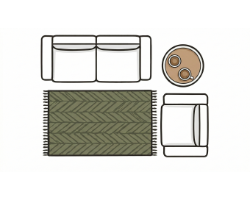
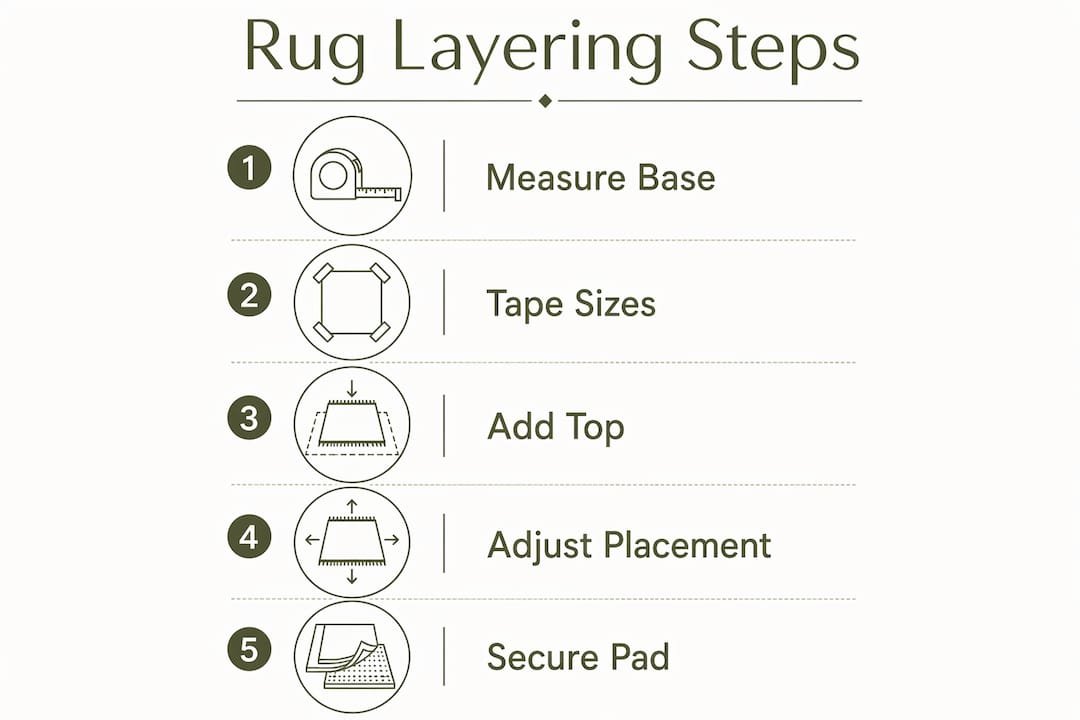
- Measure your furniture group first. In a living room, measure the full seating arrangement, not just the sofa. Your base rug should be large enough that the front legs of every main seat rest on it. For most living rooms, a generously sized base rug is best.
- Calculate the top rug size. Choose a top rug size that is about two-thirds the size of the base, ensuring the base rug shows a visible border around it.
- Check the border. Lay painter’s tape on the floor to simulate both rugs before you buy. You want a generous border of the base rug visible on all sides of the top rug to frame it effectively.
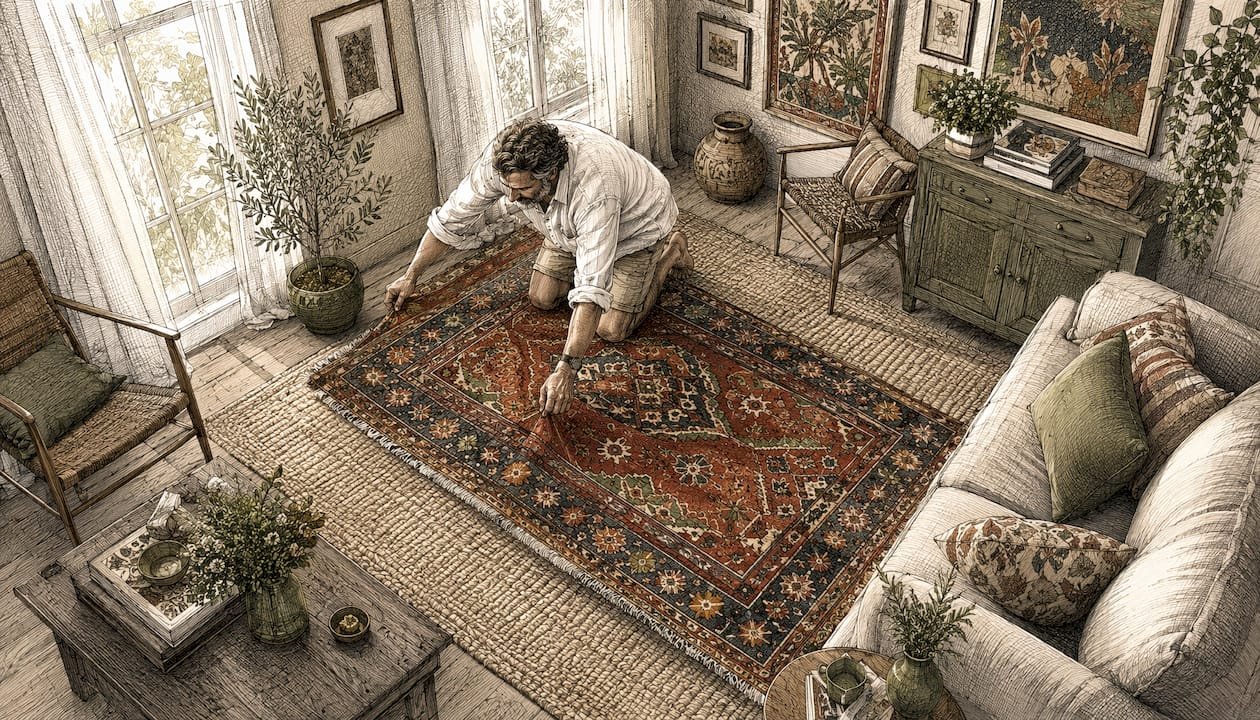
- Centering vs. off-center: Center the top rug within the seating arrangement for a formal, symmetrical look. Angle it slightly off-axis (about 15–20 degrees) for a relaxed, collected feel. Off-center works best in casual or bohemian spaces where the base rug is large enough to absorb the asymmetry.
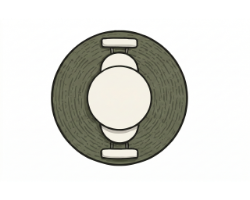
- Dining rooms: The base rug should extend sufficiently beyond the table to accommodate chairs being pulled out comfortably. A very small rug under a dining table is usually not recommended.
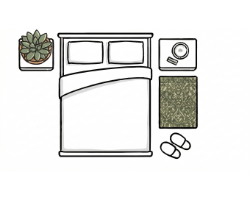
- Bedrooms: Choose a substantially sized base rug to ensure proper coverage under the bed, with ample extension on the sides and foot. Accent rugs can be placed strategically as top layers.
Pro Tip: Before ordering, outline both rug sizes with painter’s tape directly on your floor. Live with the tape for a day. You will immediately see if the top rug is too large or the border too thin, and you will save yourself a return.
For a deeper look at sizing by room, Rugsonlinemarket’s rug size and placement guide walks through every furniture configuration.
How do you pair rug materials and pile heights?
The texture contrast between your two rugs is what makes the layered look work. Without it, the combination reads flat and accidental.
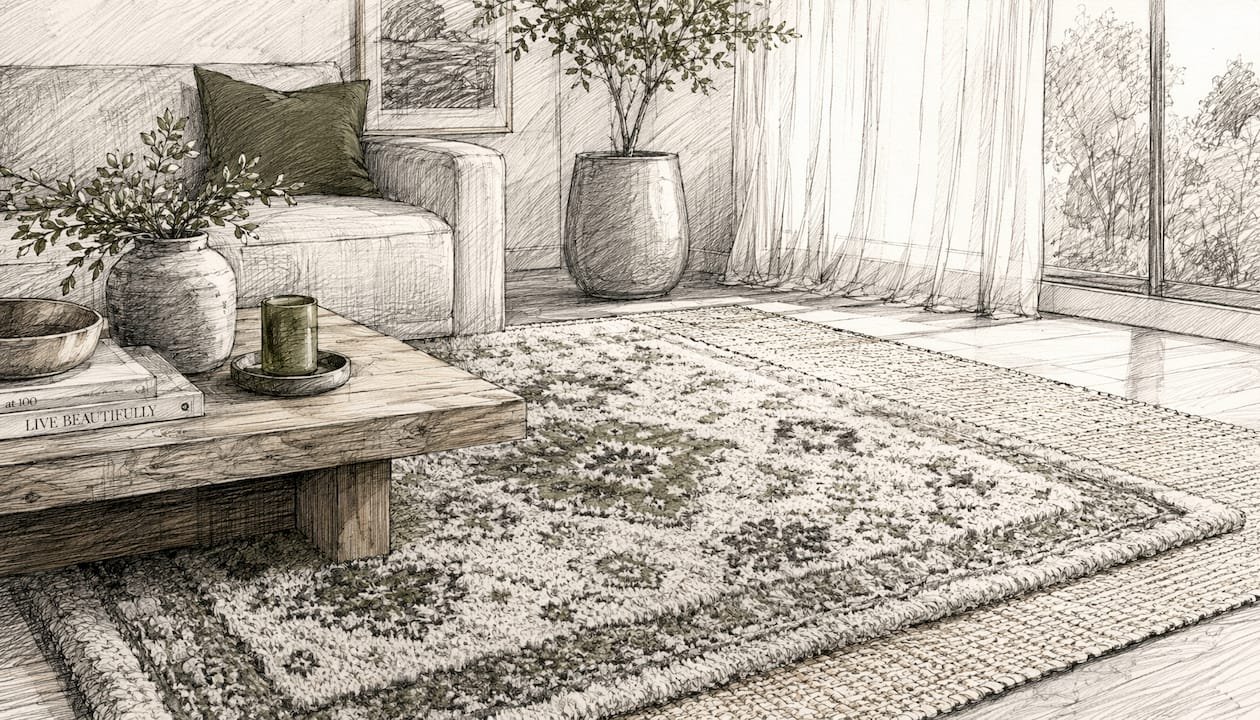
The primary rule: Use a low-profile, natural-fiber base and a higher-pile or patterned top. A flat-weave jute or sisal base reads warm and organic, adds visual interest without competing with whatever sits on top, and stays stable underfoot. A vintage Persian, Oushak, or chunky wool rug placed on top provides the softness and personality.
| Base rug type | Best top rug pairing | Expected effect |
|---|---|---|
| Natural flat-weave (jute, sisal) | Vintage Persian or Oushak | Warm, layered, collected feel |
| Low-pile wool | Chunky or shag accent rug | Textural contrast with added softness |
| Vintage kilim | Solid or tone-on-tone low-pile | Pattern-forward with a grounded base |
| Indoor/outdoor flat-weave | Decorative indoor accent rug | Durable base with a refined top layer |
A few pairings to avoid:
- Two high-pile rugs: The surface becomes spongy and unstable, and the top rug will shift constantly.
- Jute or sisal directly on synthetic loop carpet: The rough backing can pill and pull carpet loops, causing permanent damage. Use a protective barrier pad if you want this combination.
- Two heavily patterned rugs of similar scale: The eye has nowhere to rest. If you want to experiment with two patterns, keep one very small in scale and much quieter in color.
For maintenance, vacuum the base rug with a suction-only attachment (no beater bar on natural fibers) and spot-clean the top rug as needed. Lift both layers every few months to air out the floor underneath and check for moisture. If you want a top rug that handles spills without stress, Rugsonlinemarket’s washable rug options are worth a look, especially for homes with kids or pets.
Comparing wool vs. synthetic fibers is also worth doing before you commit to a top rug, since pile density and fiber type affect how well the layers sit together.
How do you mix patterns and colors so layers look intentional?
The simplest rule: one rug carries the pattern, the other stays quiet. That single constraint prevents the most common layering mistake, which is two rugs competing for attention at the same time.
- Busy + restrained: Pair a bold Persian, geometric kilim, or floral Oushak with a solid or subtly textured base. The base gives the eye a place to rest.
- Use a bridging color: Pull one color from the patterned top rug and repeat it somewhere else in the room, whether in a throw pillow, curtain, or piece of art. That connection makes the layered rug feel like part of the room’s palette rather than a separate element.
- Scale matters: A large-scale pattern on a small rug looks cramped. Match the pattern scale to the rug size. A 5×8 top rug works best with a medium-scale motif; a 6×9 can carry a larger, more dramatic pattern.
- Tone-on-tone layering: If you want a quieter, more sophisticated look, layer two rugs in the same color family but different textures. A cream low-pile wool over a natural jute reads as intentionally understated.
- Neutrals as a reset: When a room already has a lot going on visually, a neutral or monochrome base lets a statement top rug pop without adding chaos. Think charcoal flatweave under a terracotta Moroccan.
For practical color-matching help, Rugsonlinemarket’s color browsing tool lets you filter by hue so you can find a base and top rug that share a bridging tone.
Which shape and layout combinations work best?
Shape mixing adds a dimension of visual interest that same-shape layering rarely achieves.
- Round over rectangle: A round rug (4–6 feet in diameter) centered over a rectangular 8×10 or 9×12 base softens the geometry of a room and works especially well in living rooms with a circular coffee table or in a bedroom at the foot of the bed.
- Runner over area rug: A 2.5×8 or 2.5×10 runner layered over a 9×12 base rug in a living room or hallway creates a strong directional line. Keep the runner centered on the base and oriented the same way.
- Small accent rug, angled: A 3×5 or 4×6 accent rug placed at a slight angle over a larger base adds a relaxed, bohemian quality. This works best when the base is neutral and the accent rug carries a strong pattern.
- Two runners in a bedroom: Instead of one large rug, two 2.5×8 runners placed on either side of a king bed over a low-pile base create a layered effect with practical bedside softness.
| Room | Base rug | Top rug | Layout note |
|---|---|---|---|
| Living room | 9×12 rectangle | 5×8 or 6×9 rectangle | Center top rug in seating group |
| Bedroom (king) | 9×12 rectangle | 4×6 round or 5×8 rectangle | Foot of bed or centered under bed |
| Dining room | 9×12 rectangle | 6×9 flat-weave | Centered under table |
| Hallway | 3×10 runner | 2×8 runner | Centered, same orientation |
Asymmetry works when the base rug is large enough to absorb it. In a narrow hallway or a room with heavy foot traffic, keep both rugs aligned to avoid trip hazards. For placement guidance specific to Persian and patterned rugs, Rugsonlinemarket’s living room placement guide covers the key positioning decisions.
Can you put a rug on carpet, and how do you do it safely?
Yes, and it works well when you match pile heights correctly and use the right pad. The short answer: low-pile rugs on low-pile carpet is the safest combination; thick on thick is the one to avoid.
Carpet compatibility:
- Berber and low-loop carpet: The most stable base for layering. A flat-weave kilim, dhurrie, or low-pile wool rug sits smoothly and stays put.
- Plush or medium-pile carpet: Works with flat-weave or low-pile top rugs. Avoid anything with a pile height over ¼ inch.
- Deep shag or very high-pile carpet: Layering here is genuinely risky. The combined softness creates an unstable, shifting surface. If you must layer, use a very heavy hand-knotted wool rug and a carpet-to-carpet gripper.
Pad selection:
Standard hardwood rug pads do not grip carpet and can leave residue or cause slipping. Use pads specifically designed for carpet-to-carpet installation: plastic-spike grippers, rubber-coated open-weave pads, or hook-style pads. These anchor into the carpet pile on the bottom and grip the rug backing on top.
- Leave a 6–24 inch border of carpet visible around the area rug for a framed, intentional look.
- Avoid jute or sisal directly on synthetic loop carpet. The rough backing damages carpet loops over time.
- In narrow hallways, on stairs, or in homes with mobility aids, skip layering entirely. The added height and potential for shifting creates a real fall risk.
Pro Tip: Look for pads labeled “rug-on-carpet pad” or “carpet-to-carpet pad.” They are thinner and firmer than standard cushioned pads, which prevents the spongy, shifting feel that makes layering on carpet fail.
Room-by-room layering examples you can copy
Living room
- Place a 9×12 jute or natural flat-weave base so the front legs of the sofa and main chairs rest on it.
- Center a 5×8 or 6×9 vintage Persian or Oushak top rug within the seating group.
- Keep the top rug’s edges between the furniture pieces, not tucked underneath them. Both rugs should be visible.
- Weight the top rug with the coffee table legs to prevent shifting.
For Persian rug placement specifics, Rugsonlinemarket’s Persian rug placement guide covers furniture anchoring in detail.
Bedroom
- Place a 9×12 low-pile wool or flat-weave base under the bed, extending 18–24 inches on the sides and foot.
- Layer a 4×6 round or 5×8 accent rug at the foot of the bed for a focal point.
- Alternatively, use two 2.5×8 runners on either side of a king bed as the top layer, placed over the larger base.
Dining room
- Use a 9×12 base rug centered under the table, extending at least 24 inches beyond the table on all sides.
- Layer a flat-weave 6×9 top rug directly under the table. Flat-weave is critical here: chair legs need to slide smoothly, and a high-pile top rug will catch and tip chairs.
- Check that both layers lie completely flat before seating guests.
Hallway and entry
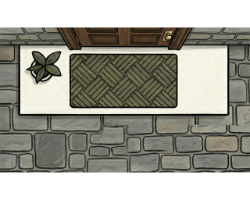
- A 3×10 runner as the base, with a 2×8 runner centered on top, creates a layered entry that feels collected.
- Leave at least 4–6 inches of the base runner visible on each side of the top runner.
- Test the combination with tape first: hallways have the least margin for error on sizing.
How to keep layered rugs safe, clean, and long-lasting
Pad and anchoring options
- Hard floor base: Use a rubber open-weave pad under the base rug to grip the floor without leaving residue.
- Between two rugs: A felt-and-rubber combination pad grips the natural fiber base while holding the top rug in place. Without this second pad, the top rug will migrate within days.
- On carpet: Use a carpet-to-carpet pad with plastic spikes or hook-style grippers. Standard waffle pads are ineffective on carpet.
- Furniture weighting: Position at least one heavy furniture leg partially on the top rug. This is the most reliable low-tech anchoring method when pads alone are not enough.
- Double-sided rug tape: Useful as a supplement at corners and edges, but not as a replacement for a proper pad. Tape alone does not distribute weight evenly and can leave residue on natural fiber rugs over time.
Cleaning and rotation
- Vacuum the base rug with a suction-only setting; avoid the beater bar on jute or sisal.
- Rotate both rugs 180 degrees every 6 months to even out wear and prevent indentations under furniture.
- Lift both layers every 3–4 months to air out the floor and check for moisture, especially in basements or humid rooms.
- Spot-clean the top rug promptly. Stains that soak through to the base rug are harder to address once both layers are in place.
Shopping checklist for pads:
- Labeled “carpet-to-carpet” or “rug-on-carpet” for layering over carpet
- Thickness under ¼ inch for carpet applications
- Open-weave or grid construction for hard floor bases
- Felt-and-rubber combination for between two rugs on hard floors
Designer-tested combinations and why they work
Three combinations that hold up across different rooms and budgets:
- Jute base + vintage Persian accent: The organic texture of jute and the aged palette of a Persian or Oushak create the layered, collected look that designers return to repeatedly. The contrast does the work. This combination suits living rooms, studies, and bedrooms equally well.
- Neutral low-pile wool base + chunky wool top: Two wool rugs in different pile heights and tones create a tone-on-tone effect that reads as quietly luxurious. The key is a meaningful difference in pile height and at least one shade of contrast. Rugsonlinemarket’s luxury rug collection includes wool options suited to both roles.
- Indoor/outdoor flat-weave base + decorative indoor accent: An indoor/outdoor base handles high-traffic areas and spills while the decorative top rug adds personality. This works well in family rooms, mudrooms, and covered porches.
Layering rugs is one of the most cost-effective design moves available to homeowners. A smaller vintage or patterned rug used as a top layer introduces personality and warmth that a single large rug rarely achieves on its own. The base does the structural work; the top rug does the storytelling.
Shopping checklist for layered rug pairs:
- Check pile height on both rugs before buying. The base should be lower-profile than the top.
- Confirm the backing material. Rough natural-fiber backings need a barrier pad on synthetic loop carpet.
- Read the care instructions for both rugs. Mismatched care requirements (one dry-clean only, one machine-washable) complicate maintenance.
- Measure your room and simulate with painter’s tape before ordering.
For styling ideas specific to eclectic and vintage-forward rooms, Rugsonlinemarket’s boho rug guide is a useful starting point.
Environmental considerations and maintenance for layered rugs
Layering two rugs does create some conditions worth managing, particularly around moisture and material longevity.
Natural fibers like jute and sisal absorb humidity. In basements, poorly ventilated rooms, or humid climates, moisture can become trapped between the rug and the floor, creating conditions for mold or mildew. Lift both layers every few months to inspect and air out the surface underneath. If you live in a humid region, consider an eco-friendly synthetic base that resists moisture absorption rather than a natural fiber.
From a sustainability standpoint, layering extends the life of both rugs. A natural fiber base protects the floor and takes the daily wear, while the decorative top rug sees less direct foot traffic and lasts longer. Rotating both rugs twice a year distributes wear evenly and prevents permanent indentations from furniture legs. When a natural fiber base eventually wears out, it can often be composted rather than landfilled, which is a genuine advantage over synthetic alternatives.
Common mistakes to avoid when layering rugs
Most layering failures come down to three things: wrong size, wrong pile combination, or no pad between the layers.
The top rug is too large. If only a thin sliver of the base is visible, the layered effect disappears. The base should read as the dominant layer, with the top rug clearly sitting on top of it, not nearly covering it.
Both rugs have similar colors or textures. A beige rug on beige carpet looks like a mistake. A navy rug on beige carpet looks like a design choice. Contrast, whether in color, pattern, or texture, is what signals intention.
Skipping the pad between layers. Even a beautifully arranged combination will shift and bunch within days without a gripper between the two rugs. This is the most common and most fixable mistake.
Choosing a high-pile top rug on a high-pile base. The instability is immediate and the tripping risk is real. Always step down in pile height from base to top.
Ignoring traffic flow. In a hallway or near a doorway, a layered rug with any height difference becomes a trip hazard. Keep layering to rooms where foot traffic is predictable and the rug edges are weighted or tucked under furniture.
How to style layered rugs in modern, boho, and traditional interiors
Modern and minimalist
In a modern interior, restraint is the point. Use a low-pile wool or flat-weave base in a neutral tone (charcoal, warm white, stone) and layer a single geometric or abstract accent rug on top. Keep the color palette tight, two or three tones at most. The layering adds texture without visual noise. A modern collection rug from Rugsonlinemarket’s modern range works well as a clean, low-profile base.
Bohemian and eclectic
Boho layering is the most forgiving style for mixing patterns, but it still needs a hierarchy. A large jute or sisal base anchors the room, and a vintage Persian, Moroccan, or kilim top rug brings the color and pattern. You can push the rules here: a slight angle on the top rug, a round rug over a rectangle, or even two patterned rugs if one is significantly smaller and quieter in color. The layering home decor objects guide from Lifted+ is a useful companion for extending this approach beyond the floor.
Traditional and formal
Traditional interiors often already have patterned wall-to-wall carpet or a large formal rug. Layering here works best with a flat-weave or low-pile accent rug in a complementary color placed under a coffee table or at the foot of a bed. Keep both rugs in the same color family and avoid clashing motifs. A Persian or Turkish-style top rug over a solid or subtly textured base is the classic traditional combination, and it works because the patterns share a visual language.
Key Takeaways
Layering rugs works when the base is large and neutral, the top rug is smaller and textural, and a proper pad holds both layers in place.
| Point | Details |
|---|---|
| Size gap is non-negotiable | The top rug should be about two-thirds the size of the base, leaving a visible border of base rug (12–18 inches or more) on all sides. |
| Texture contrast drives the look | Pair a flat-weave natural-fiber base with a higher-pile or patterned top rug; two high-pile rugs create an unstable surface. |
| Use the right pad for the surface | On carpet, use a carpet-to-carpet gripper pad; between two rugs on hard floors, use a felt-and-rubber combination pad. |
| Anchor with furniture | Position at least one heavy furniture leg partially on the top rug to prevent shifting when pads alone are not enough. |
| Rugsonlinemarket for base and top rugs | Browse natural fiber bases, low-pile wool, and patterned accent rugs across Rugsonlinemarket’s collection, with free shipping on orders over $300. |
Why layering rugs is worth doing in almost every room
There is a tendency to treat rug layering as a stylistic flourish, something you do when you want a room to look like a magazine spread. The practical case is actually stronger. A large natural fiber base protects the floor, defines the zone, and costs less than a single large statement rug. The top rug introduces the personality without the commitment. If your taste changes, you swap the top rug. The base stays.
The combination that comes up again and again, in rooms of every style and budget, is a jute or sisal base with a vintage or distressed patterned top. It works because the contrast is built in: organic texture against aged pattern, neutral ground against warm color. You do not have to be a designer to get it right. You just have to respect the size hierarchy and use a proper pad.
For homeowners who have been hesitant because the room already has carpet, the answer is almost always yes, you can layer, as long as you match pile heights and use a carpet-specific gripper. The one situation where I would say skip it entirely: deep shag carpet in a high-traffic hallway. Everything else is workable.
Start building your layered rug look with Rugsonlinemarket
Rugsonlinemarket carries the full range you need to build a layered setup from scratch, natural fiber bases in jute and sisal, low-pile wool and flat-weave options, and a deep selection of patterned Persian, Moroccan, Turkish, and Oushak accent rugs that work as top layers in any style of room.

Three good starting points:
- Natural fiber base rugs: Jute and sisal options in sizes up to 9×12 and larger, priced to let you invest more in the decorative top layer.
- Runner rugs: For hallway layering and bedroom side-of-bed setups, the runner category covers the key sizes and styles.
- Shop the full collection: Browse by style, size, material, or color to find a base and top rug that work together.
Free shipping on orders over $300, hassle-free returns within 30 days, and a 100% feedback guarantee mean you can order both rugs, test the combination at home, and return what does not work.
Useful sources and further reading
- Layered Rugs: Designer Ideas for a More Elevated Home — Detailed designer guidance on proportions, pad selection, and combination logic.
- Can You Put a Rug on Carpet? Complete Layering Guide — D and G Flooring’s comprehensive guide to carpet compatibility, pad types, and safety.
- How to Decorate with Layered Rugs and Carpets — Architectural Digest’s archive of designer rooms using layered floor coverings.
- How to Layer Rugs: Advice and Inspiration from Designers — Better Homes & Gardens designer interviews and budget-friendly layering strategies.
- Tips for Using an Area Rug on Carpet — The Spruce’s sizing and pile-height guidance for layering over wall-to-wall carpet.
- The Role of Area Rugs in Design: A 2026 Guide — Broader design rationale for area rugs and their function in styled rooms.
For warranty concerns about layering over specific carpet types, consult your carpet manufacturer’s care documentation directly. For complex installations in commercial spaces or homes with mobility considerations, a professional flooring installer can assess pile compatibility and anchoring options on-site.
