















































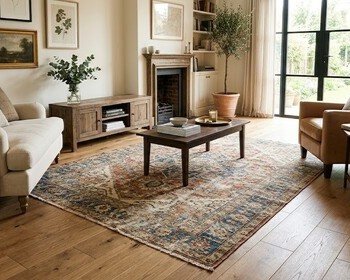








For most rooms, a rug pad between 1/4 and 3/8 inch thick is the right choice. Go thinner, around 1/8 to 1/4 inch, under flatweaves, small rugs and anywhere a door has to swing over the rug. Go thicker only under plush rugs in low-traffic rooms where you want extra softness. The thickest pad is rarely the best one, and the details below show why.
Key takeaways
- Rug pads generally run from 1/16 to 1/2 inch thick. For living rooms and bedrooms with light to moderate traffic, 1/4 to 3/8 inch is typically adequate.
- Thinner pads (1/8 to 1/4 inch) suit flatweave rugs, small rugs and spots with limited door clearance. Thicker 3/8-inch pads are for plush rugs and formal rooms.
- A pad that is too thick can make edges a tripping hazard and let the rug ripple or shift. Add the pad height to the rug height before you buy.
- Material matters as much as thickness: felt with a rubber backing is the safest all-round pick, and solvent-based adhesives or thin PVC waffle mats can damage wood finishes.
Table of Contents
- What the standard thickness range actually is
- 1/4 vs. 3/8 inch: which one to pick
- Match the pad to the rug, not just the room
- Do the door clearance math before you order
- Why a pad that is too thick causes trouble
- Thickness is only half the story: material
- Thickness for hallways, stairs and heavy-use areas
- A simple way to choose in five steps
- Our perspective
- Find the rug, then the pad
- FAQ
- Sources
What the standard thickness range actually is
Pad makers sell everything from paper-thin grippers to cushions about half an inch deep. The Carpet Cushion Council’s residential guidelines put the usual range at 1/16 to 1/2 inch, with 1/2 inch as the recommended maximum for most standard applications. Light-to-moderate traffic areas such as living rooms and bedrooms are typically fine with 1/4 to 3/8 inch.
One caution about those numbers. The industry’s installation standard, CRI 105, is written for wall-to-wall carpet that is stretched over cushion and fastened at the edges. It says residential cushion should not exceed 7/16 inch. An area rug is not stretched or anchored that way, so the same logic applies even more strongly: a thick, springy layer under a loose rug gives it room to bunch and creep.
Here is how the common sizes break down in practice.
| Pad thickness | Best for | Watch out for |
|---|---|---|
| 1/16 to 1/8 inch | Low-profile grip under flatweaves, runners, small rugs, tight door clearance | Little cushioning; mostly about grip and floor protection |
| 1/4 inch | The all-rounder: living rooms, bedrooms, dining rooms, hallways | Check door clearance if the rug is also thick |
| 3/8 inch | Plush or formal rooms where cushioning is the goal | Edges become noticeable; avoid under heavy-pile rugs |
| 1/2 inch | Dense, low-traffic spots under sturdy rugs | Highest tripping and rippling risk; rarely needed |
1/4 vs. 3/8 inch: which one to pick
These two sizes cover most purchases, so it helps to separate them clearly.
Choose 1/4 inch when the rug is a flatweave, a kilim, a thin hand-knotted piece, a runner, or anything that sits near a door or on a threshold. The Houzz guidance on rug pads recommends thinner pads of 1/8 to 1/4 inch for flatweaves and areas with door-clearance limits, to avoid creating a trip hazard. A quarter inch is also the thickness Wirecutter’s testers rated most comfortable: they found the 1/4-inch Mohawk Home Dual Surface pad the most springy underfoot, with better grip than most pads tested.
Choose 3/8 inch when the rug has a plush hand, the room is formal or low-traffic, and you want that sink-in feel. The same Houzz piece describes 3/8 inch as typically reserved for plush rugs and formal rooms where maximum cushioning is desired.
If you are torn, pick the thinner one. You can always feel a rug that is a little firm underfoot. You cannot easily fix one that curls at the edges or catches a toe.

Match the pad to the rug, not just the room
Thickness is a three-way balance between the rug’s own pile, the floor and the traffic. Start with the rug.
Low-pile, flatweave and hand-knotted rugs
These rugs have little built-in cushion, so a 1/4-inch pad adds comfort without changing the profile much. A flatweave on a 3/8-inch pad starts to look and feel like it is floating. For very small rugs, such as a 3×5 at a sink or entry, the Houzz article recommends a thin pad so there is no sudden change in height. Our entryway rug guide covers sizing for those spots.
High-pile and plush rugs
A deep pile already provides loft. Stacking a thick pad underneath gives you a rug that is soft in the middle and awkward at the edge, and it can feel unstable under furniture legs. Keep the pad at the lower end of the range, or choose a firm 1/4-inch felt pad so the pile does the cushioning.
Rugs layered over carpet
When the floor is already soft, the pad’s job is to keep the rug from creeping and bunching, not to add cushion. Use a thin, grippy pad made for carpet, and cut it smaller than the rug. We walk through the setup in layering rugs on carpet and in our guide to rug pads for carpet, including why the pad should sit about an inch inside the rug’s edge.
Do the door clearance math before you order
This is the step shoppers skip most often. Measure the gap between your floor and the bottom of any door that opens over the rug. Then add the rug’s pile height to the pad thickness. If the total is close to the gap, the door will drag, and you will end up trimming the door or removing the pad.
A quick worked example: a rug with 1/2 inch of pile on a 1/4-inch pad stands 3/4 inch off the floor. That is a lot for a door with a gap smaller than that. Switching to a 1/8-inch pad drops the total to 5/8 inch. Measure your own door; the gap varies from house to house.

The same rule protects you at the rug’s edges. Anyone walking across will feel a step that is the sum of the rug and pad, and kids, pets and anyone carrying laundry will find it first. Tape out the rug footprint before you buy, as we suggest in our 5×7 vs 8×10 rug comparison, and walk over the edges.
Why a pad that is too thick causes trouble
Three problems show up repeatedly.
- Tripping at the edges. More height means a bigger step. Thin rugs on thick pads are the worst combination.
- Rippling and buckling. The CRI standard exists because cushion that is too thick or too soft lets carpet shift and wrinkle. Industry guidance also stresses that a pad should never be used to make up for a poor-quality carpet, and that a too-soft pad can stretch it unevenly. The principle carries over: firm support beats squishiness.
- Furniture instability. Chairs and sofa legs on a tall, soft stack wobble. If a rug sits under a dining table, keep the pad thin and firm so chairs can slide.
Thickness is only half the story: material
Two pads with the same thickness can behave very differently on your floor.
- Felt and rubber combination. Wirecutter’s reviewers favor this construction for most homes. The felt provides comfort and breathability and the rubber backing supplies the grip to keep a rug from sliding on hard floors. One pad Wirecutter recommends comes in 0.25-, 0.5- and 0.75-inch versions, which shows how widely thickness varies by brand, so always read the actual spec, not the product name.
- Solvent-based adhesives and thin PVC waffle mats. Experts advise avoiding pads with solvent-based adhesives, which can permanently damage hardwood or luxury vinyl floors. Some PVC waffle-style mats can bond to a finish, discolor it or leave a sticky residue. Our rug pads for hardwood comparison goes through which materials put a finish at risk, and rugs on hardwood covers the rest of the setup.
- Porous felt and vacuuming. Wirecutter notes that porous materials like felt let air through, which improves suction when you vacuum the rug. A dense, non-porous pad can make the rug harder to clean.
If slipping is your main complaint, see how to stop a rug slipping on any floor type before you simply buy a thicker pad. Grip comes from the backing, not from the height.
Thickness for hallways, stairs and heavy-use areas
Intuition says high-traffic spots need extra cushion. The Carpet Cushion Council’s commercial guidelines suggest the opposite: for busy hallways and stairs, choose a higher-density cushion even if it is slightly thinner, because density gives better durability and stops the carpet from moving. In the residential context, that means a firm 1/4-inch pad under a runner will outlast and outperform a soft, thick one.
Durability is also a question of what sits on top. If you are outfitting a hallway with fabric-based accents or runners, this explanation of fabric durability is a helpful read on how weave and fiber affect wear. Pair a tough runner with a firm pad and it will hold its shape for years. Browse runner rugs if a long narrow space is what you are furnishing.
A simple way to choose in five steps
- Check the floor. Hardwood and luxury vinyl need a felt or felt-and-rubber pad without solvent adhesives. Carpet needs a thin, grippy pad.
- Measure rug pile and door gap. Add pile height and pad thickness. Leave room for the door.
- Pick a base thickness. 1/4 inch for most rugs, 1/8 inch for thin or tight spots, 3/8 inch for plush rugs in quiet rooms.
- Size the pad. It should be about an inch smaller than the rug on every side, so the edge of the rug lies flat over the pad rather than curling around it. For round rugs, reduce the radius by the same amount.
- Test it. Lay the rug on the pad for a day. Walk over the edges, open the doors, slide a chair.
Our perspective
We sell rugs in many constructions, from hand-knotted and handmade pieces to flatweaves, runners and washable styles, and the pad question comes up with almost every one. Our view is simple: the pad should disappear. If you notice it, because an edge catches your foot or a door scrapes, it is the wrong pad.
That is why we steer people to 1/4 inch as a starting point and treat thicker pads as a deliberate choice for plush rugs, not a default upgrade. A hand-knotted wool rug is heavy and dense, and it rarely needs help staying put. What it needs is a pad that protects the floor and the back of the rug without lifting it. We also tell customers to match the pad to the rug’s pile and to measure before they buy, since a rug that fits the room can still fail at the door.
— ROM team
Find the rug, then the pad
If you are still choosing the rug, start with the room. Our living room rugs and handmade rugs collections list styles, sizes and materials side by side, and our living room rug size guide helps you settle on dimensions first. Orders over $300 ship free, and returns are accepted within 30 days. Once the rug is picked, you will know its pile height and can choose the pad thickness with confidence.
FAQ
How thick should a rug pad be for a living room?
A thickness of 1/4 to 3/8 inch is typically adequate for living rooms and other light-to-moderate traffic areas. Use 1/4 inch if the rug is flat or thin or sits near a door, and 3/8 inch for a plush rug where you want extra softness.
Is a 1/2-inch rug pad too thick?
For most homes, yes. The Carpet Cushion Council treats 1/2 inch as the maximum for standard applications, and a pad this tall raises tripping, rippling and door-clearance problems. It can work under a sturdy, dense rug in a quiet corner, but few rooms need it.
What are the main types of rug pads?
The common types are felt, rubber, and felt-and-rubber combinations, plus thin PVC waffle-style mats. Felt-and-rubber is the best fit for most homeowners, and you should avoid pads with solvent-based adhesives or PVC that can discolor wood and vinyl floors.
Does a thicker rug pad make a rug last longer?
Not by thickness alone. A pad protects the rug’s back from abrasion against the floor, but density and material quality do more for durability than height. A firm, dense pad of moderate thickness usually outlasts a thick, soft one.
What pad goes under a thin rug?
A 1/4-inch felt-and-rubber pad adds comfort and grip without creating a noticeable edge. For very small or very thin rugs, 1/8 inch keeps the profile low.
Sources
- Carpet Cushion Council: residential minimum recommendations
- Carpet Cushion Council: commercial guidelines
- CRI 105: standard for installation of residential carpet
- Houzz: prevent slips and floor damage with the right rug pad
- Wirecutter: the best rug pads
- Wirecutter: get thee a rug pad
