

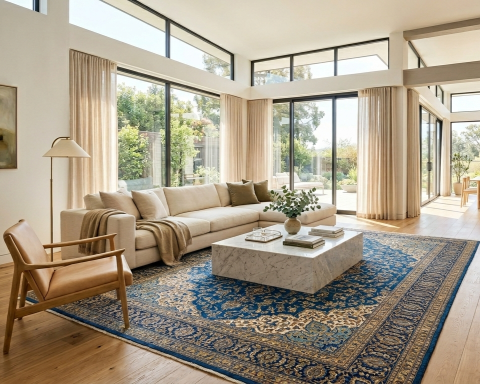
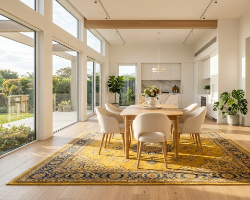
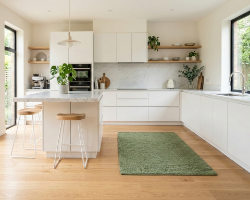
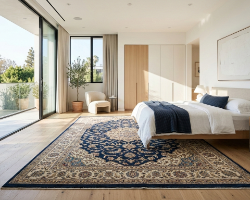
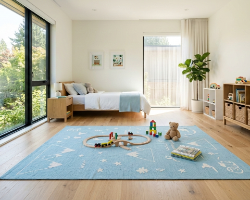
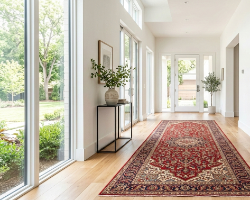
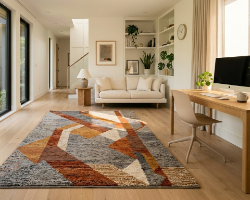
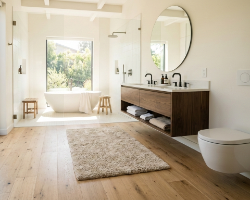

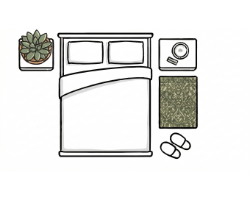
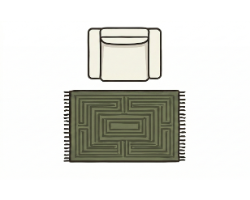
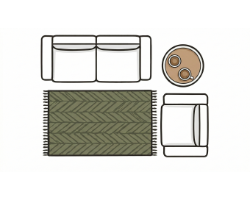
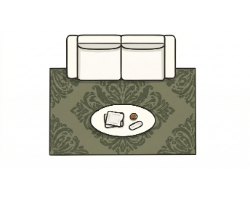
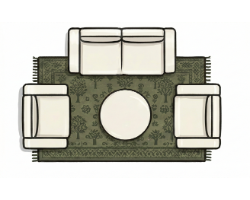
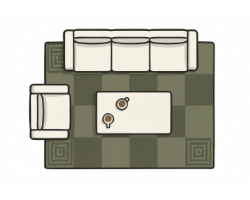
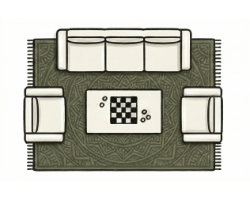
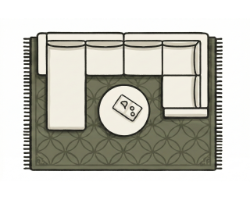
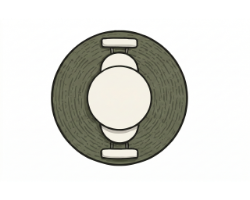

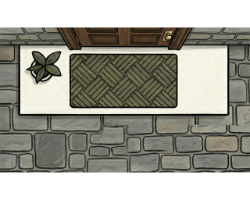
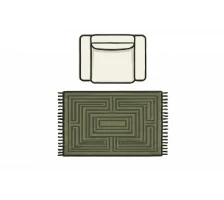





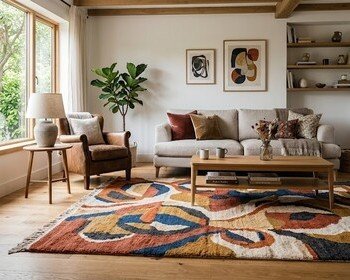

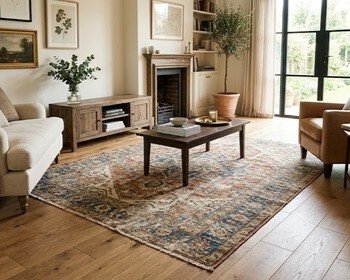
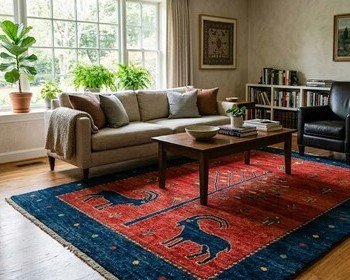
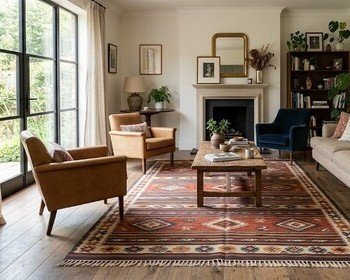
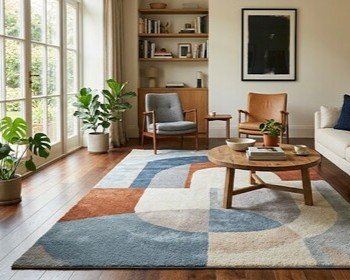

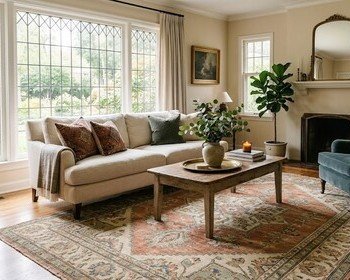
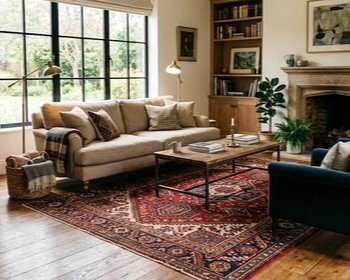
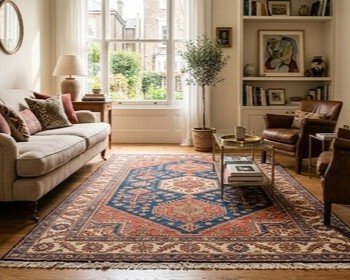
Choose a 5×7 when you need an accent piece for a defined small zone, like a reading chair or an entry bench. Choose an 8×10 when the rug has to anchor a furniture group, such as a sofa and two chairs sharing one visual base. A 5×7 measures 60 by 84 inches (35 square feet); an 8×10 measures 96 by 120 inches (80 square feet), a difference big enough to change how a whole room reads. Rugsonlinemarket lists exact dimensions on every product page, and room-by-room guidance below will settle any remaining doubt.
TL;DR:
- A 5×7 rug is ideal for accenting small zones or defining a corner, while an 8×10 better anchors full furniture groups in most living rooms.
- To ensure proper fit, tape out both sizes on your floor and check door swings, traffic flow, and aesthetics before purchasing.
- For rooms with a sofa or sectional, an 8×10 typically supports a front-legs-on layout, whereas a 5×7 may look too small under standard furniture.
- In bedrooms, an 8×10 offers balanced coverage for queen beds, while 5x7s often look undersized unless used as foot-of-bed accents.
- Expect the price of an 8×10 to be roughly 129% higher than a 5×7 due to more material, and larger rugs generally require professional cleaning and heavier handling.
Table of Contents
- 5×7 vs 8×10 Rug: A Quick Side-by-Side
- How Much Floor Each Size Covers, and How to Test It First
- Choosing Between 5×7 and 8×10 for Living Rooms
- Bedroom Placement: Matching Rug Size to Bed Size
- Dining Rooms, Offices, and Small Zones
- A Decision Checklist Before You Buy
- What Size Changes Cost and How You’ll Care for It
- An Editor’s Note on Getting Rug Size Right
- Buy the Right Size With Less Risk
- Sources
- FAQ
5×7 vs 8×10 Rug: A Quick Side-by-Side
The numbers tell most of the story before you even get to furniture. A 5×7 rug measures 60 by 84 inches and covers 35 square feet, while an 8×10 measures 96 by 120 inches and covers 80 square feet. That’s roughly 45 more square feet of floor, about 129 percent more material, for the larger size. In metric terms, 5×7 works out to about 152 by 213 centimeters, and 8×10 lands around 244 by 305 centimeters.
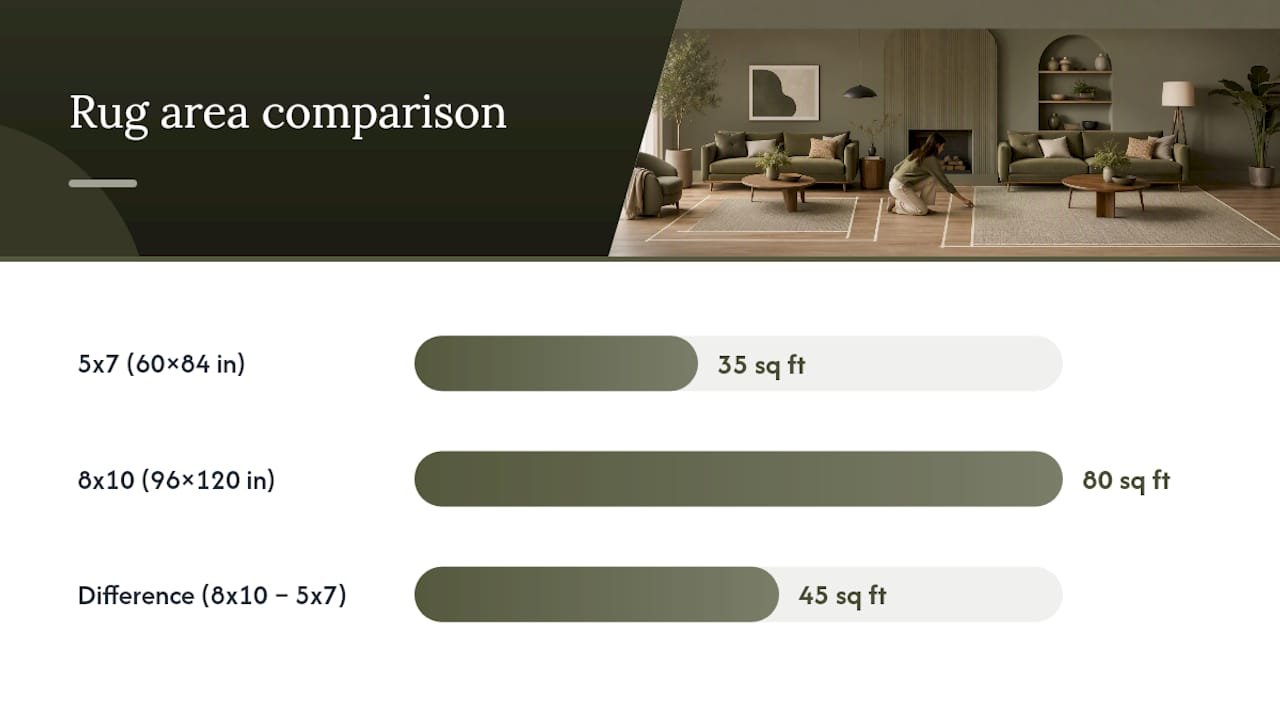
The real question isn’t which size is “better.” It’s whether the rug needs to physically connect your furniture into one grouping or simply define a smaller functional pocket of the room. That single factor decides almost everything else: price, portability, and how the room feels once the piece is down.
5×7 rug benefits:
- Works as a standalone accent under a coffee table, reading chair, or entry bench without swallowing the room.
- Lighter and easier to lift, rotate, shake out, or run through a washing machine if it’s a low-pile design.
- Costs noticeably less since it uses less than half the material of an 8×10.
8×10 rug advantages:
- Anchors a full seating group so the sofa, chairs, and coffee table share one visual base instead of floating separately.
- Reads as “finished” in most medium to large living rooms, which is why most living rooms favor an 8×10 or larger.
- Better suited to open-concept layouts where the rug has to visually separate the living area from a dining or hallway zone.
If your furniture already touches or nearly touches each other, a 5×7 might be fine. If there’s real distance between the sofa and the chairs across the room, an 8×10 is doing a job a 5×7 physically cannot.
How Much Floor Each Size Covers, and How to Test It First
Eighty square feet versus 35 square feet doesn’t mean much until you see it on your own floor. The extra 45 square feet on an 8×10 usually shows up as an additional 18 inches or so of visible rug around each edge of a centered furniture group, compared to a 5×7 tucked under the same setup. That’s the difference between a rug that looks like a placeholder and one that looks intentional.
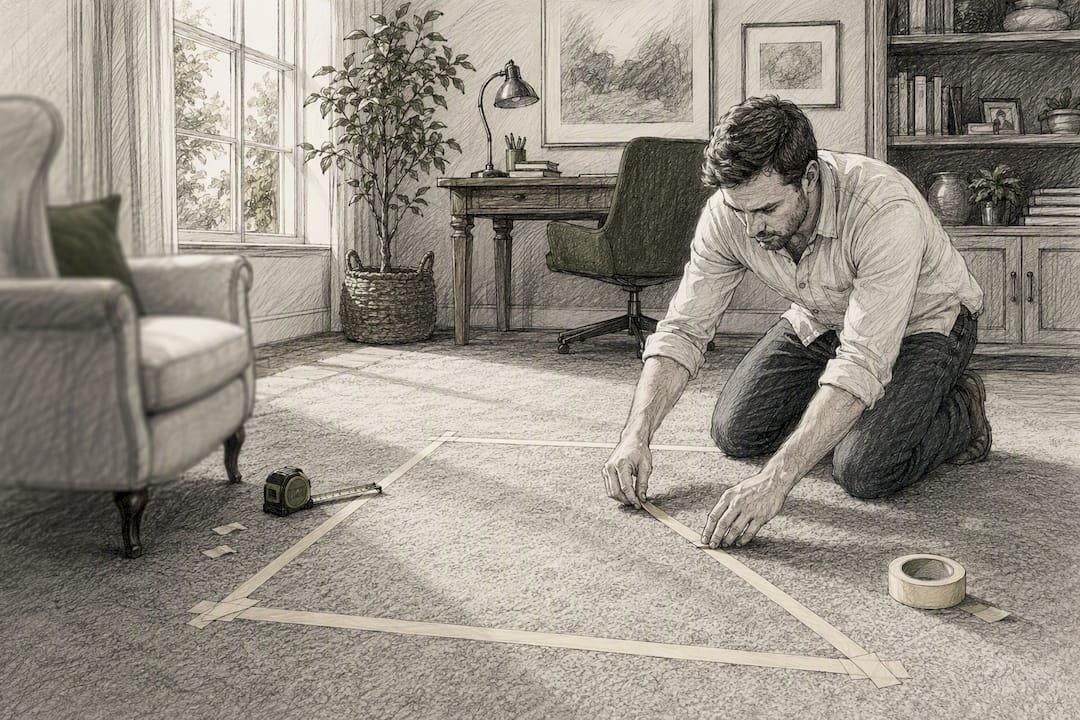
A tape-out test removes the guesswork entirely, and it’s the single best-known method for avoiding an expensive returns headache.
- Measure your room’s usable floor space, subtracting for doorways and traffic paths.
- Mark the four corners of a 5×7 footprint with painter’s tape, then do the same for an 8×10 in a different color.
- Set your actual furniture (or boxes matching its footprint) onto each taped zone.
- Walk the room as you normally would, checking whether door swings, walkways, or console drawers get blocked.
- Stand back from the doorway and look at both footprints from the entrance, where you’ll actually judge the room’s first impression.
Watch for tight spots near hallway entries and swinging doors. A rug that blocks a door from opening fully is a rug that gets kicked or bunched within a month.
Pro Tip: Tape out the footprint and then actually sit in your usual spot on the sofa. If your feet land off the rug’s edge, size up. That one detail catches more sizing mistakes than any measurement on paper.
Choosing Between 5×7 and 8×10 for Living Rooms
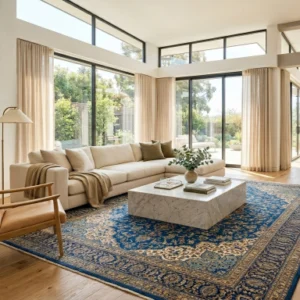
Living rooms are where this decision matters most, because sofa layout drives everything. There are two placement styles worth knowing before you pick a size: front-legs-on, where only the front legs of your sofa and chairs rest on the rug, and all-legs-on, where the entire furniture group sits fully on top of it. All-legs-on tends to look more polished and cohesive, but it requires more rug.
For a standard 3-seat sofa paired with two accent chairs, an 8×10 is usually the minimum size that supports a front-legs-on layout without looking cramped. If your living room measures somewhere between 12×14 and 14×16 feet, treat 8×10 as close to a floor, not a ceiling. A large sectional often needs 8×10 or bigger just to keep every seat connected to the same rug.
A 5×7 still has a real place in living rooms, though. It works well in:
- A small apartment living room where an 8×10 would touch every wall.
- A defined reading nook with a single chair and side table, separate from the main seating area.
- A secondary conversation area in an open-concept space that already has a larger rug anchoring the primary sofa group.
Community threads on sizing debates back this up from the buyer’s side: homeowners frequently report that a 5×7 looked too small once placed under a sofa, and many ended up exchanging for an 8×10 to get a finished look. That’s not a universal rule, but it’s a pattern worth taking seriously before you buy.
Whichever size you land on, orientation matters as much as dimensions. Center the rug on the seating group, not on the room itself, since those two centers rarely line up. And leave a visible margin of floor between the rug’s edge and the wall. A commonly cited design rule calls for 12 to 18 inches of exposed floor at the perimeter to keep the room from feeling like it’s wearing a rug that’s slightly the wrong size. Skip that margin, and even an 8×10 can look like it’s trying to be wall-to-wall carpet and failing.
A 5×7 pushed halfway under a sofa, with the front legs floating just past the rug’s edge, is the classic “floating rug” mistake. It reads as unfinished no matter how nice the rug itself is. If you can’t commit to a full front-legs-on or all-legs-on placement, that’s usually a sign the rug is too small for the space, not that the layout is wrong. For deeper placement mechanics, Rugsonlinemarket’s living room sizing guide walks through centering rules for several sofa configurations, and tips on placement with Persian-style rugs cover orientation choices for patterned pieces specifically. Design writers elsewhere echo the same front-legs-versus-all-legs logic, including a breakdown of sofa rug sizing rules that’s worth a look if you’re still on the fence about which layout suits your sofa.
Bedroom Placement: Matching Rug Size to Bed Size
Bedrooms follow a simpler formula than living rooms because the anchor point (the bed) doesn’t move. A 5×7 works best as a foot-of-bed accent for a twin bed, or as a small layered piece paired with a larger rug underneath a queen or king frame. On its own, though, a 5×7 tends to look undersized next to anything larger than a twin.
For a queen bed, an 8×10 gives balanced coverage on both sides and at the foot, which is why it’s the size most bedroom guides default to. Most king beds need to step up further, to a 9×12, simply because the mattress footprint alone eats into more of a 8×10’s width.
Two placement approaches work depending on the look you want:
- Full-under placement: the rug extends past the bed on all sides, with enough width to let nightstands sit fully or partially on it too.
- Partial-under placement: the rug slides under just the foot and lower third of the mattress, leaving the head of the bed on bare floor.
A commonly cited visible-floor rule applies here as well: aim for roughly 18 to 24 inches of rug showing on each side of the bed and at the foot, so the rug reads as a frame rather than a scrap peeking out from under the frame. When a 5×7 gets centered under a queen or king, you’ll often see almost no rug at all on the sides, just a sliver at the foot. That’s the unbalanced look that signals it’s time to size up.
For layout specifics by bed frame, Rugsonlinemarket’s bedroom placement guide covers sizing for platform beds, four-posters, and daybeds, where the frame shape changes how much rug actually shows.
Dining Rooms, Offices, and Small Zones
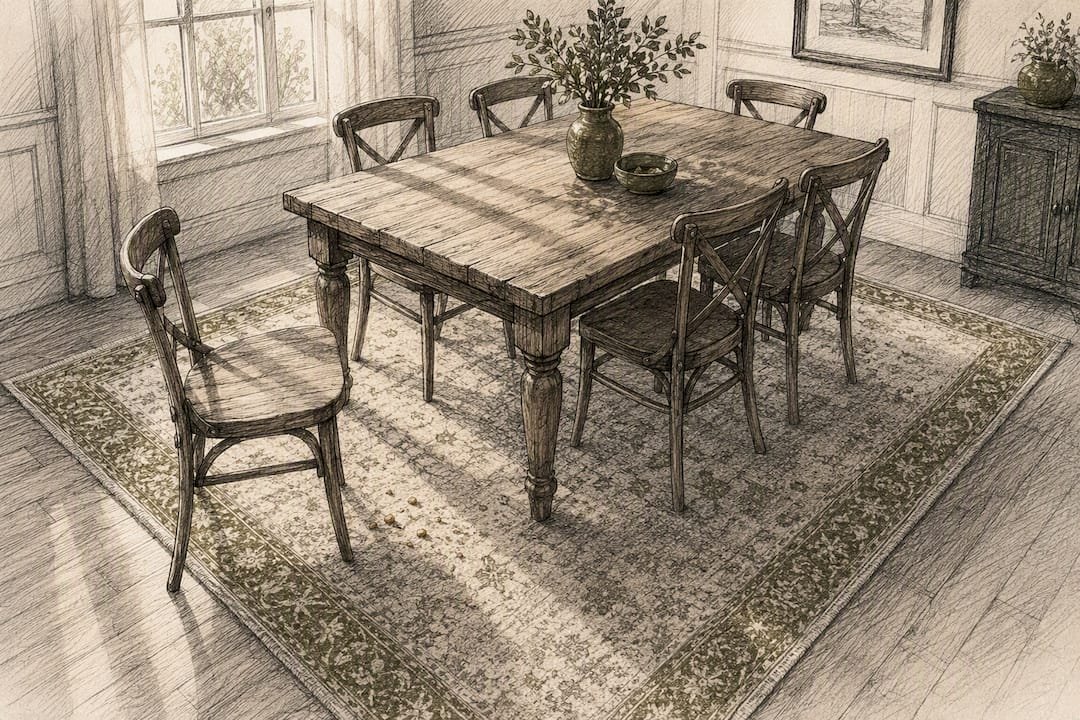
Dining rooms punish undersized rugs faster than any other room, because chairs move. The standard rule is to allow about 24 inches of rug beyond the table’s edge in every direction, which accounts for the chair being pulled back during use. For a four- to six-seat table, that clearance calculation almost always points to an 8×10 as the safe minimum; a 5×7 will trap back chair legs off the rug’s edge the moment someone leans back.
Home offices are a different problem entirely. A desk chair on casters needs a stable, snag-free surface, and a 5×7 sitting loose on hardwood can shift, bunch, or catch under repeated rolling. If you want a rug in a home office, size up to a 6×9 for more stable footing, or switch to a low-pile hard-floor mat designed for chair casters.
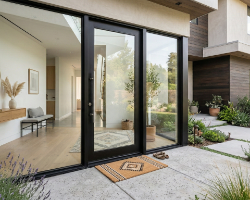
Entries and small nooks are where the 5×7 genuinely shines. A console table and bench in a foyer rarely need more than 35 square feet of rug beneath them, and an 8×10 in that same space would crowd the walking path. Dining and entry rug placement guidance covers exact clearance math for different table shapes if you’re sizing a specific set. And for narrower hallway-style entries, a runner rug often solves the space problem that neither a 5×7 nor an 8×10 was built to handle.
A Decision Checklist Before You Buy
Skip the guesswork and run through this sequence before ordering either size:
- Measure the full room, then measure the actual furniture footprint you want the rug to serve.
- Add clearance: roughly 24 inches beyond a dining table, 18 to 24 inches around a bed, 12 to 18 inches of visible floor near living room walls.
- Tape out both candidate sizes on the actual floor and compare them side by side.
- Walk the taped zones and check for blocked door swings or tight traffic paths.
- Decide whether the rug’s job is to accent one small area or anchor a furniture group, since that answer usually settles the size on its own.
Answer three questions honestly before you check out: Does this rug need to physically connect your sofa, bed, or table to the rest of the seating group? Are your chairs fixed in place, or do they get pulled back regularly? Is portability, like tossing the rug in the wash, a priority for your household?
The math is worth repeating here because it drives the price conversation too: an 8×10 covers 80 square feet against a 5×7’s 35, a jump of about 129 percent in material. That’s not a rounding error. It’s the reason an 8×10 in the same collection, same material, same construction, typically costs meaningfully more than its 5×7 counterpart. Budget for that jump before you fall in love with a specific rug at the wrong size.
What Size Changes Cost and How You’ll Care for It
More square footage means more material, and that shows up directly in price. Since an 8×10 uses about 129 percent more material than a 5×7, expect the price gap between the two sizes in the same collection to be substantial, not incremental.
Cleaning differs by size too, though pile height and material matter just as much as square footage:
- Smaller, low-pile 5×7 rugs are often machine-washable, which makes them a practical pick for households with pets or heavy foot traffic who want to toss a rug in the wash rather than schedule a cleaning appointment.
- Larger 8×10 rugs, especially wool or silk-blend pieces, generally call for professional cleaning rather than home washing, since the Carpet & Rug Institute’s maintenance guidance recommends care matched to fiber type and construction.
- A rug pad sized slightly smaller than the rug itself prevents slipping and adds real cushioning underfoot, and this matters more as size (and price) increases.
- Larger rugs are heavier to unroll, stage, and rotate for even wear, so plan for an extra set of hands when an 8×10 arrives.
Shipping and returns should factor into the decision too, especially if you’re testing a size you’re not fully sure about. Rugsonlinemarket offers free shipping on orders over $300 and accepts returns within 30 days, which gives you room to try a size, live with it for a couple of weeks, and send it back if it doesn’t work.
An Editor’s Note on Getting Rug Size Right
I’ve noticed that most rug-sizing advice stops at “measure your room,” which is barely half the job. The room isn’t what a rug has to fit. The furniture group is. A 5×7 and an 8×10 can sit in identical 14×16 rooms and produce completely different results depending on whether the sofa’s front legs land on or off the rug.
Taping out the footprint before buying isn’t optional, in my view. It’s the only step that catches the gap between a rug that looks right in a product photo and one that looks right under your actual sofa. Photos flatten perspective and hide how much floor is really left exposed once furniture sits down. A rug pad guide won’t tell you that; a piece of painter’s tape on your own floor will.
If there’s one habit worth adopting, it’s sizing up when in doubt rather than down. An oversized rug reads as a design choice. An undersized one reads as a mistake, every time.
— Kian
Buy the Right Size With Less Risk
Rugsonlinemarket makes testing a size before committing genuinely low risk, which matters more than any style feature once you’ve done the tape-out math above. Every product page lists exact dimensions so you’re never guessing between a listed “5×7” that runs slightly small and one that runs true to size.

A few practical advantages worth using as you shop:
- Size filters on every category page let you jump straight to 5×7, 8×10, or the in-between sizes like 6×9 without scrolling through unrelated dimensions.
- Returns within 30 days give you room to live with a rug in your actual living room before deciding it’s right.
- Free shipping on orders over $300 makes it easier to order the larger, pricier 8×10 without an added shipping penalty.
If your household deals with pets, kids, or heavy foot traffic, start with the washable rug options, where smaller sizes are easiest to maintain at home. Measure your furniture footprint, tape it out, then order with the confidence that a 30-day return window has your back if the size still isn’t quite right.
Sources
- 5×7 vs 8×10 Rug: Which Size Fits Your Room and Furniture?
- What Size Rug Do I Need? A Sizing Guide for Every Room — The Journal | Maison Perrin
- 6×9 Rug Size Comparison: How It Measures Up Against Other Sizes – D and G Flooring
- Carpet & Rug Institute — Cleaning and maintenance
FAQ
Is a 5×7 rug too small for a living room?
It depends on the seating group. A 5×7 works for a single chair or a small apartment layout, but it’s often too small once you add a full 3-seat sofa and accent chairs, since it can’t support a front-legs-on placement for the whole group.
Is it better for a rug to be too big or too small?
Sizing up is almost always the safer call. An oversized rug still reads as intentional once trimmed toward proper wall clearance, while an undersized rug tends to look like an afterthought, a pattern echoed in homeowner sizing discussions.
What rug size is between 5×7 and 8×10?
A 6×9 rug sits in the middle, covering about 54 square feet compared to 35 for a 5×7 and 80 for an 8×10, making it a solid fit for compact living rooms that need more coverage than a 5×7 without going full 8×10.
Is an 8×10 rug big enough for a living room?
Yes, in most medium to large living rooms an 8×10 is the standard recommendation, and designers frequently point to 8×10 or larger as the baseline for rooms in the 12×14 to 14×16 foot range. Larger rooms or full sectionals may still need to step up to a 9×12.
