

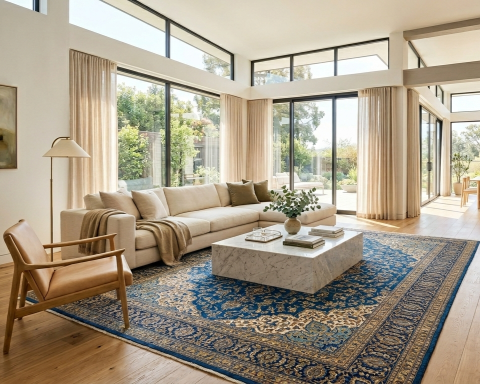
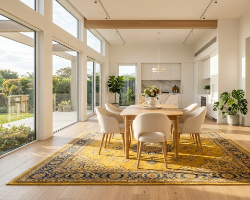
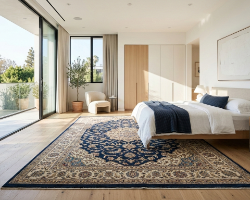

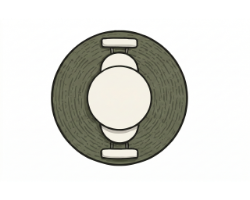




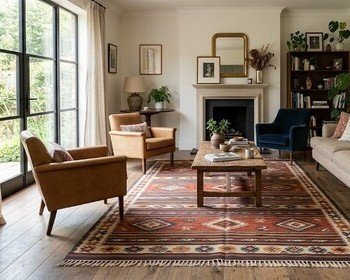
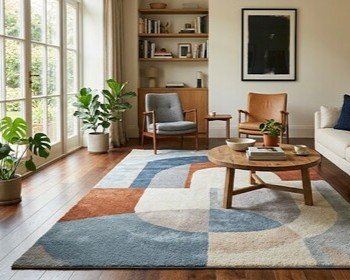


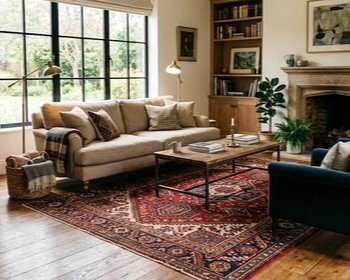
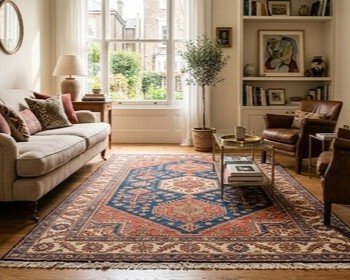
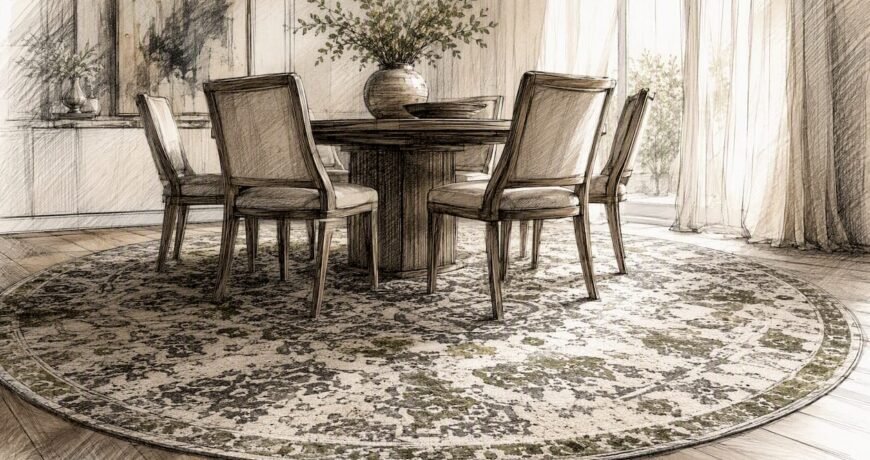
Pick a rug that extends at least a generous distance beyond every side of your dining table so chairs stay fully on the rug when pulled out. That single rule, backed by interior design standards, eliminates the most common dining rug mistake: buying a rug that looks fine until someone actually sits down. For deeper chairs or host seats at the ends of the table, increase that clearance to a larger distance to ensure ample space. The result is a rug that frames the dining group rather than floating awkwardly beneath it.
Before you buy, run through this quick checklist:
- Measure your table’s length and width.
- Add a suitable amount beyond each dimension of your table to determine your minimum rug size.
- Match rug shape to table shape: rectangular table gets a rectangular rug, round table gets a round rug.
- Mark the intended rug perimeter on the floor with painter’s tape to confirm scale.
- Plan for a rug pad cut slightly smaller than the rug to prevent shifting.
Rugsonlinemarket carries dining-ready options across every size and construction, from washable flatweaves to premium wool, with free shipping on orders over $300 and hassle-free returns within 30 days.
Pro Tip: If you have an extendable table, size the rug for the table at its fully extended length. A rug that works only when the table is collapsed will look wrong every time you host.
Table of Contents
- What are the actual sizing rules for a dining room rug?
- Rug size chart: which size fits your table?
- How do you measure and place a rug under a dining table?
- Which rug fibers and weaves actually work under a dining table?
- How do you keep a dining rug clean?
- Why do designers insist on rugs in dining rooms?
- Key Takeaways
- The rule most people get wrong
- Rugsonlinemarket has the dining rug you’re actually looking for
- Useful sources
What are the actual sizing rules for a dining room rug?
The minimum clearance rule exists because a dining chair requires a comfortable pull-out distance to seat someone properly. If the rug ends before the chair legs clear the table, the back legs catch the rug edge every time someone sits or stands. That snag is annoying at best and a trip hazard at worst.
The baseline math is simple: add a calculated extra length to your table’s dimensions to define the rug size. That gives you the minimum rug footprint. A 36-inch by 72-inch table needs at least a rug sized to accommodate comfortable chair movement around it. Most designers, though, recommend sizing up rather than down when you’re on the fence between two standard sizes. An oversized rug reads as intentional. A rug that’s even slightly too small looks like an afterthought.
When to use increased clearance instead of the minimum rule:
- Host seats at the ends of the table (armchairs or captain’s chairs sit deeper than side chairs).
- Upholstered dining chairs, which are wider and heavier than standard wood chairs.
- Open-plan rooms where you want the rug to read as a defined zone rather than just a table accessory.
- Any setup where you want a more generous, layered look.
Shape matching matters too. A rectangular rug under a round table creates visual tension that most rooms can’t carry off. Round tables pair with round rugs; rectangular and oval tables pair with rectangular rugs; square tables work with either square or round rugs depending on the room’s proportions.
One more rule worth keeping: leave at least 12–18 inches of bare floor between the rug edge and any wall or furniture. Less than that and the rug looks crammed, especially in smaller dining rooms.
Pro Tip: When you’re deciding between two rug sizes, always go larger. A rug that’s 6 inches too big is invisible. A rug that’s 6 inches too small is the first thing every guest notices.
Rug size chart: which size fits your table?
The size-chart approach from A Little Delightful applies the 24-inch rule consistently: add 48 inches to each dimension of your table. The table below maps common dining table sizes to their recommended rug sizes using that baseline, plus a “generous” column for the 30–36-inch clearance option.
| Table size | Seats | Minimum rug (24" rule) | Generous rug (30–36" clearance) |
|---|---|---|---|
| 36" x 48" | 4 | 7×8 ft | 8×9 ft |
| 36" x 60" | 4–6 | 7×9 ft | 8×10 ft |
| 36" x 72" | 6 | 8×10 ft | 9×12 ft |
| 36" x 84" | 6–8 | 8×10 ft | 9×12 ft |
| 48" x 96" | 8 | 9×12 ft | 10×12 ft |
| 48" round | 4 | 8 ft round | 9 ft round |
| 60" round | 6 | 9 ft round | 10 ft round |
Worked example for a rectangular table: You have a 36" x 72" table. Add 48 inches to each dimension: 36 + 48 = 84 inches (7 feet) wide; 72 + 48 = 120 inches (10 feet) long. Your minimum rug size is 7×10 feet. The closest standard size is 8×10, which gives you a little extra clearance and looks more intentional.
For a round table: Take the diameter and add 48 inches. A 48-inch round table needs at least a 96-inch (8-foot) round rug at the 24-inch minimum. If you want the 30-inch clearance, add 60 inches to the diameter instead.
Here’s how to work through the calculation step by step:
- Measure your table’s length and width (or diameter for round tables).
- Add a sufficient length to each dimension for the minimum clearance rule or more for generous clearance.
- Convert to feet (divide by 12).
- Find the nearest standard rug size that meets or exceeds both dimensions.
- If your calculation lands between two standard sizes, choose the larger one.
For extendable tables, always use the fully extended measurement. A rug sized for the collapsed table will leave chair legs hanging off the edge the moment you add a leaf. The Rugsonlinemarket rug size chart walks through these calculations with additional standard sizes if you need a reference while shopping.
How do you measure and place a rug under a dining table?
Measuring correctly before you buy saves you a return. Placement after delivery is where most people rush and then regret it. Here’s the full workflow:
- Center the rug under the table. Equal spacing on all sides is the rule. Measure from the table center to each rug edge to confirm symmetry.
In open-plan spaces, keep the dining rug separate from any living-room rug. Overlapping or touching rugs blur the zone definition that makes each area feel purposeful.
Pro Tip: The painter’s tape mock-up is the single best thing you can do before ordering. It takes ten minutes and has prevented countless returns. If the tape outline looks too big, it almost certainly isn’t.
For placement guidance in other rooms, the bedroom rug placement guide covers the same centering and clearance logic adapted for bed frames and nightstands.
Which rug fibers and weaves actually work under a dining table?
The dining room is a high-traffic, high-spill zone. That narrows the field considerably.

Flatweave and low-pile synthetics are the practical default. IKEA’s dining rug guidance specifically recommends flatwoven or low-pile construction because chair legs glide smoothly across a flat surface rather than catching on loops or pile. Cleaning is also faster: crumbs sit on top of the weave instead of embedding in it. Polypropylene and nylon flatweaves resist stains well and hold up under heavy chair movement.
Wool and hand-knotted rugs bring durability and a premium look that synthetics rarely match. Wool is naturally resilient and handles moderate spills if you treat them quickly. The trade-off is weight (moving the rug for cleaning is harder) and cost. A wool rug under a dining table is a long-term investment, not a casual purchase. If you’re drawn to a Persian or Oushak design for your dining room, low-pile knotted wool is a reasonable choice for adults-only households.
Natural fiber flatweaves (jute, sisal, seagrass) look beautiful and photograph well, but they’re genuinely difficult to clean. Liquid spills absorb quickly and can cause mildew if the room has any humidity. Jute works in a dry dining room with careful adults; it’s a poor fit for households with young children or pets. If you’re considering jute, the jute rug cleaning guide at Rugsonlinemarket covers the low-moisture steps that keep these rugs in good shape.
Washable rugs are worth serious consideration for family dining rooms. Machine-washable constructions have improved dramatically, and several of Rugsonlinemarket’s washable rug options are available in dining-appropriate sizes and low-pile constructions.
A few style notes on pattern and scale, drawing on King Living’s designer proportion guidance:
- Large-scale geometric or medallion patterns work best under larger tables (8-seat and up). Under a small 4-seat table, a bold pattern competes with the furniture rather than complementing it.
- Solid colors and small-repeat patterns are forgiving at any table size.
- Darker colors and busy patterns hide crumbs and minor staining between cleanings.
Pro Tip: If you’re choosing between a light solid and a patterned rug for a dining room, the patterned rug will look better longer. Crumbs and minor marks disappear into a pattern; they’re obvious on a pale solid.
How do you keep a dining rug clean?
Maintenance is where most people underestimate the commitment. A dining rug collects crumbs, grease, and liquid spills constantly. The good news: a consistent routine keeps it manageable.
Weekly basics:
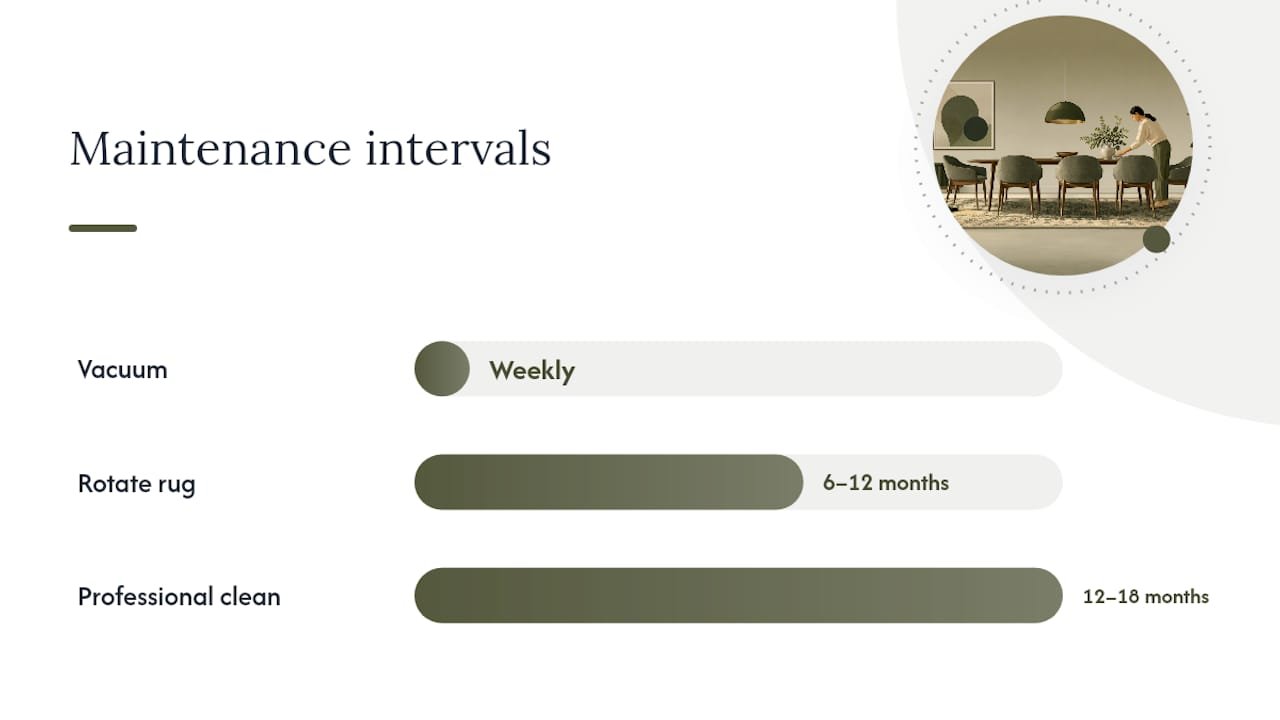
- Vacuum with a suction-only setting (no beater bar) for low-pile and flatweave rugs. Beater bars can fray flatweave edges over time.
- Shake out smaller rugs outdoors if possible to remove loose debris.
- Rotate the rug 180 degrees every 6–12 months to even out wear from chair legs.
Spill response:
- Blot immediately with a clean, dry cloth. Never rub — rubbing spreads the stain and pushes it deeper into the fibers.
- Dilute the stain with a small amount of cold water, then blot again.
- Apply a mild dish soap solution (a few drops in a cup of water) and blot from the outside of the stain inward.
- Rinse with cold water and blot dry. Let the rug air-dry completely before replacing furniture.
Deeper maintenance:
- Professional cleaning every 12–18 months is reasonable for wool and hand-knotted rugs in active dining rooms.
- Washable rugs can go in the machine per manufacturer instructions, typically every few months for heavy-use households.
- Check the rug pad every few months. A worn or bunched pad causes edge curling, which is a trip hazard. Replace the pad when it no longer lies flat.
Chair leg protectors are worth adding to any heavy wood or metal chair. Felt pads prevent the legs from snagging pile and reduce the grinding wear that shortens a rug’s life. Check them every few months; they compress and shift with use.
The Spruce’s dining rug guide notes that households with children and pets face a meaningfully higher maintenance burden because spills and crumbs collect in fibers faster than regular vacuuming can address. That’s not a reason to avoid a rug, but it is a reason to choose construction wisely.
Pro Tip: Keep a small spray bottle of diluted dish soap under the kitchen sink specifically for dining rug spills. The faster you treat a spill, the less likely it is to set.
Why do designers insist on rugs in dining rooms?
The functional case is straightforward: rugs absorb sound, soften hard floors, and add warmth underfoot. In open-plan homes, a well-sized dining rug does something more specific. It creates a visual zone that tells the eye “this is the dining area” without walls or partitions.
Rugsonlinemarket’s product range reflects this thinking directly. The collection spans traditional Persian and Oushak designs (which bring pattern and warmth to formal dining rooms), modern abstracts and Moroccan styles (better suited to contemporary open-plan spaces), and practical washable and low-pile constructions for everyday family dining. The size and placement guide on the site applies the same 24-inch logic across room types.
A few credibility signals worth noting:
- Free shipping on orders over $300 reduces the financial risk of ordering a large dining rug online.
- 30-day hassle-free returns mean you can order, lay the rug, and return it if the scale or color doesn’t work in your actual room.
- The 100% feedback guarantee reflects a consistent track record with real buyers.
Livingetc’s designer roundup makes the case plainly: sizing up creates a deliberate frame; sizing down creates an island. The rug’s job is to make the dining group look like it belongs in the room, not like it was placed there by accident.
For a deeper look at how proportion and pattern scale interact across different rug styles, the Persian rug placement guide at Rugsonlinemarket covers the same principles applied to traditional designs. And if you’re pairing a new rug with a new table, Cozyhome’s custom dining table guide is a useful reference for understanding how table dimensions and leg styles affect rug selection.
Key Takeaways
A dining rug works when it extends at least 24 inches beyond every side of the table, is centered precisely, and is made from a construction that handles chair movement and regular cleaning without constant effort.
| Point | Details |
|---|---|
| The 24-inch rule | Extend the rug at least 24 inches beyond the table on all sides; use 30–36 inches for deeper chairs. |
| Size for full extension | If your table is extendable, calculate rug size using the fully extended table length. |
| Match shape to table | Rectangular tables take rectangular rugs; round tables take round rugs. |
| Choose low-pile for dining | Flatweave and low-pile constructions clean faster and allow smoother chair movement. |
| Rugsonlinemarket | Offers washable, low-pile, and natural fiber dining rugs with free shipping over $300 and 30-day returns. |
The rule most people get wrong
Most dining rug mistakes aren’t about color or pattern. They’re about scale. The rug is too small, and the buyer knew it was borderline when they ordered it but chose the smaller size anyway because the larger one seemed excessive.
It never is. A rug that fully contains the dining group, with chairs pulled out and occupied, reads as a design decision. A rug that leaves chair legs stranded on bare floor reads as a measurement error, even when everything else in the room is well chosen.
The painter’s tape test is the one habit worth building before any rug purchase. Ten minutes on the floor with a roll of tape will tell you more about whether a size works than any photo or room visualizer. If the taped outline looks larger than you expected, that’s almost always the right size.
The other underrated move: buy a rug pad at the same time as the rug. Not as an afterthought. A pad that’s slightly smaller than the rug keeps edges flat, prevents shifting, and protects the floor finish. Edge curling on an unpadded rug is how dining room trips happen.
Rugsonlinemarket has the dining rug you’re actually looking for
Choosing the right dining rug is mostly a sizing and material decision. Once you know your dimensions and your household’s tolerance for maintenance, the shopping part is straightforward. Rugsonlinemarket makes it easier: the collection covers every practical need, from washable rugs built for family dining rooms to premium wool and silk options for formal spaces, all in the sizes the 24-inch rule actually calls for.

Free shipping on orders over $300 and 30-day returns mean you can order with confidence, lay the rug, and return it if the scale or color doesn’t land the way you expected. The rug size chart on the site maps common table sizes to recommended rug dimensions, and customer support can help with specific size questions. Browse the full collection at Rugsonlinemarket and filter by size, material, or style to find the right fit for your dining room.
Useful sources
- Should You Put a Rug Under a Dining Table? 7 Rules to Follow
- Should You Put a Rug Under a Dining Table? Designers Decide | Livingetc
- Dining Table Rug Size Chart: Find the Right Fit — A Little Delightful
- How to choose a rug for your dining table — IKEA
- Where To Put A Rug In A Dining Room?
- Rug Placement: A Designer’s Guide to Layout and Size
- Rugs Online Market | Premium Area Rugs & Home Decor Shop
