

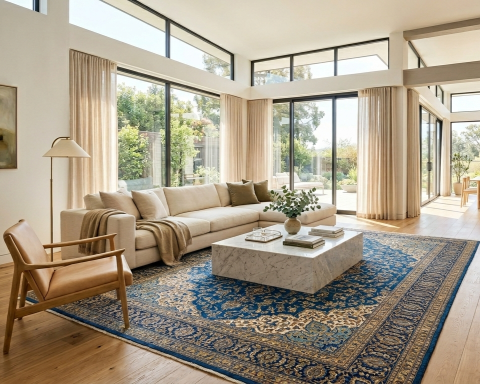
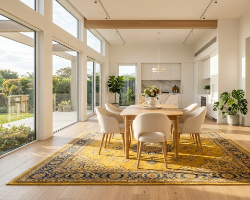
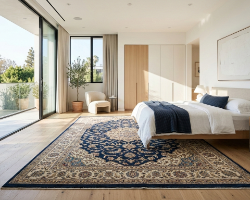




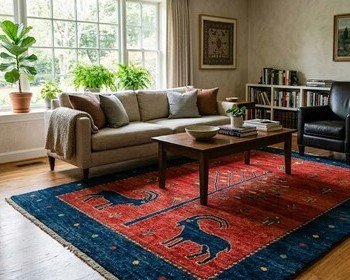
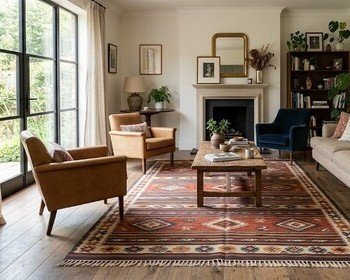
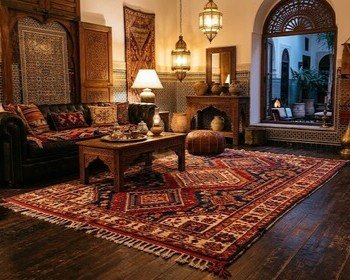
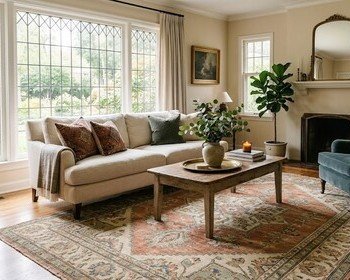
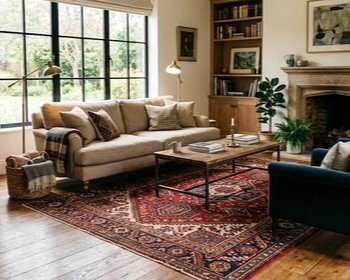
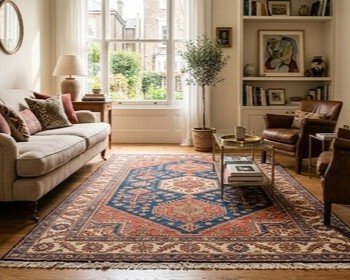
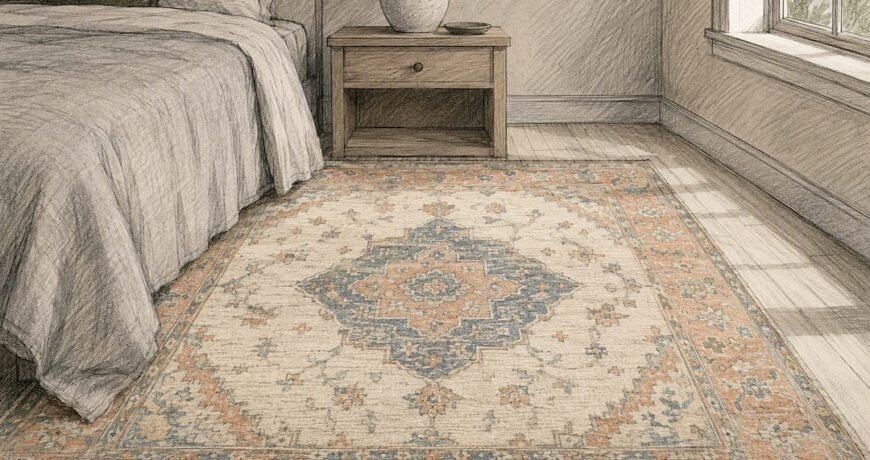
An Oushak rug is a hand-knotted wool carpet from the Uşak region of western Anatolia, known for large-scale medallions, open fields, and a soft, muted color palette that reads more antique than bold. The appeal is tactile as much as visual: quality Oushak wool carries a natural lanolin sheen that catches light differently than tighter, denser weaves. If you’re shopping for one, here’s your immediate checklist.
- Check material first. Real Oushak pile is hand-knotted wool, not machine-tufted synthetic fiber.
- Ask for provenance. A dated invoice, dealer certificate, or documented region of origin protects your investment.
- Inspect condition in person or via close-up photos. Foundation wear, moth damage, and prior repairs all affect price and longevity.
Quick take: if you want a rug that softens a room full of hard modern furniture, an Oushak, vintage or well-made reproduction, is one of the more reliable choices on the market.
Key Takeaways
The most reliable way to buy an Oushak rug with confidence is to verify hand-knotted wool construction, request provenance documentation, and match your size and style choice to how the room actually gets used.
| Point | Details |
|---|---|
| Confirm construction | Real Oushak pile is hand-knotted wool, typically using the Ghiordes knot, not machine-tufted synthetic fiber. |
| Read the pattern and palette | Large medallions, open fields, and muted, weathered color signal genuine Oushak design language. |
| Separate origin from style | “Oushak” can mean antique Uşak-region production or a broader design family; ask which one a listing means. |
| Match variant to use case | Vintage suits low-traffic formal rooms; reproductions suit hallways, dining rooms, and high-traffic spaces. |
| Shop with documented specs | Rugsonlinemarket lists material, construction, and size details on every rug page to support informed buying decisions. |
Table of Contents
- Oushak Rugs Guide: Key Visual and Construction Traits
- Where Did Oushak Rugs Come From?
- How Can You Tell If an Oushak Rug Is Authentic?
- Vintage, Overdyed, Tribal, or Workshop: Which Oushak Style Fits You?
- Vintage Oushak vs. Modern Reproduction: Which Should You Buy?
- What Should You Check Before Buying an Oushak Rug?
- How Big Should an Oushak Rug Be for Your Room?
- How Do You Care for an Oushak Rug?
- Why Trust Rugsonlinemarket for Your Oushak Purchase
- What Sizes and Formats Do Oushak Rugs Actually Come In?
- Do Regional Differences Show Up Within Oushak Rugs?
- How Did History Shape Oushak Rug Design?
- What Vintage Oushak Rugs Get Right That Modern Advice Misses
- Find Your Oushak Rug at Rugsonlinemarket
- Frequently Asked Questions
- Sources
Oushak Rugs Guide: Key Visual and Construction Traits
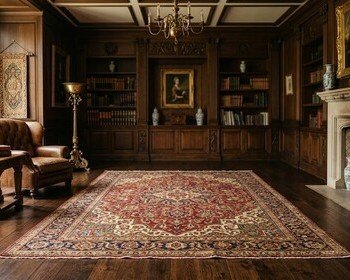
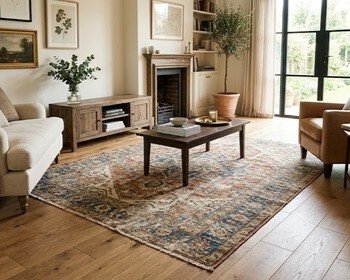
Everything about an Oushak’s construction points toward calm over complexity. Where classic Persian carpets often pack in dense, repeating botanical motifs, Oushak designs favor large-scale medallions or scattered floral sprays set against an open, breathing field. That negative space is deliberate. It’s what makes an Oushak look substantial on a floor from across a room rather than busy up close.
Color is the second signature. Oushak palettes lean toward soft apricot, faded coral, muted gold, sage green, and dusty blue, tones that read as sun-bleached even on newer pieces. This is partly a dye tradition and partly the product of decades of light exposure on antique examples.
Then there’s the wool itself. Genuine Oushak pile is prized for a natural sheen that comes from lanolin retained in hand-spun, hand-washed wool. That lanolin content changes how the pile reflects light, giving the surface a soft glow rather than a flat, uniform finish.
Construction matters just as much as pattern. Oushak weavers traditionally use the Ghiordes knot (also called the Turkish knot), a symmetrical knot tied around two warp threads that tends to produce a slightly thicker, more durable pile than the asymmetrical Persian knot. Pile height on antique and vintage pieces is often low to medium, which affects both the drape of the rug and how it wears over decades of foot traffic.
- Open field with large medallion or scattered motif
- Muted, weathered color palette (apricot, gold, sage, dusty blue)
- Lanolin-rich wool with a soft natural sheen
- Ghiordes (Turkish) knot construction, typically low to medium pile
Where Did Oushak Rugs Come From?
Oushak weaving traces back to the city of Uşak in western Anatolia, and the style became especially prominent during the Ottoman era, when Oushak workshops supplied carpets to Ottoman courts and, eventually, to European palaces and churches. Renaissance painters even depicted Oushak carpets in portraits of European nobility, a detail rug historians point to as early proof of the style’s reach beyond Turkey.
Production shifted over the following centuries. As demand grew in Europe and later the United States, weaving spread beyond Uşak itself into surrounding villages and workshops, and the term loosened from a strict place-name into a broader design category. That’s an important distinction for buyers: “Oushak” today can mean two different things.
- A rug woven in or near historic Uşak, often decades or a century old
- Any rug, new or old, that follows the Oushak design language: open field, oversized medallion, muted palette
Neither meaning is wrong, but they carry very different price expectations. A rug marketed simply as “Oushak style” is not making the same claim as one sold as an antique Uşak piece with documented origin, and sellers who blur that line deserve extra scrutiny.
How Can You Tell If an Oushak Rug Is Authentic?
Authentication comes down to reading the rug’s construction and history the way a specialist would, and you don’t need a lab to do most of it.
- Check the pattern scale against the size. Genuine Oushak medallions are proportioned to fill an open field gracefully; a busy, cramped pattern on a large rug is a signal of imitation.
- Look at the color fade. Natural dyes fade unevenly and softly over decades, often lighter where sunlight hits most. Uniform, flat color across an “aged” rug suggests synthetic dye or artificial distressing.
- Turn the rug over. Specialist dealers recommend inspecting the knots, pile density, and backing for hand-knotted irregularity. Machine-made rugs show a perfectly uniform grid on the back; hand-knotted pieces show small, natural variations.
- Ask for provenance documentation. A bill of sale, appraisal, or dealer history strengthens any age or origin claim.
- Watch for red flags: a “vintage” label on a rug with a machine-woven backing, pricing that seems too low for the claimed age, or restoration so extensive it’s hard to see original weave.
Pro Tip: Gently fold back a corner of the pile and check the base of the fibers. If the color underneath is dramatically brighter than the surface, you’re likely looking at sun fading on natural dye, a good authenticity sign rather than a red flag.
Vintage, Overdyed, Tribal, or Workshop: Which Oushak Style Fits You?
Not every Oushak on the market looks or performs the same way, and the labels sellers use actually describe real differences in weave and finish.
Vintage Oushak rugs, typically 40 to 100 years old, show the softened colors and slight irregularities that come only with age and wear. That worn, lived-in surface is exactly why designers reach for vintage Oushaks in modern rooms: it takes the edge off sharp, contemporary furniture.

Overdyed and distressed pieces start as older wool rugs, sometimes Oushak, sometimes not, that are chemically redyed in bold or muted tones and mechanically softened to fake decades of wear. They can look striking, but the process weakens fiber over time and tends to lower long-term resale value compared with an untouched original.
Tribal or village pieces tend to have smaller looms, bolder geometric motifs, and more visible irregularity, while workshop production produces larger, more symmetrical medallions with tighter, more consistent knotting.
- Vintage: naturally softened palette, genuine age, higher provenance value
- Overdyed: bold modern color, weaker long-term fiber integrity
- Tribal/village: smaller scale, bolder geometry, more character
- Workshop: larger format, tighter symmetry, more consistent sizing
Vintage Oushak vs. Modern Reproduction: Which Should You Buy?
Price in this category is driven almost entirely by three things: rarity, condition, and documented provenance, not size alone. Retail listings across U.S. dealers show that vintage Oushak pricing tracks size and condition more closely than it tracks provenance signage by itself, which means two rugs of similar size can carry very different price tags depending on wear, repairs, and dye quality.
Vintage pieces also come with upkeep considerations a reproduction doesn’t. Decades-old wool can be more delicate, and a genuine antique may need conservation rather than routine cleaning if it sees heavy foot traffic.
- Choose vintage if you want a one-of-a-kind piece for a lower-traffic room, like a formal living room or primary bedroom, and you’re comfortable budgeting for occasional conservation.
- Choose a modern reproduction for hallways, dining rooms, or homes with kids and pets, where durability matters more than rarity.
- Either way, ask what “Oushak” means on the listing: place-based antique or design family reproduction. That single question changes the fair price range dramatically.
What Should You Check Before Buying an Oushak Rug?
Buying an Oushak rug, whether from a specialty dealer, an estate sale, or online, comes down to verifying the same handful of things every time.
- Material and knot type. Confirm hand-knotted wool construction and ask directly whether the knot is Ghiordes (Turkish) or Senneh (Persian).
- Weave density and pile condition. Run your hand across the surface; even wear is normal, bald patches or foundation showing through is not.
- Fringe and edges. Original fringe is part of the foundation warp; sewn-on fringe is a common sign of past repair or reweaving.
- Repairs and restoration. Ask specifically whether any reweaving, edge binding, or color touch-up has been done, and where.
Before you commit, get these in writing or in the listing description:
- Country and region of production, if known
- Approximate age or age range
- Fiber content (wool, wool and cotton foundation, or blend)
- Any known repair or restoration history
- Return policy and inspection period
Broad U.S. market price bands, as ranges rather than guarantees, tend to run from a few hundred dollars for smaller modern reproductions up into the low thousands for well-documented vintage pieces in larger sizes, with condition and provenance moving the number more than square footage alone.
Rugsonlinemarket lists material composition, construction method, and size specifications on every rug page, which gives buyers the documentation trail that specialists recommend checking before purchase, without needing to track a dealer down for basic facts.
How Big Should an Oushak Rug Be for Your Room?
Standard sizing rules apply to Oushak rugs the same way they do to any area rug, with one exception worth knowing: because Oushak medallions are large-scale, an undersized rug can visually chop the pattern in a way that looks accidental rather than intentional.
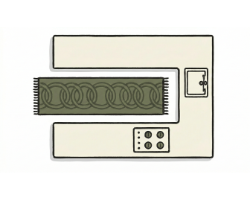
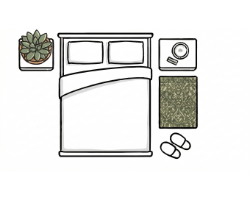
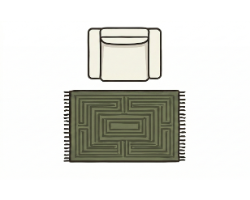
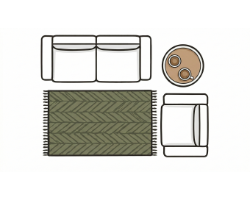
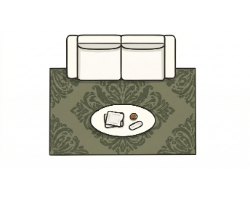
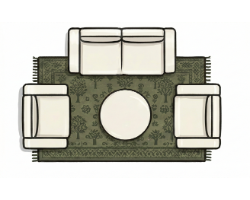
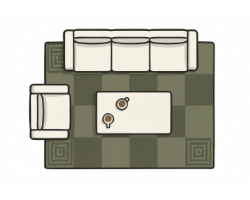
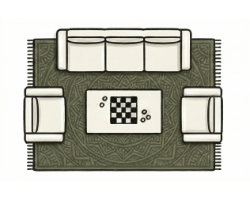
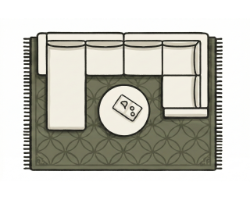
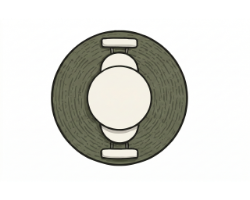
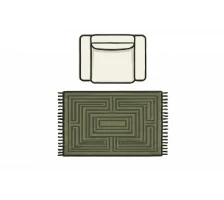
In a living room, all furniture legs should ideally sit on the rug, or at minimum the front legs of sofas and chairs; that usually means an 8-by-10 or 9-by-12 for a standard-sized room. In a dining room, the rug needs to extend at least 24 inches beyond the table on all sides so chairs stay on the rug when pulled out. Bedrooms do well with a rug that extends past the sides and foot of the bed, and hallways call for a runner sized to leave a few inches of floor visible on each side.
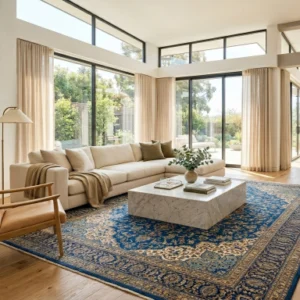
Because Oushak’s palette is so muted, it pairs comfortably with both traditional and stripped-back modern furniture, which is part of why designers keep returning to it. For room-specific layouts, Rugsonlinemarket’s living room sizing guide and bedroom placement guide walk through exact measurements by furniture arrangement.
- Living room: rug under front furniture legs at minimum
- Dining room: 24 inches of rug beyond the table on all sides
- Bedroom: rug extends past bed sides and foot
- Hallway: runner with a few inches of floor showing on each side
How Do You Care for an Oushak Rug?
Routine care is simple, but a few habits genuinely extend an Oushak’s life.
- Vacuum weekly on a low-suction or no-beater-bar setting to avoid pulling at the pile.
- Rotate the rug every six to twelve months so wear and sun fade happen evenly.
- Use a non-slip pad under the rug to reduce shifting and cushion the foundation. Specialist dealers recommend this combination of rotation, padding, and gentle vacuuming as the baseline for preserving hand-knotted wool.
- Blot, don’t rub, spills immediately with a clean cloth and plain water; avoid steam cleaners and harsh detergents on wool.
- Call a conservator, not a general cleaner, for deep stains, moth damage, or any rug with documented age or provenance value.
Pro Tip: Store an out-of-rotation Oushak rolled, not folded, with pile facing inward, and add cedar blocks nearby to deter moths during humid months.
Why Trust Rugsonlinemarket for Your Oushak Purchase
Rugsonlinemarket specializes in a wide catalog of high-quality rugs, from traditional Persian and Turkish styles to modern minimalist designs, sourced from natural materials like wool and silk. Every purchase comes with expert customer support, free shipping on orders over $300, and hassle-free returns within 30 days if a rug doesn’t work in your space.
- Diverse, curated selection spanning traditional and modern styles (Rugsonlinemarket)
- Free shipping over $300 and 30-day hassle-free returns
- Backed by a 100% feedback guarantee on customer satisfaction
What Sizes and Formats Do Oushak Rugs Actually Come In?
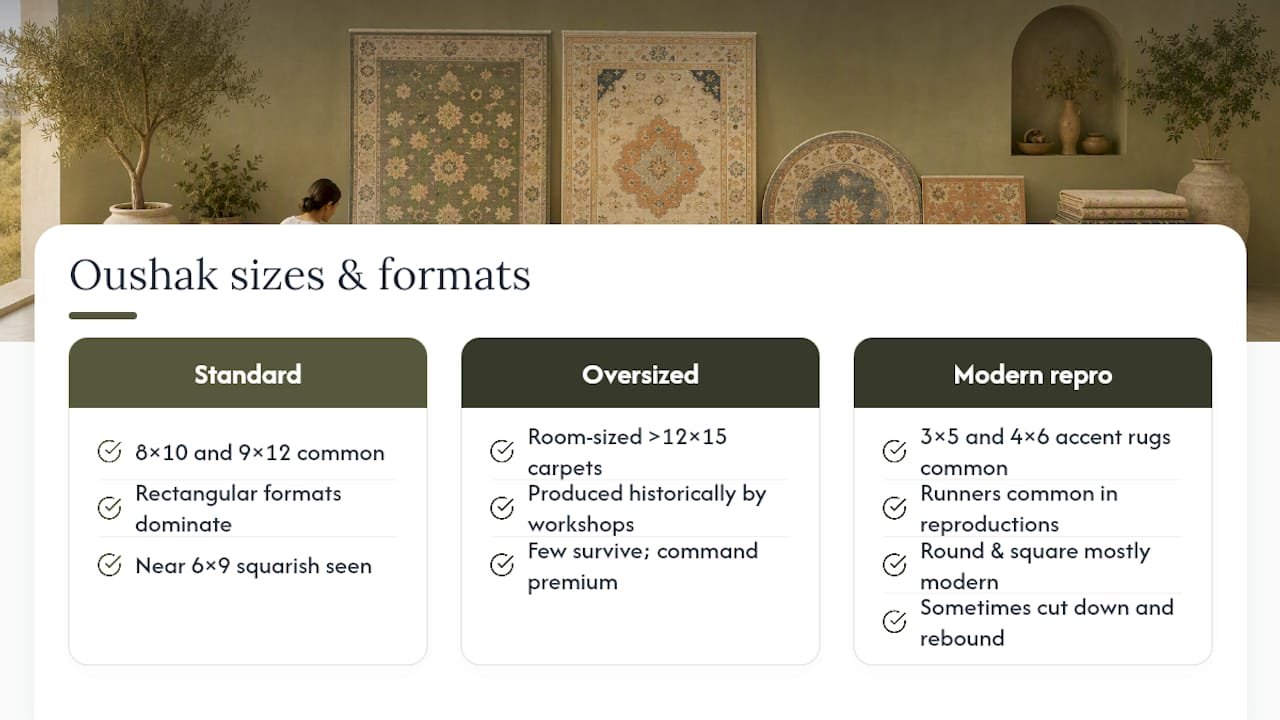
Oushak rugs show more format variety than most shoppers expect walking in. Beyond the common 8-by-10 and 9-by-12 room sizes, historic Oushak workshops regularly produced oversized formats, room-sized carpets stretching well past 12 by 15 feet, made for grand Ottoman-era interiors and later European estate homes. Those large-format antiques are still in circulation today, and they command a premium simply because so few survive in good condition.
At the opposite end, smaller Oushak-style accent and scatter rugs, often in the 3-by-5 or 4-by-6 range, were historically woven as secondary pieces to layer near doorways or seating areas rather than as standalone floor coverings. Runners are less traditional to authentic antique Oushak production but are common in modern reproductions, since the open-field, large-medallion look doesn’t always translate cleanly to a narrow format.
Shape is another variation worth knowing. While rectangular formats dominate, round and square Oushak-style rugs exist mostly as modern reproductions rather than antique originals, since traditional looms were built for rectangular production. If you come across a “vintage round Oushak,” treat that shape claim with extra scrutiny, and ask directly whether it was cut down and rebound from a larger rectangular piece, a practice that does happen and affects both structural integrity and value.
Squarish near 6-by-9 formats also turn up more often in Oushak production than in some other Turkish rug styles, a quirk tied to loom widths common in the Uşak region historically.
Do Regional Differences Show Up Within Oushak Rugs?
“Oushak” covers more ground than a single village output, and pieces from different production centers within the broader region show identifiable differences if you know what to look for.
Rugs from the historic Uşak workshops themselves tend toward the most classic large-medallion, open-field layout, with restrained, symmetrical composition associated with courtly commissions. Village production in the surrounding countryside, by contrast, often shows looser symmetry, bolder secondary motifs filling the field, and more saturated natural dye colors before fading, since village weavers worked with more creative latitude than court workshops.
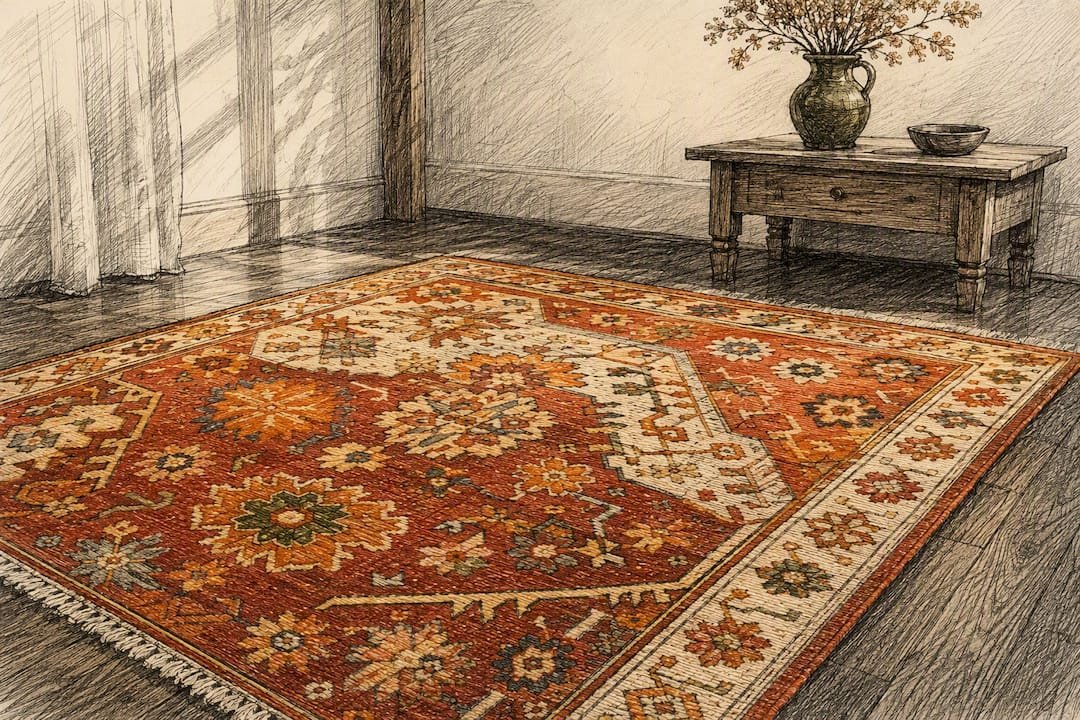
Later production centers that adopted the Oushak style, as the design language spread beyond its place of origin, sometimes introduced their own regional color preferences, cooler blues and greens in some areas, warmer terracotta and gold in others, while keeping the signature open-field medallion structure intact. This is part of why two rugs both labeled “Oushak” can look meaningfully different side by side.
For buyers, the practical takeaway is to treat “Oushak” as a spectrum rather than a single fixed look. A rug with tighter, more formal medallion symmetry and restrained color likely points toward classic workshop-style production, while looser, bolder pattern work suggests village origin, information worth asking about since it affects both aesthetic character and typical pricing.
How Did History Shape Oushak Rug Design?
Oushak’s design language didn’t develop in isolation. Ottoman court patronage during the height of the empire pushed weavers toward larger formats and more refined, symmetrical medallion work, since palace and mosque commissions called for room-sized carpets with formal presence rather than small tribal pieces.
European trade had an equally strong pull. As Oushak carpets reached Renaissance-era Europe and appeared in period paintings, demand for the style shifted production toward the palette and proportions that appealed to European buyers, softer coloration and larger open fields that suited grand European interiors rather than the denser patterning common in some other regional traditions.
The 19th and early 20th centuries brought a different kind of disruption. As European and American commercial demand accelerated, some workshops shifted toward synthetic dyes and faster production methods to meet volume, a change that rug historians still use today as a rough marker when dating pieces and separating earlier natural-dye examples from later commercial-era production.
Political and economic shifts across the region over the following decades also affected where and how weaving continued, with some traditional production centers slowing and design knowledge dispersing to new workshops that carried the Oushak aesthetic forward under different regional names. That history is exactly why the term “Oushak” today functions more as a design family than a strict guarantee of origin, and why documentation matters as much as visual style when you’re evaluating a specific piece.
What Vintage Oushak Rugs Get Right That Modern Advice Misses
Most buying guides treat Oushak shopping like a checklist exercise: verify the knot, check the dye, request the paperwork. All true, but it misses the bigger judgment call. The real question isn’t whether a rug is “authentic” in some absolute sense. It’s whether the version of Oushak you’re buying, antique, vintage, or well-made reproduction, actually fits how your room gets lived in.
Conventional advice tends to treat reproductions as a compromise. I’d argue that’s backwards for a lot of buyers. A tightly woven modern Oushak-style rug in a high-traffic dining room is the smarter purchase, full stop, not a consolation prize. Save the vintage premium for rooms where the rug won’t take daily abuse.
The design world’s obsession with Oushak isn’t really about pedigree. It’s about what that soft, faded palette does to a room full of hard modern furniture. Chase that effect first, then worry about provenance paperwork.
Find Your Oushak Rug at Rugsonlinemarket
You’ve got the checklist now: material, knot type, provenance, condition. The next step is actually finding a rug that meets it without spending weeks chasing down estate sales or waiting on overseas dealer shipments. Rugsonlinemarket carries a curated range of Oushak-style and hand-knotted wool rugs alongside its broader Persian, Moroccan, and modern collections, with material and construction details listed directly on each product page so you’re not guessing at what you’re buying.
If you’re outfitting a living room or dining space and want to browse pieces suited to those muted, large-medallion looks, the luxury rug collection is a solid starting point, and the full shop lets you filter by size and material. Orders over $300 ship free, and every rug comes with a 30-day return window if it doesn’t sit right in the room once it’s home. Start browsing sizes and colorways now to find the piece that fits your space.
Frequently Asked Questions
What makes an Oushak rug different from a Persian rug?
Oushak rugs favor large-scale medallions and open, breathing fields with muted colors, while Persian rugs typically use denser, more intricate repeating patterns and often more saturated color. Knot type differs too. Oushak weaving traditionally uses the Ghiordes knot, while many Persian rugs use the asymmetrical Senneh knot.
Are Oushak rugs the same as Kilim rugs?
No. Kilim rugs are flat-woven with no pile, while Oushak rugs are hand-knotted with a wool pile, which gives Oushak rugs more cushion, durability, and a different visual texture entirely.
How much should I expect to pay for a genuine Oushak rug?
Prices vary widely by size, age, and condition rather than by a fixed formula. Smaller modern reproductions often cost less, while larger, well-documented vintage pieces may be priced in the thousands. Condition and provenance move the price more than square footage alone.
Can a reproduction Oushak rug still look authentic?
Yes, a well-made reproduction can closely replicate the open-field medallion look and muted palette of a vintage piece, and for high-traffic rooms it’s often the more practical choice. Just don’t expect it to carry the same resale or investment value as a documented antique.
Do Oushak rugs work with modern, minimalist furniture?
Very well. The muted palette and large open field give sharp modern furniture something soft to rest against, which is a major reason designers keep pairing vintage Oushak rugs with contemporary interiors.
