













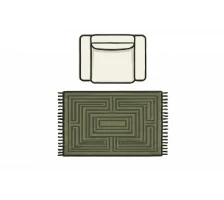

















Yes, you can run an office chair on a rug, but only if you make the right call on three things: rug type, size, and floor protection. Low-pile, flatweave, or indoor/outdoor rugs let casters roll without catching, while shag or high-pile rugs fight the chair every time you push off your desk. The fastest path to getting this right:
- Measure your chair’s full travel zone before buying anything.
- Choose a low-pile or flatweave rug, not a plush or shag style.
- Add a non-slip pad rated for your floor type, and a thin chair mat if you’re on carpet or roll constantly.
- Keep the rug’s edges sufficiently beyond where your chair actually stops to avoid catching the edge with your heel.
Key Takeaways
An office chair rolls reliably on a rug only when the rug is low-pile or flatweave, sized to the chair’s full travel zone plus a margin, and paired with a pad or mat matched to the floor underneath.
| Point | Details |
|---|---|
| Pick the right pile | Choose low-pile, flatweave, or indoor/outdoor rugs; skip shag or high-pile styles that snag casters. |
| Measure before buying | Mark your chair’s farthest roll-back point and add 6 to 12 inches of margin around it. |
| Layer your protection | Combine a rug pad matched to your floor type with a clear mat in heavy-use zones. |
| Maintain on a schedule | Rotate the rug, vacuum by material type, and replace compressed pads before they slip. |
| Shop by category | Rugsonlinemarket’s office rug and 3×5 area rug lines are built around the low-pile, right-sized specs this guide recommends. |
Table of Contents
- Which Office Chair on Rug Materials Actually Roll Well?
- How Do You Size and Place a Rug Under an Office Chair?
- What Protects a Rug (and the Floor) From an Office Chair?
- How Do You Maintain a Rug Under a Constantly Moving Chair?
- Why Most Rug Advice Skips the One Step That Matters Most
- Where to Find Office-Ready Rugs and Sizing Options
- Sources
- FAQ
Which Office Chair on Rug Materials Actually Roll Well?
The material decision determines almost everything else. Low-pile, flatweave, and indoor/outdoor polypropylene rugs are the three categories that consistently let a rolling chair move without a fight, because their tight, flat construction gives caster wheels a firm surface instead of something to sink into. Low-pile rugs are specifically recommended for chair mobility because they resist the bunching and snagging that ruins taller-pile styles within weeks.
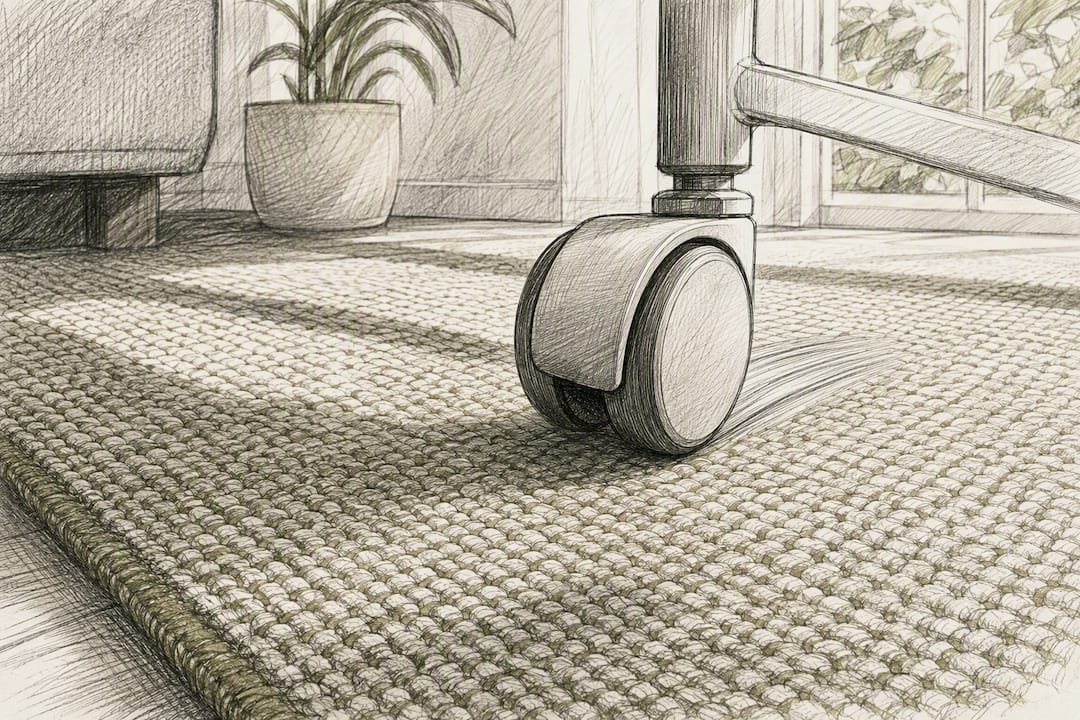
Skip anything labeled shag, high-pile, or loosely tufted. The mechanics are simple: a caster wheel needs a stable contact point, and long or loosely-looped fibers wrap around the wheel axle, crush unevenly, and eventually create bald tracks exactly where your chair travels. Flatweave and low-pile rugs are explicitly favored for office chair areas precisely because there’s no loft to compress or catch.
Material matters beyond just pile height, too:
- Polypropylene resists stains and moisture, handles rolling traffic well, and costs less than natural fiber options.
- Wool holds up under repeated pressure better than most synthetics, though it costs more upfront.
- Jute and other natural weaves look great but tend to fray faster under a caster’s grinding motion.
Pro Tip: Flip the rug over before buying and check the backing. A firm, densely woven backing paired with bound or serged edges resists curling far longer than a loose-backed rug, even at the same pile height.
How Do You Size and Place a Rug Under an Office Chair?
Get the size wrong and you’ll spend the next two years catching your caster on a curled edge or dragging your chair off the rug onto bare floor. The fix takes about five minutes with a tape measure.
- Sit in your normal working position and roll the chair back as far as you naturally go.
- Mark that farthest point on the floor, then check your side-to-side range too.
- Add a margin around that entire travel zone. Deskguide where the chair covers more ground.
- Round up to a standard size. A 5×8 rug covers most single desks comfortably; L-shaped or dual-monitor setups usually need something closer to 6×9 or 8×10.
- Decide whether the rug needs to sit under the whole desk or just the chair’s rolling path. A desk pushed against a wall often only needs the rug covering the work zone in front of it, not the space under a stationary desk frame.
Undersized rugs cause two real problems: the edges wear out fast from repeated caster contact, and a rug edge sitting mid-stride becomes a genuine trip hazard. D and G Flooring notes that skimping on rug coverage around desk legs and the chair’s path is one of the most common placement mistakes homeowners make.
What Protects a Rug (and the Floor) From an Office Chair?
A good rug alone often isn’t the whole answer, especially in a home office where the chair moves dozens of times a day. Three layers of protection cover most situations, and you rarely need all three at once.

Non-slip rug pads stop the rug itself from sliding and cushion the fibers against caster pressure. Get this part right: pads made for hardwood or laminate use different materials than pads made for carpet-on-carpet setups, and using the wrong one can leave residue on hard floors or fail to grip at all.
Clear chair mats made of polycarbonate or vinyl, placed directly on top of the rug in the chair’s rolling zone, solve the durability problem that rugs alone can’t. Chair mats generally offer superior long-term protection and noticeably smoother rolling than a rug by itself, which matters if you’re at your desk eight hours a day.
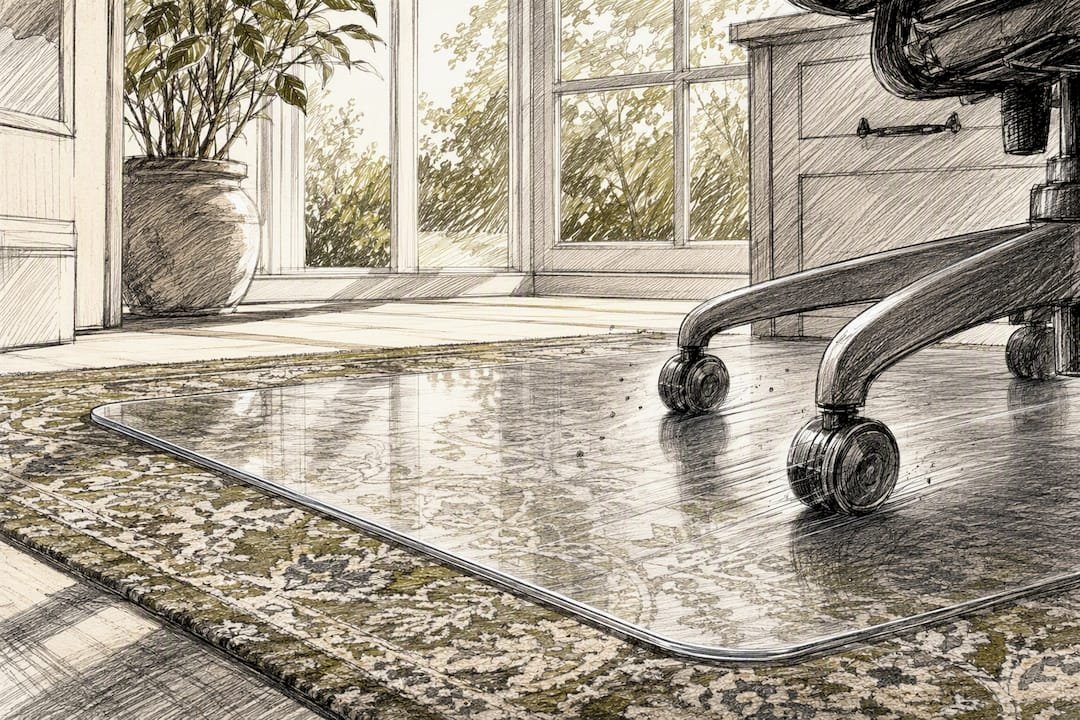
Caster upgrades are the option most people skip. Swapping stock hard-plastic wheels for soft rubber or wider rollers spreads out pressure and reduces the point-load wear that grinds fibers down over time.
The strongest setup, and the one design writers keep landing on for heavy-use home offices, is a hybrid: a decorative low-pile rug for the room, plus a small clear mat sized just to the chair’s path. That combination lets you keep the visual warmth of a real rug while protecting the exact spot that takes all the abuse.
How Do You Maintain a Rug Under a Constantly Moving Chair?
A rug under an office chair wears differently than a rug anywhere else in the house, because the damage concentrates in one narrow track instead of spreading evenly.
- Rotate the rug every few months so the wear pattern shifts instead of digging one permanent groove.
- Vacuum on a schedule that matches the material. Low-pile synthetics can handle frequent vacuuming; wool needs a gentler, less frequent approach.
- Spot-clean spills immediately, and consider a washable rug if your office doubles as a coffee station.
- Check the rug pad every few months. Pads compress under constant chair weight and lose their grip long before the rug itself shows damage.
- Watch for uneven wear, persistent bunching at the edges, or a pad that no longer stays flat. Those are signs it’s time to reposition, re-pad, or replace before the rug starts sliding out from under you mid-roll.
Cleaning frequency also matters for reasons beyond appearance. Dust and allergens build up faster in a rug that gets compressed traffic all day, which is worth factoring into your maintenance routine for home office carpeting.
Why Most Rug Advice Skips the One Step That Matters Most
Most guides on this topic jump straight to “buy a low-pile rug” and stop there. That’s incomplete advice. The material choice matters, but it’s secondary to something almost nobody measures first: the actual travel zone of your chair. I’ve seen plenty of home offices with a perfectly good flatweave rug that’s still failing, not because the material was wrong, but because it was cut two sizes too small for how far the chair actually rolls when someone leans back to grab a phone or stretch.
The conventional wisdom also treats rugs and chair mats as an either/or choice. That’s a false binary. The setups that hold up longest combine both: a rug that does the visual work of the room, and a small, almost invisible mat that absorbs the actual mechanical wear. Chasing a “pure rug” solution because a mat looks less polished is optimizing for the wrong thing.
If you take one piece of advice from this whole conversation, measure your travel zone before you shop for anything. Everything else, pile height, pad choice, caster upgrades, is easier to get right once you know exactly what space the rug needs to cover.
— Kian
Where to Find Office-Ready Rugs and Sizing Options
Once you know your travel zone and preferred pile height, the shopping part is straightforward. Rugsonlinemarket carries office rugs built with the low-pile, flatweave-style construction that lets casters roll cleanly, so you’re not stuck cross-referencing pile specs across a dozen listings.

For a standard single desk, the 3×5 area rug category is a practical starting point that matches the sizing math covered above, and it’s easy to size up from there if your setup is larger or L-shaped. If spills and daily wear are a real concern, the washable rug options solve the maintenance headache without forcing you into a synthetic look you don’t want.
Before you order, run through this: measure your travel zone, pick a low-pile or flatweave material, decide whether you need a pad, a thin chair mat, or both, and then match the size to what you measured, not what looks proportional in a room photo. Browse the office rug collection with those numbers in hand and you’ll land on something that works the first time.
Sources
- Rug Under Desk: Complete Guide for Homeowners – D and G Flooring
- Deskguide
- Office Rugs You Can Roll Your Chair Over – Emily Henderson
- Rug Vs. Chair Mat: Will A Rug Protect Carpet From Office Chair Damage? – SleepBloom
FAQ
Should I Put a Rug Under My Office Chair?
Yes, as long as it’s a low-pile or flatweave rug sized to cover your chair’s full travel zone. It protects your floor, cuts down on rolling noise, and defines the workspace visually.
Can I Use a Rug Instead of a Chair Mat?
You can, but a rug alone won’t match a dedicated chair mat’s long-term durability for heavy daily rolling. Most heavy-use setups do best with a low-pile rug plus a small clear mat layered over the chair’s path.
Can an Office Chair Damage Carpet?
Yes, repeated caster contact crushes carpet fibers and can wear visible tracks over time, especially with harder plastic wheels. Rug-friendly soft casters and a chair mat both reduce that concentrated wear.
Will a Rug Protect Hardwood From an Office Chair?
A well-chosen rug with the correct hard-floor pad underneath does protect hardwood from scratches and caster marks. Skipping the pad, or using a carpet-rated pad on hardwood, can undercut that protection or leave residue.
