

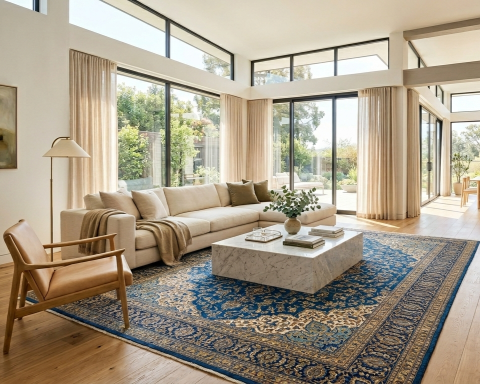
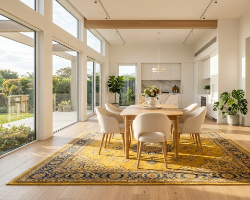
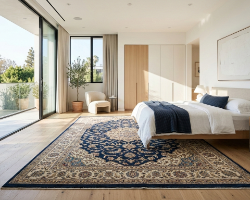
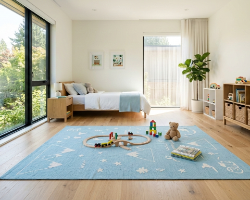
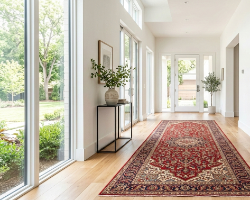
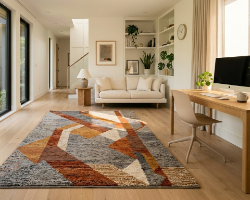
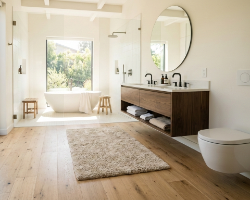
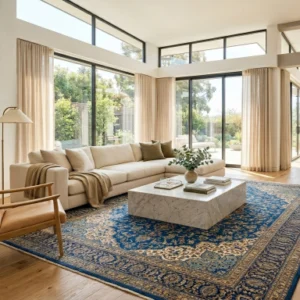

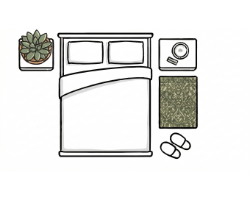
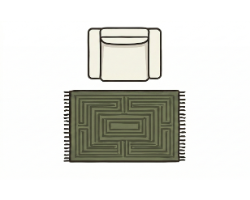
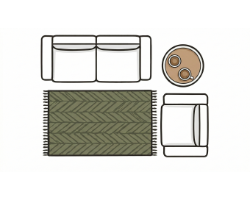
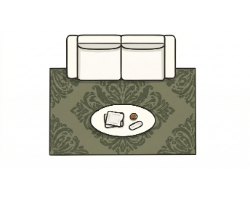
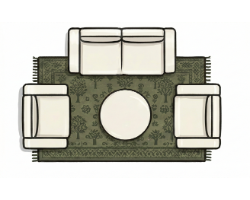
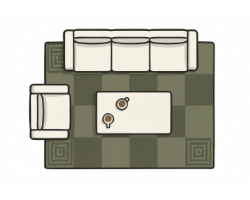
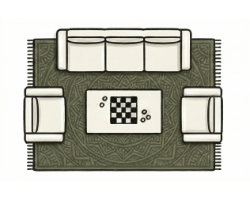
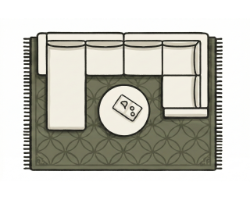




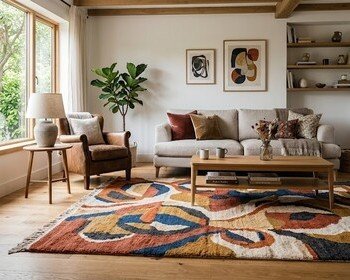

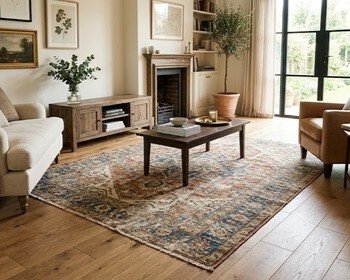
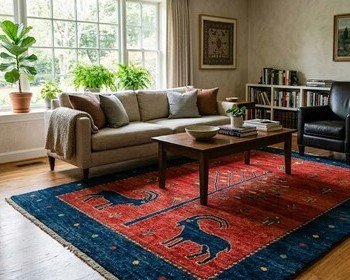
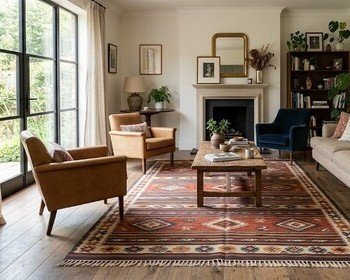
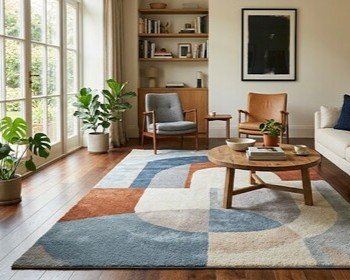

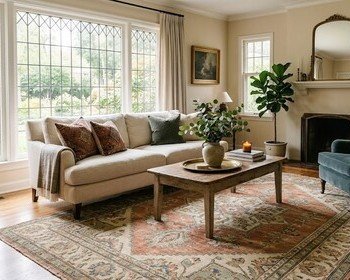
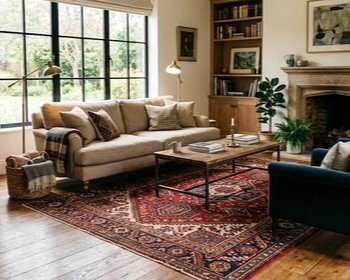
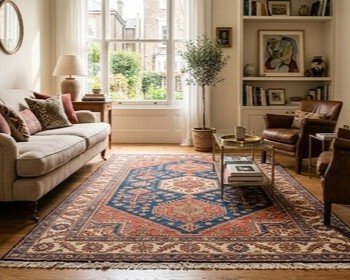
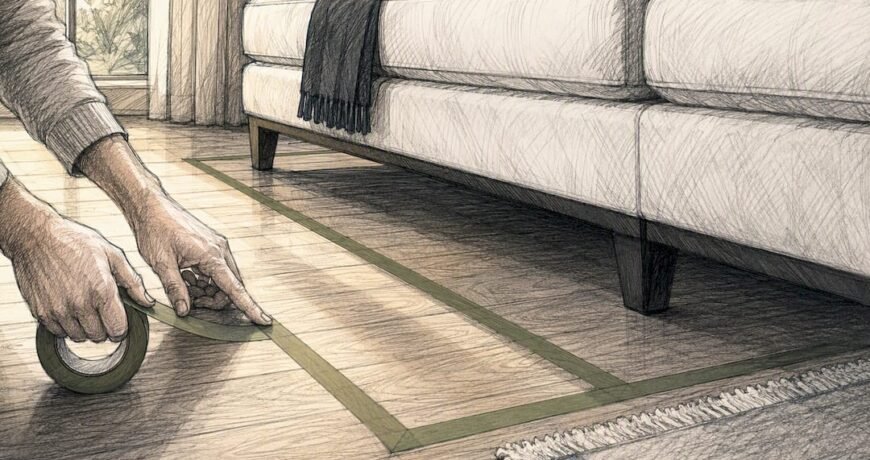
Most sectionals look right under an 8×10 or 9×12 rug, and very large or U-shaped layouts often need a 10×14 or bigger. The one rule to apply before anything else: get the front legs of the sectional on the rug, and put all four legs on it when the room has the space. When you’re stuck between two sizes, buy the larger one and tape it out on your floor before you commit.
TL;DR:
- Opt for a larger rug size, such as 9×12 or 10×14, if your sectional is large or U-shaped, to ensure proper coverage and proportional balance.
- Always measure the sectional’s footprint and use tape on the floor to test rug size, ensuring front legs land on the rug and there’s sufficient clearance around furniture.
- Place the rug so at least 8 to 12 inches of the floor extends beyond the furniture edges to maintain a balanced and grounded room appearance.
- Avoid small rugs that only cover the coffee table, as they shrink the seating area’s visual impact and disrupt room proportions.
- Prioritize furniture shape and configuration over room size when choosing rug dimensions, focusing on front-leg contact rather than fixed proportion rules.
Table of Contents
- Quick rug size cheat sheet for sectionals
- How rug placement changes the feel of the room
- Sizing rules for L-shaped, U-shaped, and chaise sectionals
- How to test rug size in your room before you buy
- Common sizing mistakes and how to avoid them
- Why measurement-first advice works better than guessing
- What most rug guides get wrong about sectionals
- Find the right size and material on Rugs Online Market
- Where these placement rules come from
- Sources
- FAQ
Quick rug size cheat sheet for sectionals
Standard rug sizes exist for a reason: manufacturers cut to the dimensions that fit most rooms, and most living rooms and sectionals commonly use 8×10 or 9×12 rugs. A 10×14 comes into play once the sectional itself gets large or wraps into a U shape. Knowing which of these three sizes fits your layout saves you from guessing at checkout.
- 8×10: works for smaller L-shaped sectionals or living rooms under roughly 200 square feet.
- 9×12: the default for a standard-size sectional in an average living room.
- 10×14 or larger: needed for oversized sectionals, U-shaped configurations, or open-plan rooms where the rug also has to define a seating zone.
- Runner or layered pieces: sometimes added alongside a main rug in modular setups, rather than replacing the primary size.
If your sectional’s footprint falls between two sizes, size up. A rug that reads slightly large still looks intentional, while one that’s too small makes the whole seating area look disconnected from the floor. A rug size chart can help you map your exact sectional dimensions to a standard size before you shop.
How rug placement changes the feel of the room
There are three placement strategies for a rug under a sectional, and each one changes how grounded the space feels.
- All legs on the rug: every leg of the sectional sits on the rug. This gives the most polished, finished look and works best in larger rooms where you can afford a 9×12 or 10×14.
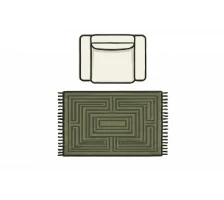
- Front legs on, back legs off: only the front legs touch the rug while the back rests on bare floor. This is often the best trade-off for smaller rooms because it anchors the seating visually without forcing you into a rug that’s too big for the space.
- Floating rug: the rug sits under the coffee table only, with the sectional’s legs entirely off it. This works in tight layouts or rooms where the sectional already sits against a wall and doesn’t need visual anchoring.
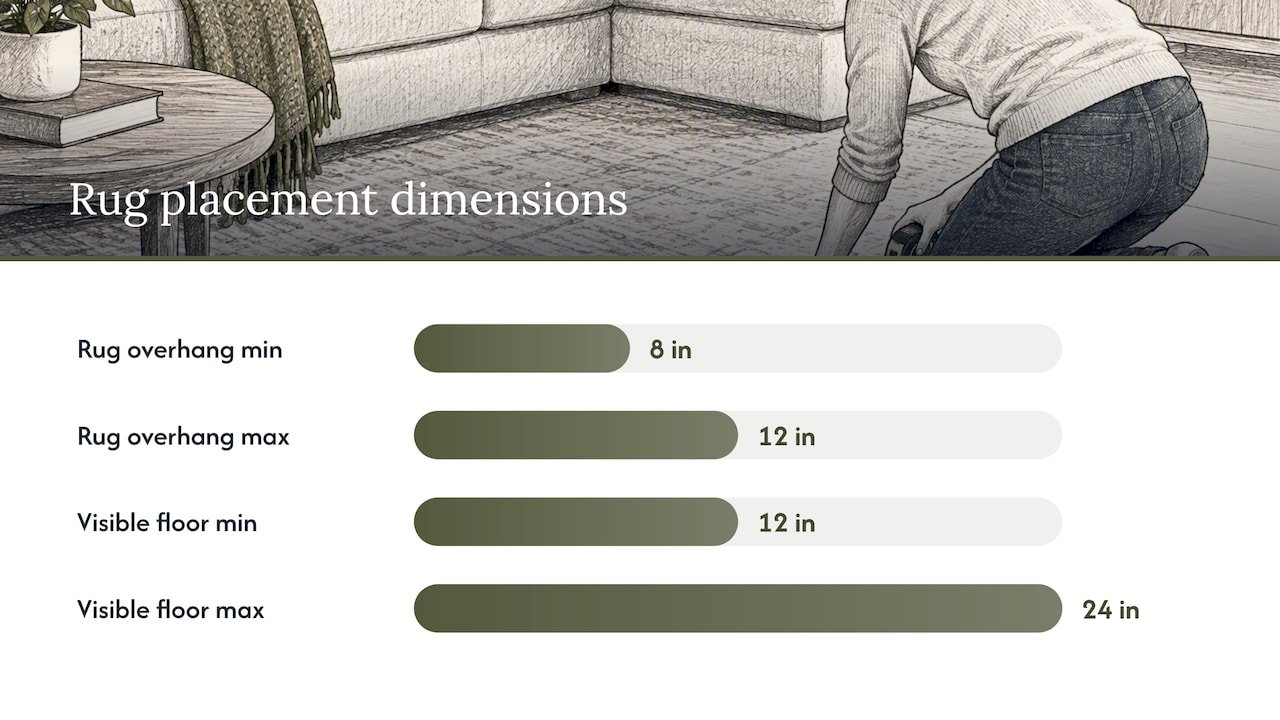
Whichever option you choose, keep the numbers in mind. Design guidance calls for at least 8 to 12 inches of rug extending beyond the edges of large furniture, and 12 to 24 inches of visible floor between the rug’s edge and the walls to avoid a wall-to-wall look.
Pro Tip: When in doubt, front legs on is almost always the safer call than floating, since it visually ties the sectional to the rug instead of leaving it looking like an afterthought.
Sizing rules for L-shaped, U-shaped, and chaise sectionals
The shape of your sectional decides more about rug size than the room itself does, since designers recommend basing rug selection on furniture configuration rather than room dimensions alone.
- L-shaped sectionals: match or slightly exceed the length of the shorter run (the chaise or return side). A compact L usually pairs with an 8×10; a longer one calls for a 9×12.
- U-shaped sectionals: aim to capture the front legs of the entire seating run, which usually means a 9×12 at minimum and often a 10×14 for larger configurations.
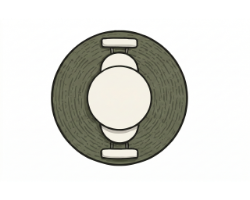
- Chaise sectionals: make sure the chaise’s front legs land on the rug just like the rest of the piece. For rounded or curved sectionals, a round rug centered under the coffee table can look more intentional than a rectangular one fighting the curve.
- Modular sectionals: if you’ve split pieces into separate seating zones, consider a rug under each cluster instead of one oversized piece stretching across the whole room.
For real-room photo examples of how this looks with sectionals specifically, the guide to placing rugs under sofas and sectionals walks through several layouts.
How to test rug size in your room before you buy
You don’t need to guess. A roll of painter’s tape and ten minutes will tell you more than any size chart.
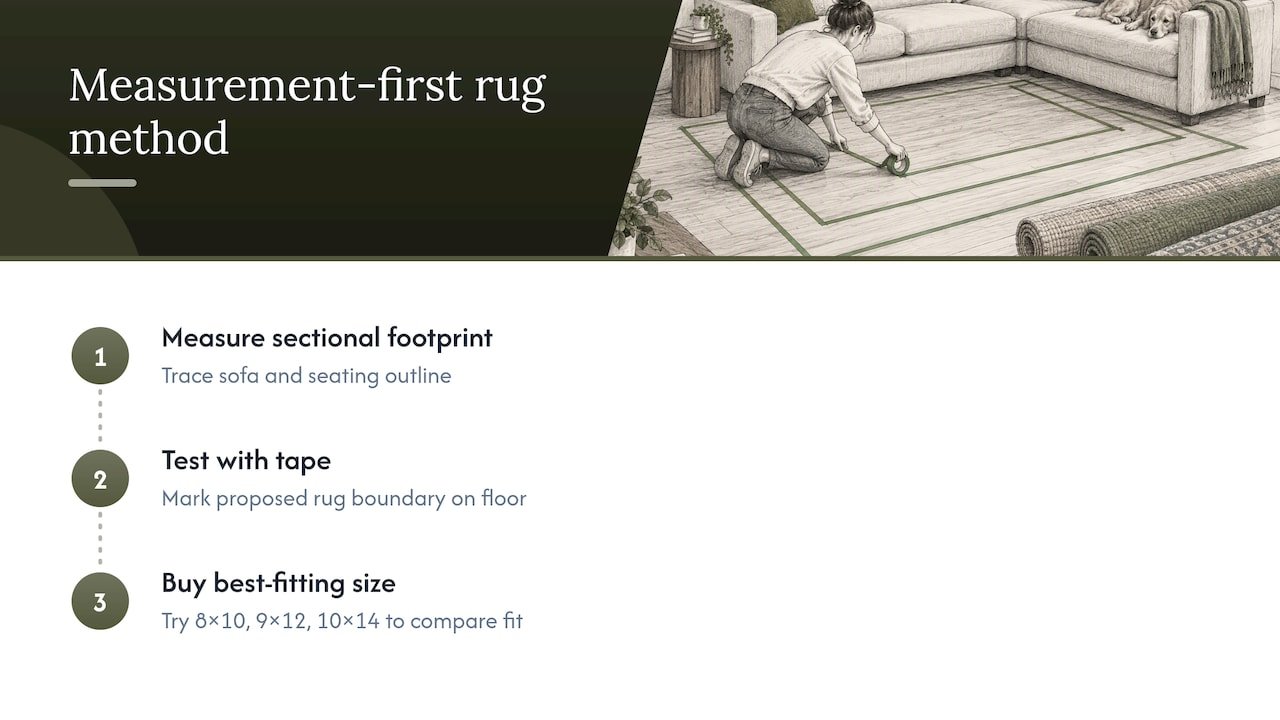
- Measure the sectional’s footprint, including the chaise or return, plus the distance to the nearest walls.
- Tape out candidate rug sizes directly on the floor using their actual dimensions. This tape-out method is the fastest way to catch a sizing mistake before it becomes a return.
- Check three things inside the taped outline: whether the front legs land inside it, whether foot traffic still flows around the edges, and whether you’ve held the 8 to 12 inch border rule beyond the sectional.
If the tape shows the rug crowding a doorway or leaving less than a foot of clearance to the wall, go down a size. If it leaves the sectional looking stranded in the middle of bare floor, go up. A detailed walkthrough of this exact comparison, including an 80 square foot versus 35 square foot tape-out test, shows how dramatically two sizes can change a room’s proportions.
Common sizing mistakes and how to avoid them
The single most frequent error is buying a rug that’s too small. According to design guidance, a rug that’s undersized for the furniture breaks the room’s proportion and makes the sectional look oversized by comparison, rather than making the room look bigger.
- Too small: a rug that only fits under the coffee table when the sectional needed front-leg coverage shrinks the whole seating area visually.
- Wrong orientation: placing a rectangular rug so it doesn’t align with the sectional’s main run confuses the eye and wastes floor space.
- Ignoring traffic paths: a rug that blocks a natural walkway gets pushed, bunched, and worn unevenly.
- Wrong material for the space: a delicate wool pile in a high-traffic family room wears faster than a flatweave or natural-fiber option built for daily use.
Pro Tip: Add a rug pad under any size you choose. It stops slipping, protects the rug’s backing from friction, and makes vacuuming easier around sectional legs.
Why measurement-first advice works better than guessing
This guide leans on the same measurement habits that keep rug returns rare: figure out the sectional’s footprint, test it with tape, then buy. Written by Kian for Rugs Online Market, the approach favors practical testing over style guesswork, because a rug that photographs well online can still be the wrong size for a real room.
A retailer with a wide size range from 8×10 up through 10×14 and beyond, and natural materials like wool and silk, supports that approach. Many stores offer free shipping above a certain order amount and a 30-day return window to help customers find the right size in person.
What most rug guides get wrong about sectionals
Most advice on rug sizing still leans on the old two-thirds rule, the idea that a rug should cover about two-thirds of the seating area. That guideline works fine for a simple sofa and two chairs. It falls apart with sectionals, because the more useful principle for irregular furniture shapes is furniture anchoring and front-leg contact rather than a fixed proportion.
The bigger issue I see is that people treat rug size as a style decision when it’s really a measurement problem. Nobody eyeballs a mattress size. A sectional deserves the same treatment. If you take one thing from this guide, let it be this: measure the footprint first, tape it out second, and let the numbers tell you which of the three standard sizes actually works. Style comes after fit, never before it.
— Kian
Find the right size and material on Rugs Online Market
Once you know your target size, filtering is faster than browsing. Rugs Online Market lets you search by exact standard dimensions, so you can pull up every 8×10, 9×12, or 10×14 option in a given style without scrolling past sizes that won’t work in your room.

Because free shipping applies on orders over $300 and returns are open for 30 days, you can order the size your tape-out pointed to and confirm it in person before deciding it’s final. A few starting points:
- Traditional Rugs for classic patterns in standard sectional-friendly sizes.
- Handmade Rugs for durable, natural-material options built for daily use.
- Natural rugs for texture that holds up well under heavy foot traffic.
Browse by size and material, order what your measurements point to, and use the return window as your final check.
Where these placement rules come from
The measurement and spacing guidance in this article draws on Architectural Digest’s rug sizing guide, The Spruce’s sectional-specific sizing advice, and Style by Emily Henderson’s guidance on furniture anchoring. For more room-by-room rules beyond sectionals, see this breakdown of rug size rules by room.
Sources
- Choosing the right rug size for every room — Style by Emily Henderson
- Rug sizes: How to figure out the best area rug for your space — Architectural Digest
- What size rug is best for your living room sectional? — The Spruce
FAQ
What is the 2/3 rule for couches?
The 2/3 rule suggests a rug should cover roughly two-thirds of the seating area in front of a sofa. For sectionals, design guidance favors prioritizing front-leg contact over a strict two-thirds measurement, since irregular shapes don’t map cleanly onto a simple ratio.
What kind of rug goes with a sectional?
Wool and natural-fiber rugs hold up well under the heavy use a sectional’s seating area typically gets, and both are available through categories like Natural rugs. Flatweave and low-pile options also make vacuuming around the sectional’s legs easier.
Should a rug be longer or shorter than a couch?
For a sectional, the rug should extend past the furniture’s edges rather than stop short of them. Designers recommend at least 8 to 12 inches of rug beyond the edges of large furniture so the piece doesn’t look cut off at the rug’s edge.
How do I place an 8×10 rug under a sectional?
An 8×10 typically works best under a smaller L-shaped sectional in a compact living room, with the front legs resting on the rug and the back legs allowed to sit off it. Tape out the 8×10 footprint on your floor first to confirm the front legs land inside it and the 8 to 12 inch border rule is met on the open sides.
