




















































For a straight staircase, add one tread depth to one riser height, multiply by the number of steps, then add extra for the top and for waste. A typical 12-step staircase with a 10.5-inch tread and a 7.5-inch riser needs about 18 feet of runner before allowances, and most people end up buying between 19 and 22 feet. Here is how to get your own number, step by step, and how to avoid the two classic mistakes: ordering too short and ordering a length you can’t fit around a turn.
Key takeaways
- The core formula is (tread depth + riser height) × number of steps. Measure over the nose of each step, not just the flat part.
- Add a cushion on top: 12 inches of extra material, or 10% for plain runners on straight stairs, and 15% to 20% for patterns, winders or several turns.
- Landings, winders and bullnose bottom steps are measured separately and by their real path, never by the straight-flight formula.
- Measure every step. Older homes often have steps that differ, and one wrong step throws the total off.
- Round up, then compare the result with the lengths a runner is actually sold in.
Table of Contents
- The basic formula for stair runner length
- A worked example: how long a runner for 12 steps
- How to measure your stairs
- How much extra to add
- Landings, turns and winders
- Length is only half the order: width and reveal
- Check the pile, the pad and the fastening before you order
- Perspective: why we tell customers to measure twice and round up
- Where to find runners for hallways, landings and entries
- Frequently asked questions
- Sources
The basic formula for stair runner length
A runner follows the staircase like water running down it: across the tread, down the riser, across the next tread. So the length used per step is the tread depth plus the riser height. This Old House describes it this way: add the height of one riser and the depth of one tread, multiply by the number of stairs, and add 12 inches of extra material. Ideal Home credits flooring expert Liam Cleverdon with the same core method: add tread depth and riser height, then multiply by the number of steps.
Written out:
Runner length (inches) = (tread + riser) × number of steps + extra
Divide by 12 to get feet.
The two measurements that matter most:
- Tread depth: from the front edge of the step (including the nosing, the lip that overhangs) back to the riser behind it.
- Riser height: the vertical face of the step, from the top of one tread to the top of the next.
If your steps have a nose that overhangs, measure the tread from the very outer point of the nose, and measure the riser from the tread surface down to the next tread. The runner wraps the nose, so the nose has to be counted.
A worked example: how long a runner for 12 steps
Take a common set of dimensions: a 10.5-inch tread and a 7.5-inch riser.
- Tread + riser = 10.5 + 7.5 = 18 inches per step.
- 18 inches × 12 steps = 216 inches, which is 18 feet.
- Add 12 inches of extra material: 228 inches, or 19 feet.
- If you prefer a percentage buffer, 10% on 18 feet brings you to about 19.8 feet.
There is one wrinkle to count. A flight of 12 risers has 12 risers but only 11 full treads, because the top of the flight meets the floor of the landing. Many installers still run the carpet a little onto the top floor or tuck it in at the top, so the calculation usually treats the top as roughly a half step extra. Add a half step to 12 steps (12.5 × 18 inches = 225 inches, or 18.75 feet) and then 10% waste, and you land near 20.6 feet. Different rounding rules give you slightly different answers, which is why you will see figures from 19 to 22 feet for the same 12 steps.
For a stock-length purchase, the practical answer is 20 to 22 feet. If you are choosing from fixed lengths, go up to the next size, never down. A runner that is one inch short costs you the same as one that is a foot short.

Quick reference for common step counts
These figures use the same 18-inch tread-plus-riser example and add a 12-inch cushion. Your own staircase will differ, so treat the table as a sanity check, not a shopping list.
| Number of steps | Base length (18 in per step) | With 12 in extra |
|---|---|---|
| 10 | 15 ft | 16 ft |
| 12 | 18 ft | 19 ft |
| 13 | 19 ft 6 in | 20 ft 6 in |
| 14 | 21 ft | 22 ft |
| 15 | 22 ft 6 in | 23 ft 6 in |
| 16 | 24 ft | 25 ft |
If your tread plus riser is 17 inches, each step uses an inch less, and over 14 steps that is more than a foot. Small differences add up, so measure rather than assume.
How to measure your stairs
You need a metal tape measure, a notepad, and a few minutes.
- Count the steps that will be covered. Count risers, the vertical faces, because that is what a flight is made of. Decide whether the runner starts at the first riser or on the floor.
- Measure one tread from the outer edge of the nose to the riser.
- Measure one riser from the tread surface to the next tread.
- Check every other step. Measure a few more, or all of them. Differing steps get measured on their own and then added together.
- Measure the width of the stair at the narrowest point, and note whether it is a closed stair (walls both sides) or open on one or both sides.
- Write down the geometry: any landings, winders (the pie-shaped steps at a turn), a bullnose bottom step, or open ends.
The best habit is to measure along the line the runner will actually take. Young House Love recommends measuring riser plus tread, including around the bullnose, multiplying by the number of steps and adding 10 to 15 percent extra. That buffer isn’t padding. It is what lets you turn the runner under, shift it later to spread wear, and recover from a cutting error.
Do your steps comply with code, and does it matter?
In newer homes, the steps are usually very uniform, and the dimension is rarely a surprise. The IRC allows a maximum riser height of 7¾ inches and a minimum tread depth of 10 inches where the tread has a nosing, according to Family Handyman’s summary of stair codes. So a modern staircase tends to run around 17 to 19 inches of tread-plus-riser per step. Older houses, renovated staircases and custom builds can fall well outside those figures, which is one more reason to measure your own.
How much extra to add
There is no single universal cushion, because the right amount depends on the staircase and the runner.
| Situation | Typical allowance |
|---|---|
| Plain runner, straight flight | 12 inches extra, or about 10% |
| Patterned runner that needs matching | 10% to 15%, often more |
| Bullnose bottom step | More than a standard step, because the curve uses extra material |
| Winders or multiple turns | 15% to 20% or more |
The 10% figure for plain runners on straight flights, and the 15% to 20% range for patterns, winders, bullnose bottoms and multiple turns, come from Stairrunner.co’s measuring guidance. The principle behind it is simple: the more the runner has to bend, wrap or line up a repeat, the more material it consumes.
Why patterns eat length
A geometric or striped runner has a repeat, the distance before the design starts again. When the pattern has to line up at each step, or a border has to wrap a corner cleanly, some material is cut away to keep the design looking right. If you love a bold pattern, ask for the repeat length before you decide how much to order.
Leave room to shift the runner later
Stair runners wear on the nose of each step first. With an extra 12 inches or so, a fitter can move the runner up or down in the future to spread the wear. It also gives you a chance to correct a measurement slip without scrapping the roll.
Landings, turns and winders
A straight flight is the easy case. Real houses often include a half landing, a quarter turn or a few winders, and these are measured differently.
Landings. A landing is a flat stretch, so its length is just the floor distance you want covered, measured along the line the runner will take. Measure it separately and add it to the flights on either side. If the runner is continuous across the landing, you add its depth. If you are using two separate runners, one for each flight, each flight is its own calculation, and the landing may get a rug or its own piece.
Winders. Winding steps taper, so the outside edge is longer than the inside. The standard approach is to measure along the outside perimeter of the winder, including the riser, because that’s the longest path the covering has to follow. Treat each winder as its own step, and plan on more material than a straight step would use.

Tolerance per flight. Every separate flight should get a little cushion of its own. Measuring guides from runner makers commonly suggest adding roughly 50 centimeters, about 20 inches, per flight for fitting tolerance. If your staircase has two flights and a landing, do the calculation for each flight, add the landing, then add the tolerance twice.
An example with a landing. Say you have 7 steps, a landing 40 inches deep, then 6 steps, all at 18 inches per step.
- First flight: 7 × 18 = 126 inches
- Landing: 40 inches
- Second flight: 6 × 18 = 108 inches
- Subtotal: 274 inches, about 22 feet 10 inches
- Add 15% for the turn and waste: about 315 inches, or 26 feet 3 inches
If you instead used two separate runners, you would order about 126 inches plus allowance for the first flight and 108 plus allowance for the second, and cover the landing another way. The right choice depends on how the landing looks and gets used. For a staircase with several turns or any curves, a measurement taken from the actual path always beats a formula, and a fitter’s template beats both.
Length is only half the order: width and reveal
A correct length on the wrong width still looks off. Most stair runners are centered, leaving a strip of bare stair on each side, called the reveal. A reveal of roughly 3 to 4 inches per side is a common look, which is why runners around 27 to 30 inches wide suit a standard 36-inch stair. Measure the actual width of your treads and decide how much wood or paint you want to show, then work out the runner width from that.
On a stair with an open side, the reveal can be different on each side, or the runner can sit nearer the wall. Choose the look first, and then go to the sizing.
Check the pile, the pad and the fastening before you order
Length determines how much you buy. What you put under and on top of the stairs determines whether it is safe to use.
- Pile height: A thick, plush runner can look luxurious but makes the wrap at each nose bulkier and harder to fix tightly. Our rug pile height guide explains how pile changes behavior by room.
- Padding: The pad cushions each step and protects the nose. See how to choose in our rug pad thickness guide.
- Fastening: A loose runner on a staircase is a falling hazard. If children or older relatives use the stairs, read our stair runner safety guide before you decide on pile and fixings.
If you want styling ideas, including patterns that look right on stairs, our stair runner ideas article has examples and sizing tips.
Perspective: why we tell customers to measure twice and round up
We sell rugs for every part of the home, including runner rugs for hallways and entries, and the sizing questions we hear most are about length. Our experience is that people rarely get stuck on the arithmetic. They get stuck because one measurement was taken from the flat of the tread instead of the nose, or because they never checked that all the steps matched.
Our advice is practical. Tape or chalk out the line the runner will follow if you are unsure. Write down every number, including the odd ones. And if you are caught between two lengths, take the longer one: extra material can be tucked or shifted, while a runner that comes up short can’t be fixed.
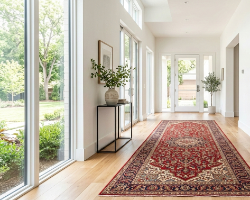
For halls, landings and long passages, the same thinking applies. Measure the space, subtract the bare floor you want to show on either side, and buy the next size up that still looks balanced. Our rug size rules guide covers that room by room.
— ROM team
Where to find runners for hallways, landings and entries
If your staircase connects to a long hall or you want a matching runner for the landing or upstairs corridor, browse our runner rugs. We carry runners in traditional, handmade, natural-fiber and modern styles, and we offer free shipping on orders over $300 and returns within 30 days. Compare the listed sizes against your own measurement, and if you are unsure, our customer service team can help you choose.
For wall-to-wall entries, our entryway rug ideas page covers minimum sizes, and how to stop a rug slipping helps on smooth floors.
Frequently asked questions
How long of a runner do I need for 12 steps?
About 19 to 22 feet for most standard stairs. With a 10.5-inch tread and 7.5-inch riser, the steps themselves use 18 feet, and you then add 12 inches or 10% for the top and waste. Patterned runners or a bullnose bottom step push you to the upper end.
How do I measure steps for a stair runner?
Measure the tread from the outer edge of the nose to the riser, and the riser from tread to tread. Add the two, multiply by the number of steps, and add your cushion. Check that every step matches, and measure any that differ on their own.
Should the runner cover the top step and the landing?
That is a design choice. The runner can end at the nose of the top step, tuck at the top, or continue across the landing. Whichever you choose, measure that extra distance and add it to the total.
How much extra should I add for waste?
Add 12 inches, or around 10%, for a plain runner on a straight flight. Go to 15% to 20% for patterns, winders, bullnose steps or several turns. If your staircase is unusual, a measurement along the real path is more reliable than a percentage.
Can I use the same formula for winders?
Not directly. Winders are measured along their outer edge, riser included, because the outside is the longest path. Treat them as their own sections and keep extra material for them.
Sources
- How To Install a Stair Runner, This Old House
- How to measure for a stair runner, Ideal Home
- How To Install A Stair Runner, Young House Love
- How to measure for a stair runner, Stairrunner.co
- Standard Stair Rise and Run, Family Handyman
