

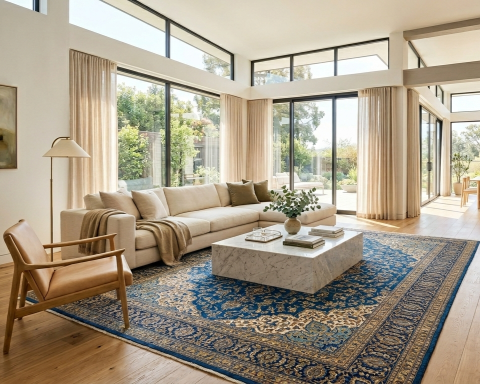
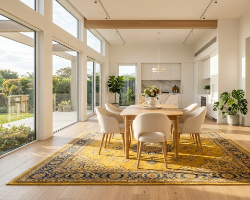
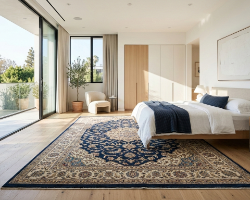
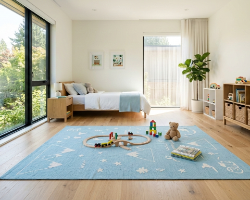
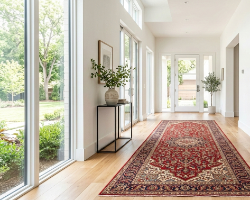
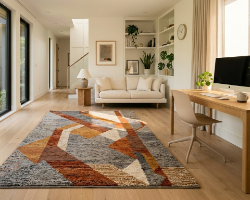
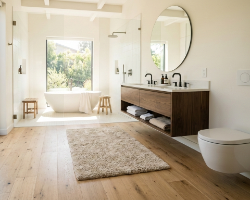

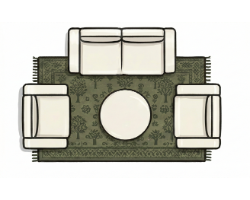
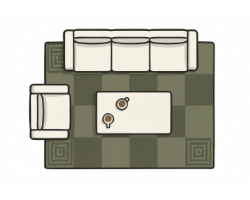
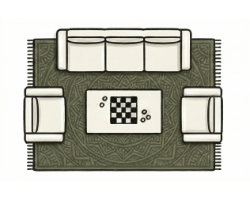
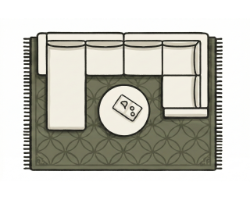
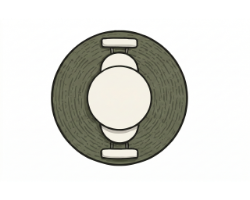








The single rule that prevents most round rug mistakes: for dining tables, your rug diameter should equal the table diameter plus at least 48 inches. For seating areas, every major furniture piece should either sit fully on the rug or have its front legs touching it. Get those two right and you’ve solved 80% of placement problems before you even unroll the rug.
Three quick checks you can run right now:
- Dining table: Measure your table’s diameter, then add 48 inches. That’s your minimum rug diameter so chairs stay on the rug when pulled out.
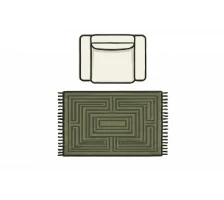
- Living room seating: Stand back and ask whether your sofa and chairs touch the rug. If nothing does, the rug is too small.
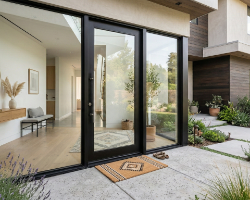
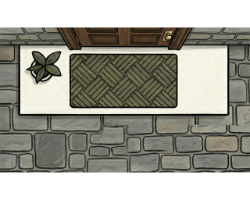
- Entryway: Swing your door fully open and mark the arc. Your rug needs to clear that arc with room to spare.
Pro Tip: Before buying, lay painter’s tape or kraft paper on the floor at the intended rug diameter. This visualization technique takes five minutes and almost always prevents the most expensive mistake: buying too small.
For high-traffic zones like dining rooms and hallways, low-pile wool or polypropylene holds up far better than shag or natural jute.
Table of Contents
- Where do round rugs work best in a home?
- When should you pick a round rug over a rectangular one?
- How do you measure for the right round rug diameter?
- Round rug size guide by room type
- How should you place a round rug in a living room?
- How do you size a round rug under a dining table?
- Where should round rugs go in a bedroom?
- How do you place a round rug in an entryway or small nook?
- Which rug materials work best in each room?
- What are the most common round rug placement mistakes?
- Key Takeaways
- The one thing most round rug guides get wrong
- Find the right round rug at Rugsonlinemarket
- Useful sources and further reading
Where do round rugs work best in a home?
Round rugs outperform rectangular ones in specific situations, and design guidance from Houzz identifies six clear scenarios where the circular shape wins. Knowing these spots saves you from forcing a shape that fights the room.
Ideal placements:
- Dining rooms with round tables: — The shapes echo each other, reinforcing the geometry of the space.
For more on how to layer effectively, the layering rugs guide covers the practical rules room by room.
Architectural cues that favor round rugs: curved windows, round pendant lights or chandeliers, circular dining tables, and any room where the furniture floats in the center rather than against walls.
A round rug can make a small room feel larger by encouraging the eye to move across the curve rather than stopping at a corner. The effect is subtle but consistent: the absence of right angles reduces the visual “boxing in” that rectangular rugs create in tight spaces.
When should you pick a round rug over a rectangular one?
The short answer: choose round when you’re defining a vignette, emphasizing curves, or working with a non-rectangular furniture footprint. Choose rectangular when you’re anchoring a long sofa bank, a linear dining table, or a hallway.
Practical trade-offs:
- Sizing ease: Rectangular rugs are simpler to size for linear furniture. Round rugs require you to think in diameters, which trips up first-time buyers.
- Pattern translation: Geometric and medallion patterns often center better on a round rug. Stripes and borders look awkward when cut into a circle.
- Chair clearance: Under a round dining table, a correctly sized round rug is often the better functional choice. When the rectangular rug needed to provide the same clearance would be impractically large for the room, a round rug keeps the scale balanced.
- Visual flow: Round rugs soften rooms with hard architectural lines. In a room already full of curves (arched doorways, round tables, curved sofas), a rectangle can feel like a mismatch.
Pro Tip: Layer a round rug over a larger rectangular one to get both benefits. The rectangle anchors the full seating area; the round rug on top creates a focal point at the coffee table. This works especially well in open-plan living rooms where you need to define zones without walls.
How do you measure for the right round rug diameter?
Start with the furniture, not the room. The room’s dimensions matter for scale, but the furniture footprint determines the minimum rug size.
The formulas:
- Dining table: Table diameter + 48 inches = minimum rug diameter. A 48-inch table needs at least a 96-inch (8-foot) rug.
- Seating area: Measure the full footprint of your sofa and chairs. The rug should be large enough that all major pieces at least touch it. If you prefer the front-legs-on-rug approach, allow 18–24 inches of rug beyond the front legs.
Step-by-step before you buy:
- Measure your table or furniture footprint at its widest point.
- Add the required clearance (48 inches for dining; 18–24 inches for seating).
- Mark that diameter on the floor with painter’s tape or kraft paper.
- Pull out dining chairs fully and check whether they stay within the tape boundary.
- Sit in your seating pieces and confirm the rug feels connected, not floating.
- Check the rug size chart to match your calculated diameter to a standard rug size.
Pro Tip: When your calculation lands between standard sizes, always size up. A rug that’s slightly too large looks intentional; one that’s slightly too small looks like a mistake.
Round rugs commonly come in a range of sizes increasing by about a foot increments in diameter. If your math gives you 7’6", you’re buying an 8-footer.
Round rug size guide by room type
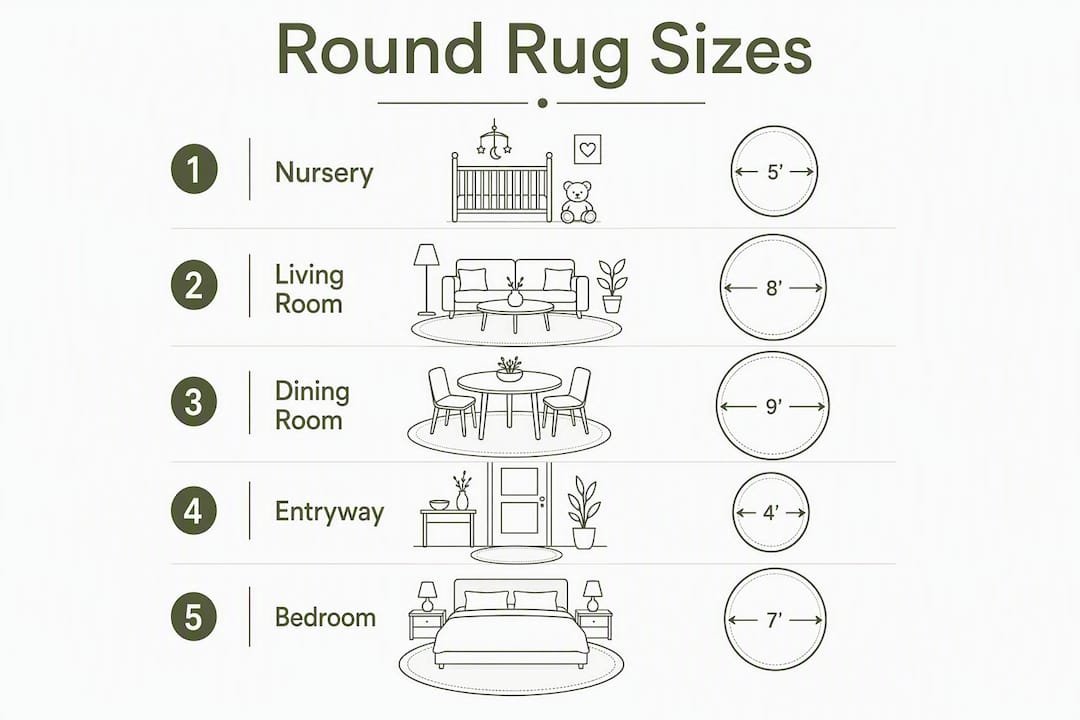
The table below maps common room setups to recommended minimum diameters. These are starting points; always verify with the tape method before purchasing.
| Room / Setup | Recommended Diameter | Why |
|---|---|---|
| Small reading nook or nursery | 4’–5’ | Defines the zone without overwhelming the space |
| Small living room or seating vignette | 6’ | Fits a loveseat-and-chair grouping; all pieces touch |
| Medium living room | 8’ | Accommodates a standard sofa with front legs on rug |
| Large living room | 10’ | Anchors full seating groups; all furniture on rug |
| Dining: small round table | rug sized to fit table diameter plus clearance for chair pull-out | |
| Dining: medium round table | large enough rug to allow chair clearance | |
| Dining: large round table | appropriately sized rug to keep chairs on rug when pulled out | |
| Bedroom (bedside accent) | 4’–5’ | Provides 18–24" of soft landing beside the bed |
| Bedroom (under small bed) | 8’ | Bed legs touch rug; exposed rug at foot and sides |
| Entryway / foyer | 3’–4’ | Clears door swing; leaves 6–12" border of floor |
Standard diameter guidance from 2Modern’s round rug collection confirms that 4-foot rounds suit nooks, 6-foot rounds work for small living rooms and nurseries, 8-foot rounds fit medium living rooms and bedrooms, and 10-foot rounds handle large spaces.
Tips for nonstandard layouts:
- L-shaped seating: Treat the inner corner as the center of the rug. A large round rug (8’–10’) can anchor both arms of the L if centered at the coffee table.
- Bay window nook: A 4’–5’ round rug centered under a small chair or bench fills the nook without spilling into the main room.
- Open-plan zones: Use rug size to define the boundary of each zone. The dining rug and living room rug should not touch or overlap.
How should you place a round rug in a living room?
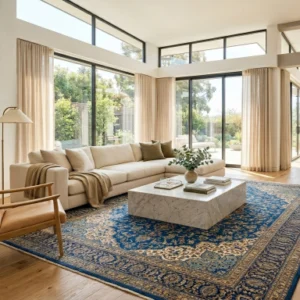
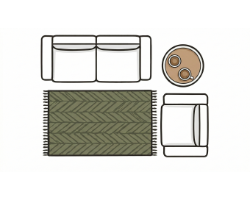
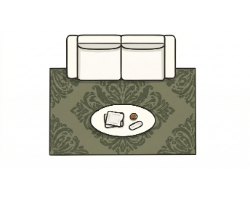
The core rule for a round rug in a living room: the rug should connect the furniture, not sit under it like a coaster. Every key piece, sofa, chairs, and ottoman, should either rest fully on the rug or have its front legs on it.
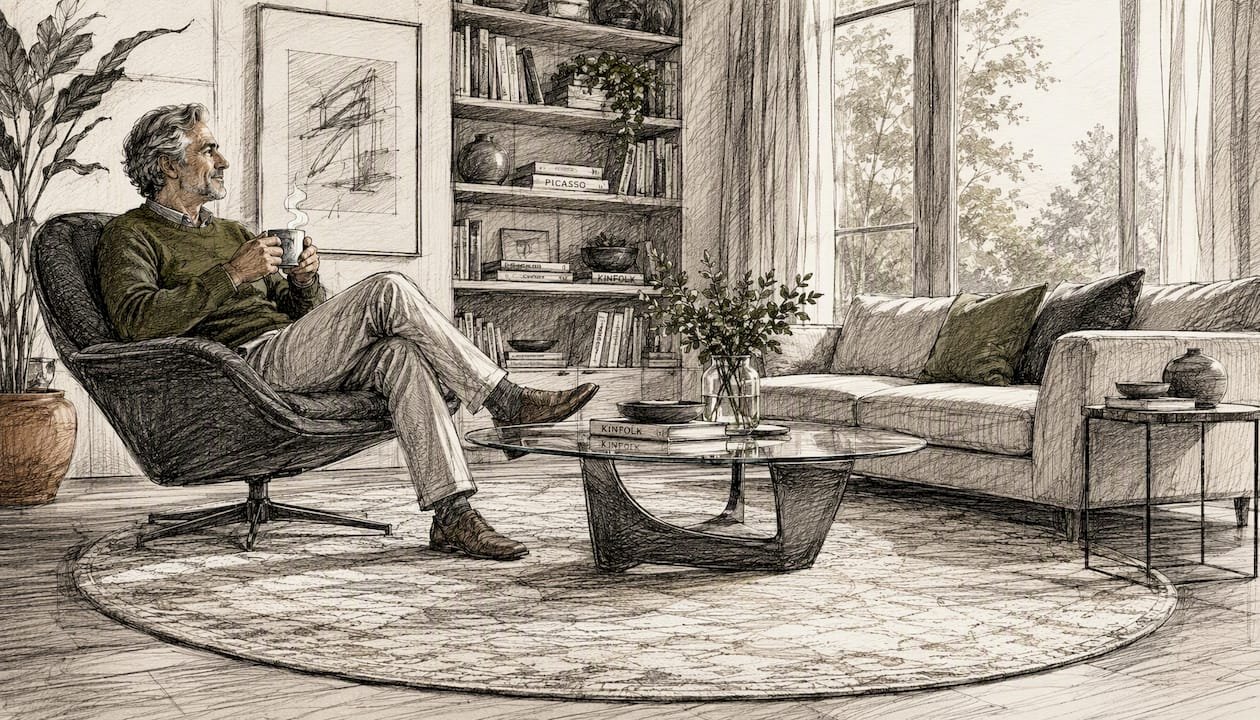
For small seating groups (loveseat plus one or two chairs), a 6-foot round rug centered on the coffee table pulls the group together. All pieces touch the rug, which defines the vignette clearly.
For larger living rooms, the front-legs-on-rug approach works well. Place the rug so the front legs of the sofa and chairs rest on it, with 18–24 inches of rug visible beyond those legs. This keeps the room feeling open while still anchoring the seating.
Quick placement checklist:
- Center the rug under the coffee table, not under the sofa.
- Check that the rug extends at least to the front legs of every seating piece.
- Leave a consistent border of bare floor (at least 12–18 inches) between the rug edge and the walls.
- Confirm traffic paths around the seating group are clear; the rug edge should not create a trip hazard.
- For symmetry, the rug’s center should align with the center of the sofa, not the center of the room.
A 6-foot round in a compact living room (say, 10’ x 12’) defines the seating area but leaves enough bare floor to keep the room breathing. Step up to an 8-footer in the same room and suddenly the furniture feels anchored rather than perched. That one size difference is often the gap between a room that looks styled and one that looks accidental. For more on living room rug sizing, the full placement guide covers rectangular and round layouts side by side.
| Point | Details |
|---|---|
| Center on the coffee table | Align the rug’s center with the coffee table, not the room’s center. |
| Front-legs rule | All major seating pieces should have at least their front legs on the rug. |
| Size up for larger rooms | Use an 8’–10’ round for standard living rooms; 6’ suits compact vignettes only. |
| Border clearance | Leave 12–18 inches of bare floor between the rug edge and the walls. |
How do you size a round rug under a dining table?
The standard recommendation is to allow enough rug beyond the table edge on every side to accommodate chair movement comfortably, typically about double the chair pull-out distance.
The reason is purely functional. When someone pulls their chair back to sit down or stand up, the chair legs travel roughly 18–24 inches from the table edge. If the rug ends before that point, the chair catches on the rug edge every time, which is both annoying and a tripping hazard.
How to check chair clearance before buying:
- Measure from the table edge to the outermost point a pulled-out chair reaches.
- Mark that boundary with tape on the floor.
- Add a few inches of buffer; the rug edge should sit outside that mark.
- If the required rug diameter feels too large for the room, consider whether a rectangular rug might work, or accept that a smaller round rug will mean chairs catch the edge.
What to do when the math produces an impractically large rug: A correctly sized round rug is often the better choice precisely because the rectangular equivalent would be even larger. If a 9-foot round still feels too heavy, the real solution is a smaller dining table, not a smaller rug.
Pro Tip: For dining zones, low-pile materials and a quality rug pad are non-negotiable. Low pile means chairs glide instead of catching; the rug pad prevents the rug from shifting every time someone sits down. Wool and polypropylene both hold up well under dining chairs.
Where should round rugs go in a bedroom?
Bedrooms offer three practical configurations for round rugs, and the right one depends on bed size and how much floor you want to cover.
Three bedroom configurations:
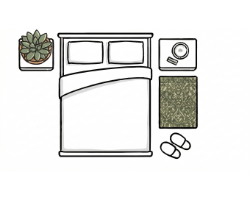
- Bedside accent (single round rug): Place a 4’–5’ round beside the bed, centered on the nightstand. You get 18–24 inches of soft landing when you step out of bed. This works well in smaller bedrooms where a large rug would crowd the space.
- Flanking pair (two matching rounds): One round rug on each side of the bed, each 3’–4’ in diameter. The symmetry reads as intentional and styled. Works best with queen or king beds where the sides are equally accessible.
- Oversized anchor (large round under the bed): An 8-foot round centered under a full or queen bed, with the bed’s lower legs resting on the rug. The rug extends 18–24 inches at the foot and sides, giving you soft floor on all accessible sides.
For bedroom rug placement in general, the rule is the same as every other room: the rug should connect to the furniture, not float in the middle of the floor.
Layering note: A round rug layered over a larger jute or sisal base rug adds texture and warmth in bedrooms without requiring a single oversized rug. The base rug handles the square footage; the round rug handles the visual interest.
| Point | Details |
|---|---|
| Bedside accent | Use a 4’–5’ round beside the bed for 18–24" of soft stepping space. |
| Flanking pair | Two 3’–4’ rounds flank a queen or king bed for a symmetrical, styled look. |
| Under-bed anchor | An 8’ round centered under a full or queen bed keeps all sides covered. |
| Layering option | A round rug over a larger base rug adds texture without one oversized piece. |
How do you place a round rug in an entryway or small nook?
Entryways are where round rugs earn their keep fastest, but door clearance is the one thing most people forget to check.
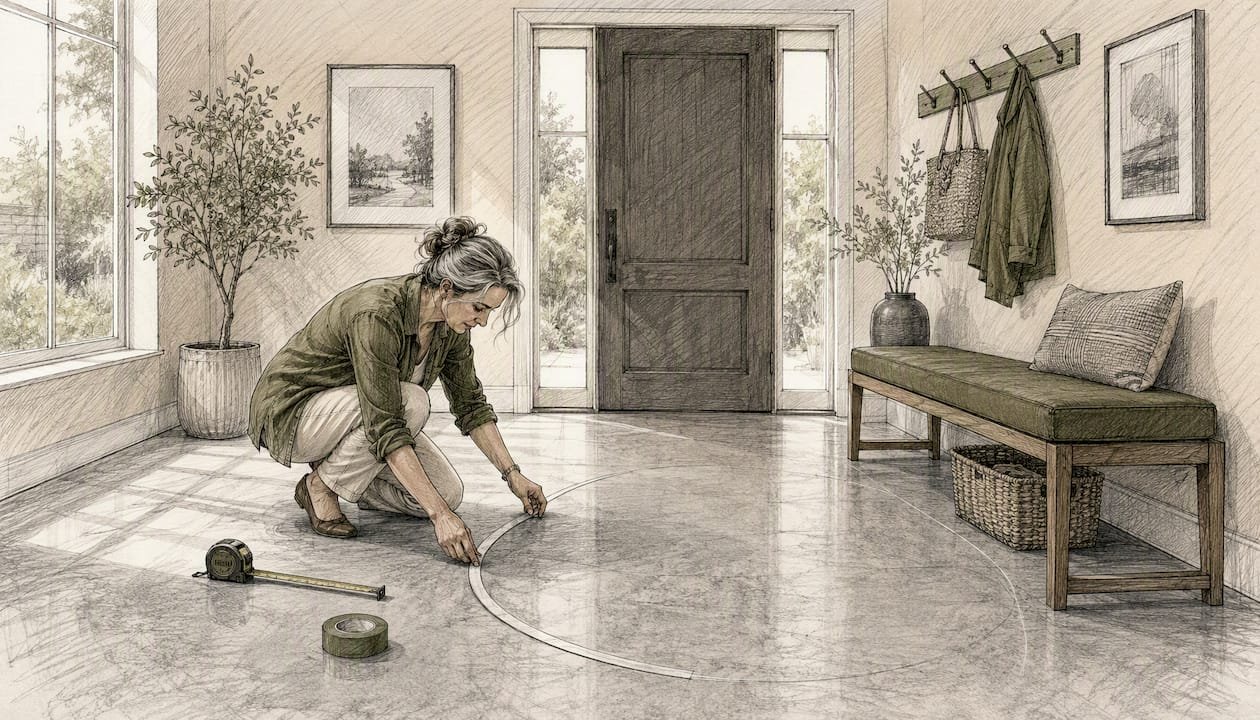
The rule: Choose a rug diameter that leaves the door swinging freely and keeps at least a 6–12 inch border of bare floor around the rug’s edge. That border makes the rug look placed, not crammed.
Practical tips for small spaces:
- Measure the full arc of your door swing before choosing a size. A 3-foot round works in most standard entryways; a 4-footer fits a wider foyer.
- In a narrow hall niche, a smaller round (2’6"–3’) can substitute for a doormat and adds more visual interest than a flat mat.
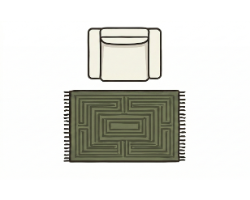
- For a reading nook, a 4’–6’ round centered under the chair or chaise defines the zone without bleeding into the adjacent room.
- If the nook has a curved wall or bay window, align the rug’s center with the architectural focal point, not the geometric center of the floor.
Pro Tip: Tape the door swing arc on the floor before buying. It takes 30 seconds and prevents the frustrating scenario of a rug that bunches every time the door opens. A rug that fights the door gets moved, folded, or returned.
Scaling wall art and mirrors in an entryway follows similar proportional logic to rugs. The wall art size guide from Noirci Studio covers how to match art dimensions to wall and furniture scale, which is useful when you’re styling a foyer from floor to ceiling.
Which rug materials work best in each room?
Material choice is where a lot of buyers get it wrong, usually by choosing what looks good in a photo rather than what survives the room.
High-traffic zones (dining rooms, living rooms, entryways):
- Wool: Durable, naturally stain-resistant, and holds its pile under heavy use. The go-to for dining rooms and living rooms that see daily foot traffic.
- Polypropylene: Synthetic but tough. Resists moisture and stains, cleans easily, and costs less than wool. A strong choice for families with kids or pets.
- Low pile (under 0.5 inches): Non-negotiable for dining areas. Chairs glide cleanly; crumbs don’t disappear into the fibers.
Low-traffic zones (bedrooms, reading nooks):
- Jute and sisal: Natural fibers that add texture and warmth. Not ideal for dining or wet areas, but excellent as bedroom base layers or accent rugs in dry spaces. For care specifics, the jute rug cleaning guide covers the low-moisture steps that keep natural fibers looking good.
- Shag and high pile: Soft underfoot and visually cozy. Fine for bedrooms and reading corners where chairs don’t drag across the surface.
- Washable rugs: For kids’ rooms, playrooms, and pet-heavy households, a machine-washable round rug is the practical choice. Pile height matters less than the ability to throw it in the wash.
Pro Tip: Pile height affects chair glide more than most buyers expect. A half-inch pile under a dining chair creates noticeable drag. If you love a shaggy look, use it in the bedroom and choose a flat-weave or low-pile option for anywhere chairs move regularly. Rugsonlinemarket carries natural fiber rugs and washable options across multiple round sizes.
What are the most common round rug placement mistakes?
Most placement problems come down to one of five mistakes, and every one of them is preventable with a tape measure and five minutes.
- Buying too small: Designers consistently flag this as the most common error. A rug that doesn’t reach the furniture looks like an afterthought. Fix: run the measurement formula before you shop, not after.
- Skipping chair pull-out clearance: Measuring the table and forgetting the chairs is how you end up with a rug that catches every time someone sits down. Fix: simulate the pull-out with tape and measure to the outermost chair position.
- Centering the rug to the room instead of the furniture: A rug centered on the room’s floor but offset from the furniture looks wrong even when you can’t immediately identify why. Fix: center on the coffee table or dining table, not the walls.
- Choosing high pile for dining areas: Thick pile grabs chair legs and traps food. Fix: low pile or flat-weave for any room with moving chairs.
- Skipping the rug pad: Without a pad, a round rug on hard floors shifts constantly. It also wears faster and can scratch the floor underneath. Fix: buy a round rug pad cut to match or slightly smaller than the rug diameter.
Before you purchase, run this one-line check: Does the rug diameter cover the furniture footprint plus the required clearance, is the pile appropriate for the room’s use, and do I have a pad?
Key Takeaways
The single most important rule in round rug placement: size for the furniture first, not the room, using the table-diameter-plus-48-inches formula for dining and the front-legs-on-rug standard for seating.
| Point | Details |
|---|---|
| Dining table formula | Table diameter + 48" = minimum rug diameter; a 48" table needs at least an 8’ rug. |
| Living room rule | All major seating pieces should touch the rug, or front legs on rug with 18–24" exposed. |
| Visualize before buying | Use painter’s tape or kraft paper at the intended diameter to preview scale and clearance. |
| Material by traffic | Low-pile wool or polypropylene for dining and high-traffic zones; shag and jute for bedrooms. |
| Rugsonlinemarket | Browse round rugs by diameter with free shipping over $300 and 30-day returns. |
The one thing most round rug guides get wrong
Most placement guides treat round rug sizing as a math problem. It is, but only partly. The real issue is that homeowners measure the room and then pick a rug that fits the room, when they should be measuring the furniture and picking a rug that fits the use.
A dining table doesn’t care about the room’s square footage. It cares whether the chairs stay on the rug when someone stands up. A living room seating group doesn’t need a rug that reaches the walls. It needs a rug that connects the pieces so the group reads as a unit. Those are functional requirements, not aesthetic ones, and they produce a specific number every time.
The second thing guides underplay: the rug pad. Buyers spend time agonizing over pattern and pile height, then skip the pad to save $30. A round rug without a pad on hardwood shifts every single day. It also wears unevenly, curls at the edges, and eventually damages the floor. The pad is not optional; it’s part of the rug.
One practical habit worth building: before you finalize any rug purchase, tape the diameter on the floor and live with it for a day. Walk around it, pull out the chairs, sit on the sofa. The tape version of the rug tells you more in 24 hours than any photo or room planner will.
Find the right round rug at Rugsonlinemarket
Knowing your measurements is the hard part. Finding the rug is the easy part, if you’re shopping in the right place.

Rugsonlinemarket carries round rugs across every major diameter, from compact 4-foot accent rounds for reading nooks to 10-foot statement pieces for large living rooms. The round rug collection covers traditional Persian, Moroccan, abstract, and modern styles, so you’re not choosing between function and design. For families and pet owners, the washable rug options include low-pile rounds that handle real-life use without sacrificing the look. Orders over $300 ship free, returns are open for 30 days, and the size chart is available on-site to confirm your diameter before checkout. Measure first, then browse by size to find exactly what your room needs.
Useful sources and further reading
The measurement standards and placement rules in this guide draw from the following sources:
- When to go round with your rug | Houzz — six scenarios where round rugs outperform rectangles, with layering examples.
- Rules of Thumb for Rugs Under Round Dining Tables | Mix & Match Design — the case for sizing up and the round-vs-rectangular trade-off under dining tables.
- Rug size chart | Rugsonlinemarket — measurement templates and standard size conversions for computing rug diameters before purchase.
