











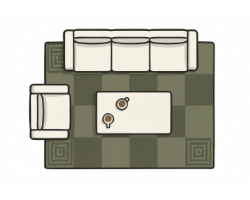
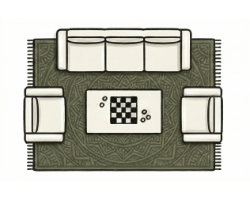
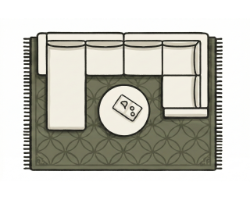









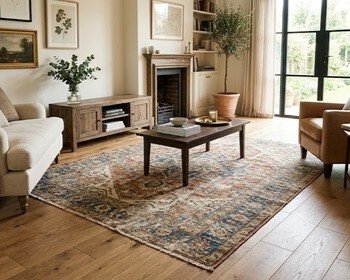
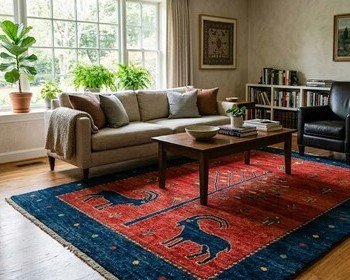






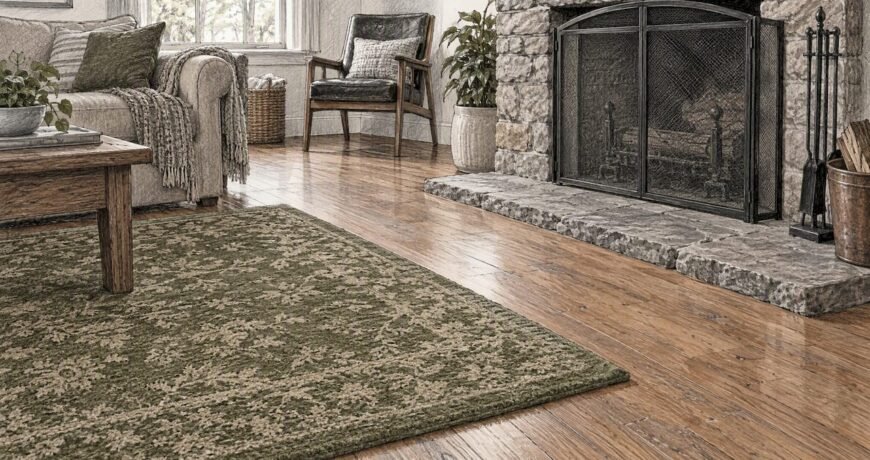
Wool is the safest common fabric for a decorative rug near a fireplace or wood stove, since it resists ignition from small sparks, while a purpose-made fiberglass hearth mat is the better choice for direct ember exposure. The one rule that matters most: keep combustible materials, including rugs, within the clearances your appliance manufacturer and the U.S. Fire Administration recommend, and confirm any rug you buy is labeled for hearth or fireplace use.
Key Takeaways
Wool and fiberglass hearth rugs provide the best safety near fireplaces and wood stoves by resisting ignition and ember penetration, but combining safety with proper placement is essential.
| Point | Details |
|---|---|
| Choose the right material | Select wool for decorative hearth-edge placement and fiberglass for direct ember zones to optimize safety and style. |
| Understand safety labels | Verify rugs have labeling for fireplace use and meet federal flammability standards to ensure they are appropriate for hearth safety. |
| Measure correctly | Measure your hearth and extend coverage outward to adequately protect against embers while maintaining clearance zones. |
| Maintain and clean properly | Follow specific cleaning routines for each material as washing and improper care can weaken fire-resistant treatments over time. |
| Rugs are part of a safety system | Use hearth rugs alongside fire screens, clearances, and chimney checks to create a comprehensive fire safety setup, especially with Rugsonlinemarket options. |
Table of Contents
- How common rug materials perform near fireplaces and wood stoves
- What U.S. safety standards and labels mean for rugs
- How big a hearth rug should be and where to place it
- Cleaning, wear, and how care affects fire resistance
- How to choose the right fire-resistant rug for your fireplace or wood stove
- Why trust Rugs Online Market for hearth-area rugs
- Benefits of choosing fire-resistant rugs in different home settings
- Comparison of fire-resistant rugs versus standard rugs in terms of safety and performance
- Tips for integrating fire-resistant rugs with other fire safety measures in the home
- Author perspective: recommended approach for most homeowners
- Where to buy hearth-appropriate rugs from Rugs Online Market
- FAQ
- Sources
How common rug materials perform near fireplaces and wood stoves
Not every rug marketed as “natural” or “heat friendly” behaves the same way once a spark lands on it. The differences come down to fiber type, backing, and whether a flame-retardant treatment has been applied.
Wool tends to char and self-extinguish rather than catch fire outright when it meets a small ember, which is why it shows up so often in hearth-adjacent decorating advice. It will not survive sustained contact with hot coals, but for the occasional stray spark, wool holds up better than most woven fibers.
Fiberglass hearth mats sit in a different category entirely. They are built to be effectively noncombustible, which makes them the right pick for the few square feet closest to an open flame or a wood stove door where embers regularly land. The tradeoff is that they look utilitarian and cannot be machine washed; agitation damages the glass fibers, so cleaning means shaking or wiping, not laundering.
Treated synthetic rugs fall in between. A flame-retardant treatment can meaningfully slow ignition, but that protection is not permanent. Repeated washing or heat exposure degrades the chemical treatment over time, so a rug that passed testing when new may perform differently a few years and many washes later.
- Wool: chars rather than flares; good for decorative hearth-edge placement.
- Fiberglass mats: essentially noncombustible; best for direct ember zones.
- Treated synthetics: effective when new; treatment can fade with washing.
- Polypropylene and olefin: melt rather than char, which can stick and spread damage instead of self-extinguishing.
Polypropylene and olefin deserve a specific warning. These petroleum-based fibers tend to melt when they meet high heat, and melted synthetic can cling to skin or embers rather than simply burning out, so they are a poor match for any spot where sparks are likely.
What U.S. safety standards and labels mean for rugs
Every rug sold in the United States has to meet a federal flammability standard, and knowing what that standard actually tests helps you read a label correctly instead of guessing.
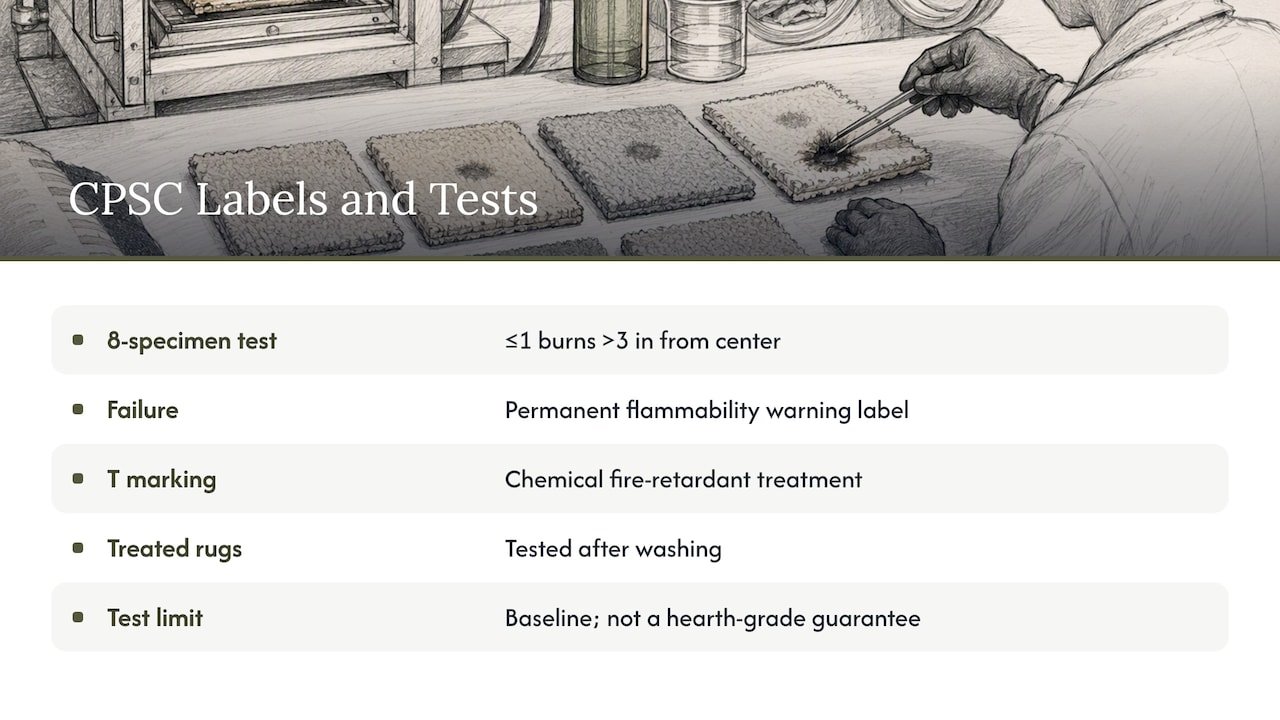
Every rug legally sold in the U.S. must pass the CPSC’s pill test, which uses eight specimens and allows at most one to burn beyond 3 inches from the center before the product fails, according to CPSC guidance on carpets and rugs. A rug that fails must carry a permanent warning label stating it does not meet the flammability standard, so checking for the absence of that warning is a quick first screen.
The regulatory text in 16 CFR Part 1630 also governs the “T” marking, which identifies a rug that relies on a fire-retardant chemical treatment rather than naturally resistant fibers. Treated products are required to be tested after washing, since the standard recognizes that treatments can wear off with laundering.
It helps to understand the pill test’s limits, too. It is a baseline safety screen, not a guarantee of hearth-grade performance, and tests like ASTM E84 (surface burning characteristics) or ASTM E648 (critical radiant flux) are more rigorous measures used for flooring in commercial or high-risk settings. For hearth use specifically, look for rugs explicitly marketed as fireplace-appropriate, and if a product description does not say so, ask the seller directly whether the item has been tested or labeled for that use.
How big a hearth rug should be and where to place it
Sizing a hearth rug is really about covering where embers land and keeping the surrounding area clear, not just matching your room’s dimensions.
A commonly cited baseline is to extend coverage about 16 inches in front of the fireplace opening and 8 inches on each side, based on practical guidance from CPSC’s rug FAQ. Pair that with the broader 3-foot safety zone the USFA recommends for keeping any combustible item away from a wood stove or fireplace opening. The rug handles close-range ember spray; the 3-foot zone handles everything else nearby, including furniture and bedding.
- Measure your hearth opening, then add the recommended front and side extensions before shopping.
- Tape out the footprint on your floor to see whether a half-round or rectangular shape fits better.
- Choose a larger area rug placed further back if you want more decorative coverage beyond the hearth mat itself.
- Add non-slip backing or a rug pad to prevent sliding on hard flooring.
- Pick a rug with bound or finished edges to reduce curling, which can catch embers underneath.
Pro Tip: Lay painter’s tape on the floor in your planned rug shape for a day before buying, so you catch foot-traffic conflicts or awkward furniture overlap first.
Cleaning, wear, and how care affects fire resistance
How you clean a hearth rug can quietly change how well it protects you. Flame-retardant treatments are not permanent coatings; CPSC testing protocols require washed specimens for treated products precisely because washing can reduce treatment effectiveness over time.
Care routines should match the material:
- Wool: spot clean and brush out debris; avoid soaking, which can affect both fiber structure and any applied finish.
- Fiberglass mats: shake out loose ash and wipe down; never machine wash, since agitation damages the glass fibers.
- Treated synthetics: follow the manufacturer’s specific instructions, and skip aggressive laundering that could strip the treatment early.
Inspect any hearth rug every few months for thinning spots, scorch marks, or a backing that has started to crack or peel. Once a treated rug has been through repeated heavy washing, or a fiberglass mat shows fraying at the edges, it is worth replacing rather than assuming the original fire performance still holds.
How to choose the right fire-resistant rug for your fireplace or wood stove
Picking a hearth rug comes down to matching material to risk level, then confirming the practical details before checkout.
- Prioritize wool or a labeled fiberglass mat over untreated synthetics for anything near an open flame.
- Measure your hearth opening and confirm the rug or mat covers the recommended front and side extensions.
- Check for non-slip backing, especially over hardwood or tile.
- Look for explicit fireplace or hearth labeling, not just a general flammability pass.
- Ask the seller whether treatment durability has been tested after washing.
- Confirm the recommended cleaning method fits your routine before buying a treated rug you cannot easily launder.
When ember contact is a near-daily reality, such as with a wood stove used through winter, a dedicated fiberglass hearth mat is worth the tradeoff in looks. When the rug sits a bit further back and mainly needs to handle an occasional spark, a well-made wool rug gives you both safety and style. For heat concerns that extend beyond the floor, like mounting a television above a mantel, measuring actual heat exposure before installation is worth doing at the same time you plan your rug.
Why trust Rugs Online Market for hearth-area rugs
We carry a wide range of natural rugs and handmade wool rugs suited to hearth-adjacent placement, organized by size and style so you are not hunting through unrelated categories. Our traditional rugs collection includes natural-fiber options that work well just beyond the hearth extension zone.
For sizing questions, our guide to rug size and placement and our non-slip backing advice cover the practical details that matter once the rug arrives.
Benefits of choosing fire-resistant rugs in different home settings
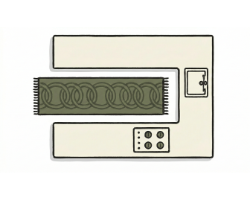
Fire-resistant rugs earn their keep in more rooms than just the living room hearth. In kitchens, a wool or treated rug placed near a range reduces the risk from grease spatter or a dropped match catching a floor covering that would otherwise flare quickly. Near a fireplace or wood stove, the same reasoning applies at a larger scale, since embers pop further than most people expect.
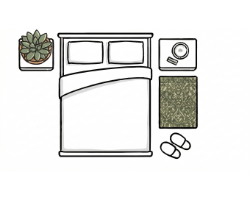
Children’s rooms benefit for a different reason: kids are more likely to be near candles, nightlights, or space heaters without realizing the fire risk, so a rug that resists quick ignition adds a buffer against a careless accident. Home offices with space heaters under a desk face a similar scenario, where a rug that chars instead of flaring gives you more reaction time.
None of these settings call for the same heavy-duty fiberglass mat you would want at a wood stove’s door. A wool or treated natural-fiber rug offers a meaningful safety improvement over an untreated synthetic one while still fitting the room’s decor. The common thread across kitchens, hearths, and bedrooms is the same: anywhere a spark, dropped ember, or heating appliance is part of daily life, the rug underfoot is worth a second look, not just a style choice.
Comparison of fire-resistant rugs versus standard rugs in terms of safety and performance
A standard rug, especially one made from polypropylene or an untreated synthetic blend, is built for comfort and cost, not heat exposure. Dropped embers, sparks from a wood stove, or a kicked-over candle can cause these materials to melt or ignite quickly, and once melted synthetic fiber catches, it tends to spread rather than self-extinguish.
A fire-resistant option, whether that is wool, a treated synthetic, or a dedicated fiberglass mat, changes that outcome in a specific way: it either chars in place (wool) or does not combust at all (fiberglass), buying time and limiting damage to a small, contained spot. That difference is not about which rug looks better or feels softer underfoot; it is about what happens in the first few seconds after an ignition source makes contact.
Performance-wise, standard rugs often win on price and sometimes on softness, since treated fire-resistant synthetics can feel slightly stiffer depending on the chemical treatment used. But for any floor area within a few feet of an open flame or heating appliance, that comfort tradeoff is minor compared to the practical safety gap. The right approach is not choosing one rug type for the whole house, but reserving fire-resistant materials for the handful of rooms where ignition risk is realistically higher.
Tips for integrating fire-resistant rugs with other fire safety measures in the home
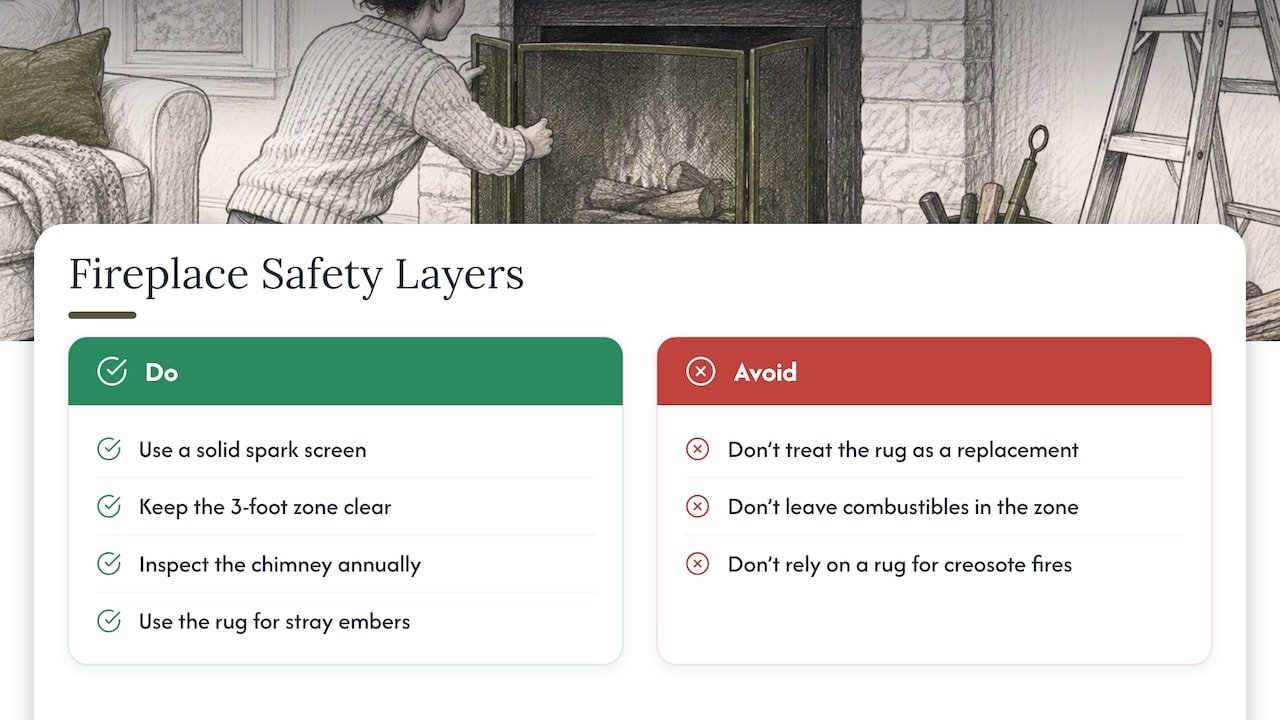
A fire-resistant rug is one layer in a broader safety setup, not a replacement for the basics. The USFA’s fireplace and wood stove safety guidance is explicit that rugs are a supplementary aid, meant to work alongside a proper screen, adequate clearance, and routine chimney inspection, not instead of them.
Start with the appliance itself: a solid spark screen in front of an open fireplace catches most embers before they ever reach the floor, and the hearth rug handles whatever gets through. Keep the 3-foot safety zone free of furniture, baskets of kindling, and anything else combustible, since a well-chosen rug does not offset clutter stacked just outside that zone.
Annual chimney inspection matters here too, since a poorly maintained flue increases the chance of larger sparks or creosote fires that no rug is designed to handle. Safe ash disposal, using a metal container away from combustible walls, closes the loop on the most common sources of stray embers in the first place.
Think of the rug as the last line of defense for the few square feet closest to the appliance, with the screen, clearance, and chimney maintenance doing the heavier lifting. When all four pieces are in place, the odds of a stray spark turning into an actual problem drop considerably compared to relying on any single measure alone.
Author perspective: recommended approach for most homeowners
For most living rooms, a well-made wool rug at the hearth edge, backed up with a fiberglass mat only where embers routinely land, covers both safety and style without overcomplicating the decision. Keep the screen up and the clearances honest. Decor choices matter less than the habit of checking them.
— Kian
Where to buy hearth-appropriate rugs from Rugs Online Market

We make it simple to find hearth-ready rugs without digging through a catalog built for every other room in the house. Start with our natural rugs and traditional rugs collections for wool options suited to hearth-adjacent placement, or browse runner rugs for a longer wood-stove seating area.
- Free shipping on orders over $300
- 30-day hassle-free returns
- Sizing and non-slip guidance available on every product page
Use our rug size calculator first if you are unsure what dimensions to order, then shop with confidence knowing returns are covered for a full 30 days.
FAQ
What rug material is fire-resistant?
Wool is the most commonly recommended natural fiber for fire resistance because it chars rather than catches fire when exposed to a small spark. Fiberglass hearth mats go a step further and are considered effectively noncombustible, which makes them suitable for direct ember exposure.
What are the best fire-resistant rugs for a fireplace?
A wool rug positioned at the hearth edge works well for general decorative coverage, while a dedicated fiberglass hearth mat is the better choice right at the fireplace opening where embers regularly land. Many buyers combine both: a mat for the immediate ember zone and a larger wool rug further back.
What is a good fireproof rug for a deck?
Outdoor settings call for materials built to handle moisture and UV exposure in addition to occasional sparks, so a durable, weather-resistant outdoor rug paired with careful placement away from fire pits or grills is the safer approach. No rug should be treated as fireproof outdoors any more than indoors; keep the same safe clearances you would use near an indoor hearth.
How do you know if a rug is flame-retardant?
Check the product label for a “T” marking, which indicates the rug relies on a fire-retardant chemical treatment rather than naturally resistant fibers, as required under federal flammability regulations. If the label or description does not mention fireplace suitability or flammability testing, ask the seller directly before using it near an open flame.
Are fire resistant rugs safe to use alone near a fireplace?
Fire-resistant rugs reduce risk but are not a standalone safety solution; the USFA recommends pairing them with a proper screen, a 3-foot clearance zone, and regular chimney inspection. Treat the rug as one layer of protection, not a replacement for those other precautions.
Sources
- Cpsc
- Fireplace and Wood Stove Safety | USFA
- 16 CFR Part 1630 — Standard for the Surface Flammability of Carpets and Rugs | eCFR
